


 Danielle Ames
 By the age of 12, Argentine comedian and writer Tamara Yajia had migrated with her family from Argentina to the U.S., back to Argentina, then back to the U.S. again — all in an effort to escape Argentina’s chronic economic instability. Back in the 1980s, she split her childhood between being somewhat of a child star and helping her parents at their food stand, which was called “Sexy Chicken.”
“I often say that I didn’t think I had a story to tell, which is crazy, because I definitely had a story. Not just mine, but my family’s story, it turns out,” Yajia told the Herald on a call from her home in California. She bribed her small dog Odie with a treat in exchange for his silence during the interview.
Although she’s Los Angeles-based, Yajia says she manages to stay connected to her Argentine roots by listening to Gustavo Cerati on loop, reading Camila Sosa Villada or Julio Cortázar (her favorite author), and having regular asados at her parents’ house.
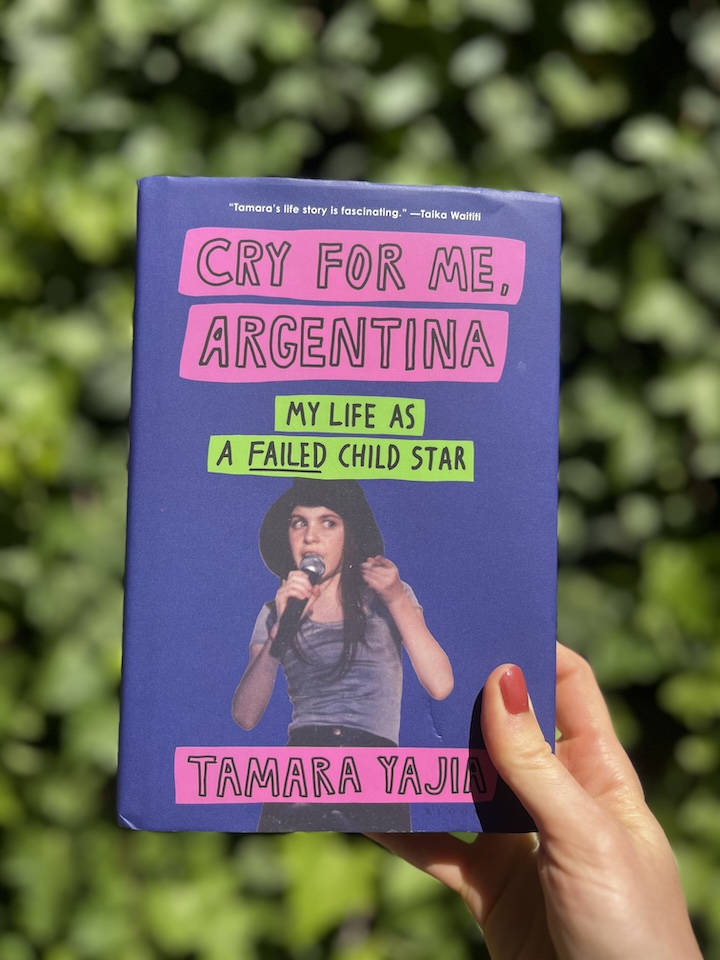
Her recently released memoir, Cry for Me, Argentina: My Life as a Failed Child Star chronicles her journey from birth to adulthood growing up in a larger-than-life Jewish family. A path filled with antics so absurd you’ll catch yourself rereading the back of the book to double-check that it’s nonfiction. Think: a mom with an OnlyFans account and a grandpa who’s a salami-obsessed poppers salesman.
Apart from writing several comedy series — including Acapulco, This Fool, and the upcoming Netflix show Strip Law — Yajia has also hosted podcasts and produced work for Funny or Die and ClickHole, and has been featured on Comedy Central. Her resume also includes a stint in the music industry working with 1980s pop band The Bangles.
Cry for Me, Argentina was born after a literary agent who’d been following Yajia online reached out and asked if she’d considered writing a book.
“He was like, ‘I feel like you’re from Argentina, you have a crazy family, what about writing a book?’ And I was like, ‘Yeah, let’s see what I can come up with,’” she recalled.
One such story? The time she lip-synched to Madonna’s Like a Prayer when she was nine in a Hebrew school talent show and stripped down to a garter belt, a tiny lace bralette, and beige underwear that made her look nude — all in front of an audience of speechless rabbis.
Her memoir earned praises from film stars like director, writer, and actor Taika Waititi (Thor: Ragnarok, Jojo Rabbit) — who called it “fascinating and magical” — and actor and director Mark Duplass (The Morning Show) — who preferred to describe it as “funny, heartfelt, and truly disgusting.” Actress Selena Gomez was even interested in the book for a potential adaptation.
“Not everything has to be funny”
Yajia wasn’t prepared for the serious undertones that line her story. “I hadn’t come to terms with how difficult my immigration journey was, or I hadn’t really allowed myself to feel that. Yeah, I was a kid. I was 12 or 13 years old, getting my period, starting a new school in the United States, and also scared of being deported,” she said.
The author had set out to write a comedy book about her family and soon realized she had a very different kind of story to tell. The book addresses themes such as undocumented immigration, mental illness, drug abuse, addiction, and being sexualized by adults when she was a child star.
The intensity of unpacking all of the book’s serious content weighed down her writing process, which ended up taking a lot longer than she’d initially anticipated. She wrote for up to an hour a day over a period of two years.
When she was a young adolescent, Yajia sang and danced on stages across Buenos Aires and was even offered a role in Argentina’s version of The Mickey Mouse Club, which she couldn’t take because her parents had decided to move back to the U.S. again.
While she loved performing, being onstage at such a young age came with darker implications. In the book Yajia writes about sexual comments she got from grown men and recounts a man standing in the front row looking up her skirt. After the performance, he walked up to her and put his cigarette out on her arm.
Yajia describes the dark humor she uses in the book as “Jewish humor” and explains that the first draft she sent to her editor was mainly comedic. But they pushed back, explaining that not everything had to be funny.
“The editor would be like… ‘Maybe this doesn’t need to be a funny chapter, because it’s a chapter about you being sexualized as a preteen, you know?’”
Nostalgia for a bygone Buenos Aires
In the book, Yajia revives the Buenos Aires of the 1980s and 1990s and illustrates a family’s generational struggle to make ends meet amidst the country’s instability.
In that context, the support of Yajia’s grandparents always came with strings attached, and part of the reason Yajia’s parents moved to the United States was to gain independence from their tight-knit Jewish families. Only to have their grandparents follow them to the U.S…. and move into the next-door apartment.
Yajia paints a familiar Buenos Aires told through a child’s eyes — anybody who’s spent time in the city will appreciate her descriptions of the lavender-blue jacarandas or an outing with her grandfather to a theater on Avenida Corrientes. She also references the cultural gems of her childhood, such as the TV shows Porcel y sus gatitas and Jugate conmigo.
Writing about Argentina presents its own set of challenges, especially when the majority of the book’s readers aren’t familiar with the joy that is the Argentine economy.
“It was really hard until I simplified it,” Yajia commented. In the book, she breaks down hyperinflation as though she were talking to a child and changes pesos to “dingledoos.”
If one diaper costs five dingledoos in the morning, then in the afternoon that same diaper would cost 30 dingledoos, she describes. “Truly, it’s just absurd and dumb, but that’s how I would understand it if someone explained it to me,” she added.
Even more complicated than the Argentine economy was knowing that her family was going to read the book. “Now the world is going to know about the sex dream I had with one of the Backstreet Boys,” she laughed.
Calmest in chaos, and while in the process of translating Cry for Me, Argentina into Spanish, Yajia is already on to her next project — a novel loosely based on a romance she had with a French man in Paris. A tale that started out as a picture-perfect love story before going to “total shit” in the most romantic city on earth.