

 Martina Jaureguy
 Don’t cry because it’s ROVer, smile because it happened. The underwater exploration of the depths of the Mar del Plata canyon in Argentina has come to an end. The Argentine marine biologists and scientists caused an internet sensation with their livestream of the expedition over the past three weeks, saying goodbye on Sunday with an emotional farewell message.
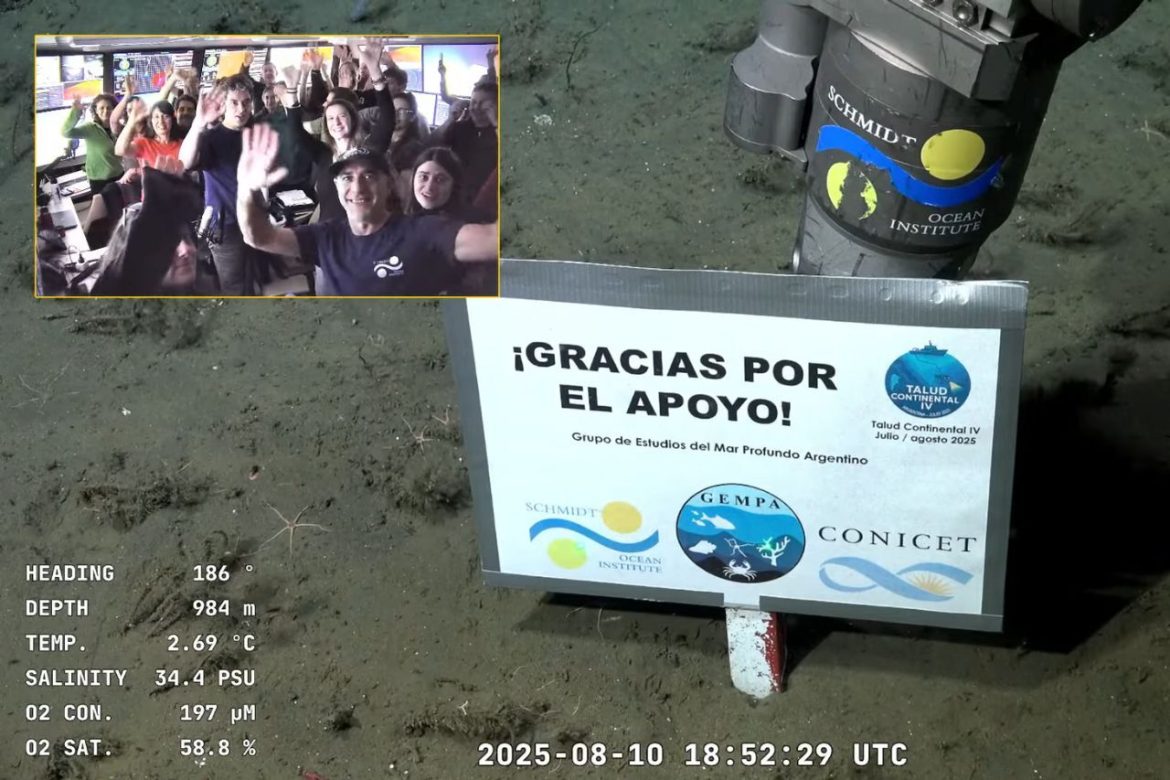
“Thank you for your support,” read a sign that the scientists briefly placed on the sand 984 meters underwater to show appreciation for the thousands of viewers that followed their exploration. The group was also shown waving at a camera placed on the boat Falkor (too), where they have been living since the start of the expedition on July 23.
The stream reached a record of 70,000 simultaneous viewers on YouTube on Sunday. The video of the last livestream is now uploaded on YouTube and by Monday noon had surpassed 800,000 views.
“This was wonderful, and being able to stream it, to have you accompanying us, to reach so many children, it was much more than we expected,” said with emotion-filled voice Nadia Cerino, one of the biologists who became popular among viewers because of her calm way of explaining what they were looking at during the dives. “Keep loving the ocean. The people who didn’t know it now have it in their hearts like we do. I’ll leave you to take care of the ocean.”
All the videos of the stream can be found in the YouTube channel of the Schmidt Ocean Institute, which provided the resources and equipment to carry out the exploration in collaboration with Argentina’s National Scientific and Technical Research Council (CONICET).
The livestreams began with a meager but supportive viewership that consistently grew as days passed. Coincidentally, it took place as students in Buenos Aires and several provinces were on their two-week winter break. Many children sent the scientists messages and drawings. Some teachers even decided to show their students the livestreams and work on related activities in biology or natural sciences classes.
During the exploration, the researchers documented several species that had never been recorded alive, and discovered several others. Some even became famous, like a cartoonish-looking starfish that resembled the character of Sponge Bob’s friend Patrick Star and was nicknamed “estrella culona” (fat-bottomed starfish, by its Spanish translation).
Users on the YouTube live chat gave funny names to several specimens they saw on their screens, such as Batatita (little sweet potato), a vibrant purple sea cucumber, or Dumbo, a mesmerizing octopus with fins that resembled wings. An X account called “Mis pokemones marplatenses” (My Pokemon from Mar del Plata) uploaded dozens of pictures from the often odd-looking animals.
The scientists were able to retrieve many animal specimens, corals and sediment using a remotely operated vehicle (ROV) called SuBastian, which had attached a 4K camera to record the depths of the ocean in high quality.
The exploration team was made up of over 30 Argentine scientists, also including researchers from other countries and ROV operators. Most were marine biologists from institutions and public universities from all across Argentina that work with CONICET. The goal was to explore the Mar del Plata underwater canyon, 300 kilometers from the coastline, “a region with high biodiversity and little exploration,” the CONICET said.
The exploration reached a depth of 3,900 meters underwater, allowing an unprecedented look at the Argentine deep-sea marine life. Many of the researchers that participated in the mission had been part of an exploration in the area around 12 years ago, in which they had only been able to retrieve specimens using nets from higher depths. Now, they were able to see them alive and in their natural habitat for the first time.
The exploration served as an opportunity to support Argentine science and public institutions such as the CONICET and national universities in contrast to libertarian President Javier Milei’s sweeping austerity measures. On Sunday, The New York Times dedicated a full page of their international section to the mission, highlighting the interest it gathered despite Milei’s attacks on Argentine science.
The Schmidt Ocean Institute’s boat Falkor (too) will now go to Montevideo, Uruguay, to carry out a new exploration of the local deep sea, starting on August 20.