

 Martina Jaureguy
 Every year, July 18 is a grim reminder in Argentina’s calendar of one of the deadliest tragedies in the country’s history: 85 people were killed and over 300 injured in the 1994 bombing of the Argentine Israelite Mutual Association (AMIA by its Spanish initials), a Jewish community center in Buenos Aires.
Thirty-one years later, nobody has been convicted of perpetrating the attack, no public officials have been found guilty of a cover-up operation, and the facts we know for sure can seem dwarfed by unanswered questions.
The Herald spoke to lawyer, journalist, and former AMIA spokesperson Horacio Lutzky about the case. Lutzky has written several books on the attack, as well as the 1992 bombing of the Israeli embassy in Buenos Aires, and attended the first trial into the AMIA case.
The bombing
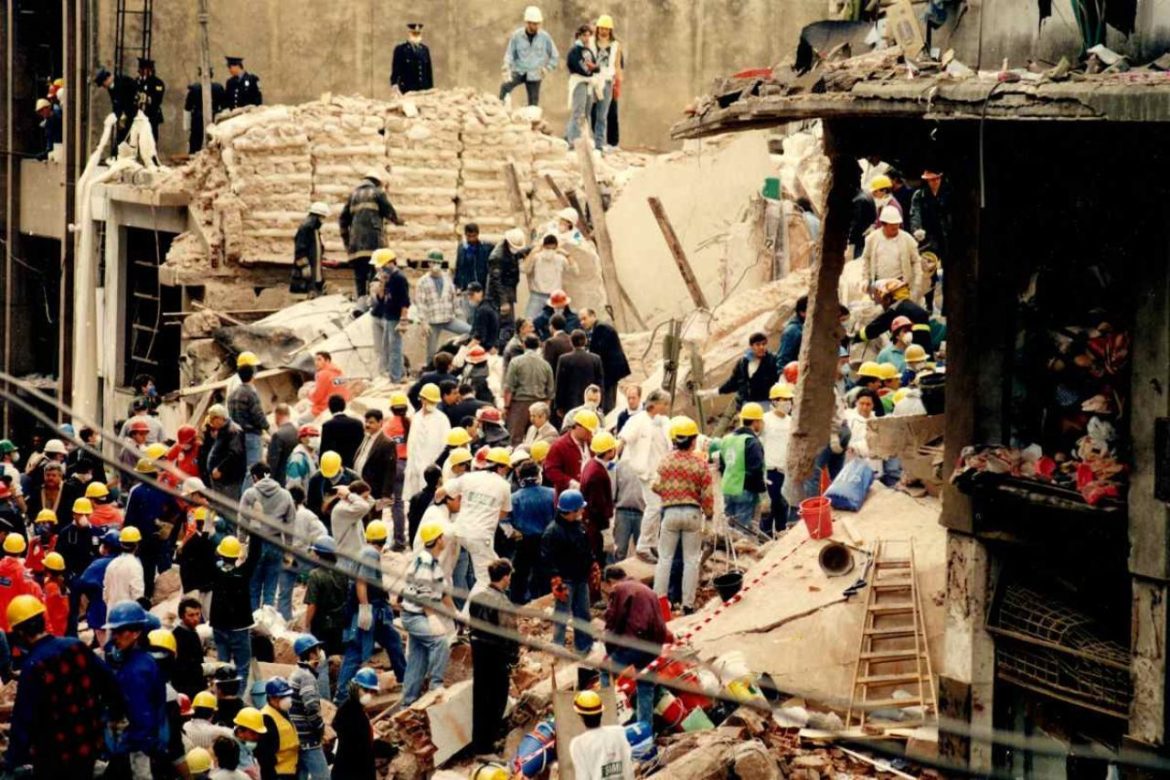
It was a normal morning in the busy commercial neighborhood of Once, in Buenos Aires. At 9:53 a.m., the shockwave of an explosion rattled shops and apartment buildings. Then, the horror: the AMIA building collapsed entirely, leaving hundreds of people buried under the debris.
The judiciary’s main theory is that a suicide bomber drove a white Renault Trafic van into the doors of the building. The attack, according to this theory, was plotted by senior officials in the Iranian government and the Lebanese party and militia group Hezbollah.
Currently, 10 Iranian and Lebanese men stand accused of perpetrating the attack. Despite decades of judicial procedures, none of them have ever surrendered to Argentine authorities.
This theory is largely based on intelligence reports, including agents who surveilled Iranians in Buenos Aires in the wake of the Israeli Embassy bombing, and former judge Juan José Galeano’s investigations.
The first AMIA trial was held between 2001 and 2004. Prosecutors José Barbaccia and Eamon Mullen charged used car salesman Carlos Telleldín and a group of Buenos Aires province police officers with providing the van to the alleged perpetrators of the attack, described by Telleldín as “foreign.”
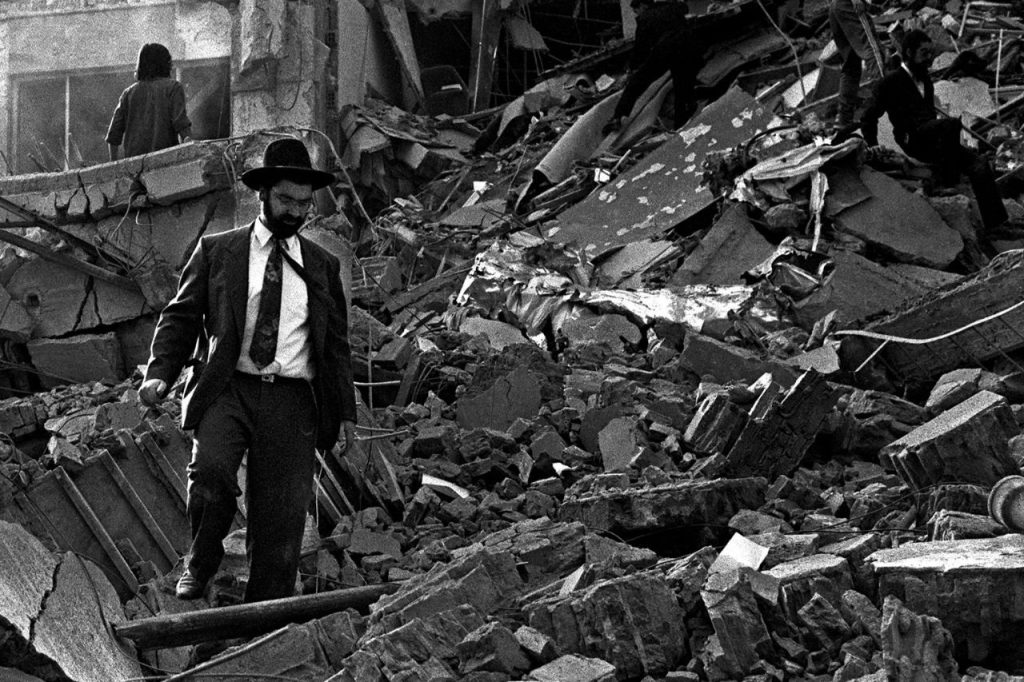
The cover-up
However, Galeano was removed from the trial in 2003. The court found he had bribed Telleldín into falsely accusing the officers of participating in the operation, using US$400,000 of funds from the SIDE intelligence secretariat. The money was provided by the SIDE head.
All of the accused in the first AMIA trial were acquitted, and the investigation was annulled. Investigators ultimately found that the cover-up extended not only to Telleldín, Judge Galeano, and Anzorreguy, but also to the Federal Police, intelligence services, prosecutors, the Delegation of Argentine Israelite Associations umbrella group — which operated in the AMIA building at the time of the attack — and the national government. These revelations led to the trial’s collapse in September 2004.
During the first trial, an evidence sheet describing the finding of part of the van’s engine “was annulled because those who said they had found it later acknowledged they had not seen anything,” Lutzky said. This added to a list of supposed evidence that had been found “at night and without any witnesses.”
The finding cast doubt on whether the attackers actually used a van at all.
You may also be interested in: Argentina ‘failed to prevent’ AMIA bombing, Inter-American Court rules
In 2009, the acquittals from the first trial were partially reversed. Those found to have deliberately misled the investigation were taken to a second trial in 2015, which specifically examined the cover-up.
In 2019, Galeano — who had previously faced impeachment and was dismissed as judge — was convicted for his role in the cover-up along with Telleldín, prosecutors José Barbaccia and Eamon Mullen, SIDE director Hugo Anzorreguy, top Federal Police officers, and public officials from the government of President Carlos Menem.
Menem and the head of the DAIA at the time, Rubén Beraja, were not convicted.
In 2019, a third trial began, seeking to identify the perpetrators of the bombing itself. Telleldín was once again accused of providing the van to the attackers. He admitted to this but said he did not know the vehicle’s purpose. Telleldín was acquitted in late 2020.
He spent a decade in jail ahead of the first trial’s resolution and was sentenced to a year and nine months in prison for his role in the cover-up, but he is currently free.
Did the car bomb exist?
According to Lutzky, the car bomb explanation is “the official story.” However, he has a different theory, based on witness testimonies that came out during the trials but were often overlooked, as well as documentary evidence.
“Over a dozen witnesses who were looking in the direction of the AMIA spoke of a double explosion and did not see a Trafic van crashing into the building,” he said. He shared a series of videos and archive material of these testimonies on X. The van was never found, only the engine part and, later, some shrapnel that matched the materials of a white Trafic van.
Several witnesses testified to having seen two men unloading bags of construction material from a truck and leaving them in front of the AMIA building just minutes before the explosions. The AMIA was carrying out renovations at the time, but the building materials company they were working with did not make any deliveries to the AMIA that morning. The sender of those materials remains unknown.
Witnesses also saw a skip being left outside the building minutes after the attack. It belonged to a company owned by Nassif Haddad, a Syrian-Lebanese businessman with close ties to President Menem. Traces of explosives similar to those Haddad used at his quarry were found at the scene of the attack.
“A few hours after the attack, he was released from detention, and the investigation was not allowed to go down that route,” Lutzky said.
Why was the AMIA bombed?
Menem, the son of Syrian immigrants, was president of Argentina between 1989 and 1999.
His presidency was marked by mass privatization of public companies, a bulk of corruption accusations, and three mysterious, unsolved tragedies: the 1992 Israeli embassy bombing, the 1994 AMIA bombing, and the explosion of a military equipment factory in Río Tercero, Córdoba, in 1995.
Menem was a canny negotiator who allied with the United States and Israel in public and with Middle Eastern countries in private.
“At the time, the government was participating in an arms trafficking operation, partnering with several of the actors that were later accused of committing the attack,” such as Syria and Iran, Lutzky said.
He explained that, during his presidential campaign, Menem had collected millions of dollars from Arab countries, vowing to fight “imperialism and Zionism.” The former president also promised to provide missiles and nuclear technology to countries, including Syria, Iran, and Libya. “But when he rose to power, he made a 180° turn and began what is known as ‘carnal relations’ with the United States,” Lutzky said.
The Middle East was roiled in conflict at the time. Israel was occupying Lebanon and fighting Hezbollah. “The choice of where to carry out the AMIA attack had to do with this dynamic, but fundamentally it was revenge against Menem. It was a message against his betrayal,” Lutzky said.
You may also be interested in: Argentina high court confirms convictions in AMIA bombing cover-up trial
Why was the AMIA bombing covered up?
Based on decades of investigation, Lutzky believes that the AMIA bombing directly involved the government because “the SIDE had been following the Iranians’ moves two months before the attack.” Fearful of what would happen if word got out that they had failed to stop it, they decided to get rid of the evidence.
Some public officials were even convicted of losing evidence, but despite the magnitude of the case, it was treated as mere negligence, Lutzky added. “It is very clear that there was a political decision to cover up everything that could affect Menem’s government.”
“I am convinced that this was not exclusively done by foreign agents,” he said. “The funding came from abroad, but the operations leading to the attack were done locally.”
Could the AMIA bombers still be tried?
Federal Judge Daniel Rafecas decided in late June to move forward with a trial in absentia, a system recently introduced in Argentina that makes it possible to try and convict suspects even if they are fugitives.
The goal is to try the 10 Iranian and Lebanese men accused of perpetrating the terrorist attack: Alí Fallahijan, Alí Akbar Velayati, Mohsen Rezai, Ahmad Vahidi, Hadi Soleimanpour, Mohsen Rabbani, Ahmad Reza Asghari, Salman Raouf Salman, Abdallah Salman, and Hussein Mounir Mouzannar. There are no Argentine suspects. So far, no one has been convicted for the attack that ended the lives of 85 people.
You may also be interested in: It’s been 30 years since the AMIA bombing. For survivors and families, the wound is still open
Cover photo of the rubble after the attack. Credit: AMIA Press