

 Martina Jaureguy
 Updated at 3:09 p.m.
Brazilian President Lula da Silva promised to work toward “fortifying inter-bloc trade with foreign associates” in the next semester as pro tempore Mercosur president after receiving the post from his Argentine counterpart Javier Milei on Thursday.
The handover concluded the Mercosur president summit that began Thursday. On Wednesday, bloc foreign ministers and representatives of the European Free Trade Association (EFTA) announced the conclusion of negotiations over a free trade agreement between the blocs.
During his speech, Da Silva said that he is “confident” that the Mercosur-European Union deal will be signed “before the Brazilian presidency ends.” The two blocs successfully concluded negotiations about the free trade deal last December, and the agreement now has to be approved by the parliaments of each of the member countries.
In contrast with Milei’s known climate change skepticism, Da Silva said he will advance “the fight against climate change” and help foster the energy transition.
Da Silva added he will analyze Argentina’s proposal to create an agency against transnational organized crime and follow up on a declaration on energy security reached during the summit.
“South America will not be part of the global race on energy sources. We must face this together,” Da Silva said. “It is only up to us to decide whether we are big or small. We have everything to play a great role in the building of a more just and sustainable world.”
After listening to speeches from each of the bloc members and associated states — in which Milei harshly criticized Mercosur’s bureaucracy and demanded more flexible trade conditions — Da Silva said he would take into account the concerns expressed by the leaders, especially regarding “the lack of speed in [Mercosur’s] decisions” and their execution.
The Mercosur president summit
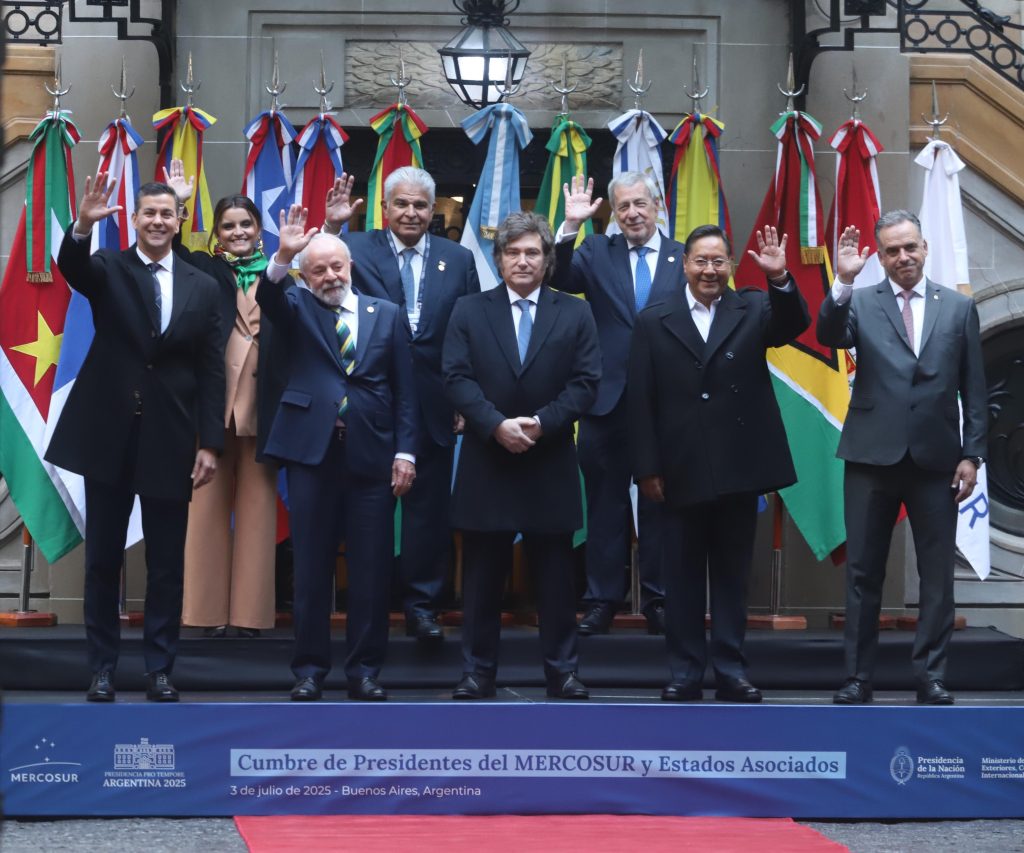
The gathering started at 10 a.m. with Milei and Da Silva alongside fellow presidents Santiago Peña (Paraguay), Yamandú Orsi (Uruguay), and Luis Arce from Bolivia, the most recent addition to the bloc.
Panama President José Raúl Mulino also attended the meeting, given his country is one of Mercosur’s associate states. The Mercosur member countries and Panama are set to begin talks to sign a free trade agreement. Representatives from the associate states were also present, such as Ecuadorian Vice President Verónica Abad and Chilean Foreign Minister Albert Leo van Klaveren Stork.
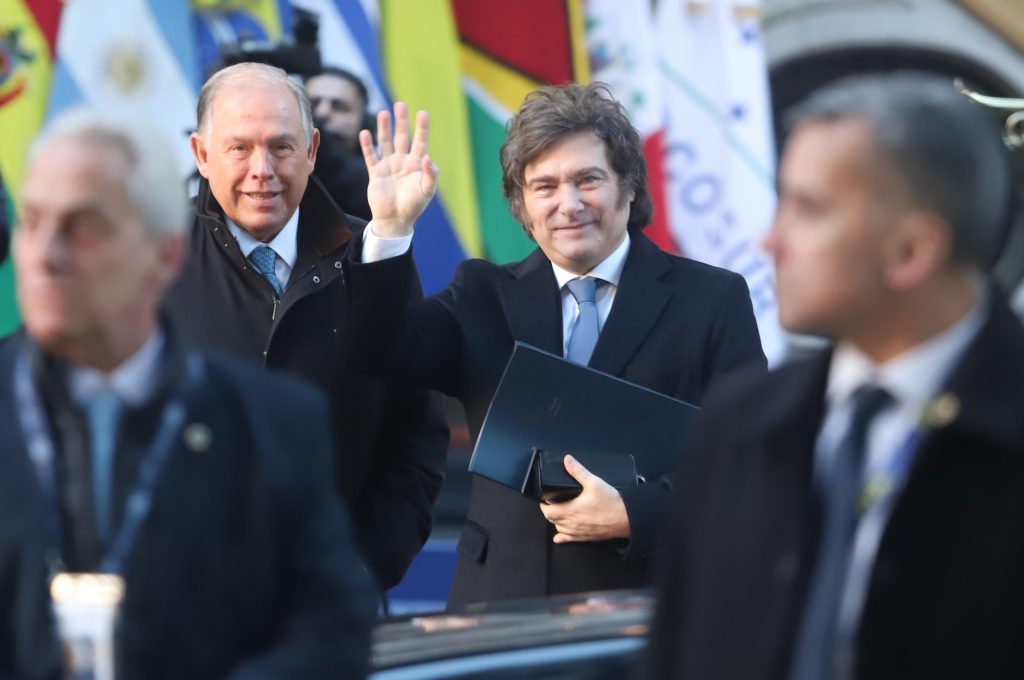
The Argentine president arrived at the San Martín Palace, where the local foreign ministry operates, at 9:20 a.m. He was accompanied by Foreign Minister Gerardo Werthein, who led two meetings with fellow ministers on Wednesday and participated in the announcement of the free trade agreement with the EFTA.
Milei’s sister and Presidency Secretary Karina Milei arrived ten minutes after him and was followed by Orsi, Peña, Arce, and, lastly, Da Silva. Milei shared a warm hug and pat on the back with Peña and serious faces — with Milei flashing just a brief, strained smile — with Lula when greeting each other and taking pictures together. At the end, however, Lula and Milei shared a brief hug and ended the summit on seemingly amicable terms.
The meeting began with speeches from Werthein and Milei, which were followed by the rest of the leaders. Although no bilateral meetings were initially scheduled between Milei and the other leaders, after the summit concluded, he met with Orsi, Peña, Mulino, and Swiss Vice President Guy Parmelin. Lula left earlier to meet with Cristina Kirchner.
Milei and the other Mercosur leaders
Milei has varied relationships with the rest of the incumbents. He shares similar views with Peña but is ideologically distant from Orsi and Arce.
The gulf widens significantly when it comes to Da Silva. The Argentine and Brazilian presidents have had their fair share of public spats, with Milei calling Da Silva a “communist” and “corrupt” on several occasions. Da Silva has demanded Milei apologize, something that has not happened.
Da Silva arrived in Buenos Aires on Wednesday night and will have a busy agenda in his brief visit of under 24 hours to Argentina. After the Mercosur summit, he is scheduled to visit ex-President and political ally Cristina Kirchner, who is under house arrest in her apartment in the Constitución neighborhood in Buenos Aires. Da Silva was granted permission by the judiciary to meet her on Wednesday after her lawyers filed a formal request, given that she is not allowed to freely receive visitors.
Lula will also meet privately with Argentine deputy Eduardo Valdés, who was recently elected head of the Lower House Mercosur commission, and human rights activist and Nobel laureate Adolfo Pérez Esquivel. The three will talk at the Brazilian embassy, five blocks away from the San Martín Palace.
The relationship between Milei and Uruguay’s Orsi has not had any points of tension so far. In November, after Orsi was elected, he attempted to smooth over concerns about their relationship: “It has to be very good. We don’t have another chance,” he said in an interview.
Milei had a bilateral meeting with Peña in April, when he visited Paraguay and highlighted the “love for the ideas of freedom” that they share.
In mid-2024, Bolivia recalled its ambassador to Buenos Aires for consultation after the Argentine government said that Arce had “falsely denounced a coup d’etat” after a military group occupied the Bolivian government headquarters. At the time, Arce also said that Milei’s “conflictive behavior” was not good for the harmony of “the neighborhood,” referring to the South American region.
