
 Buenos Aires Herald
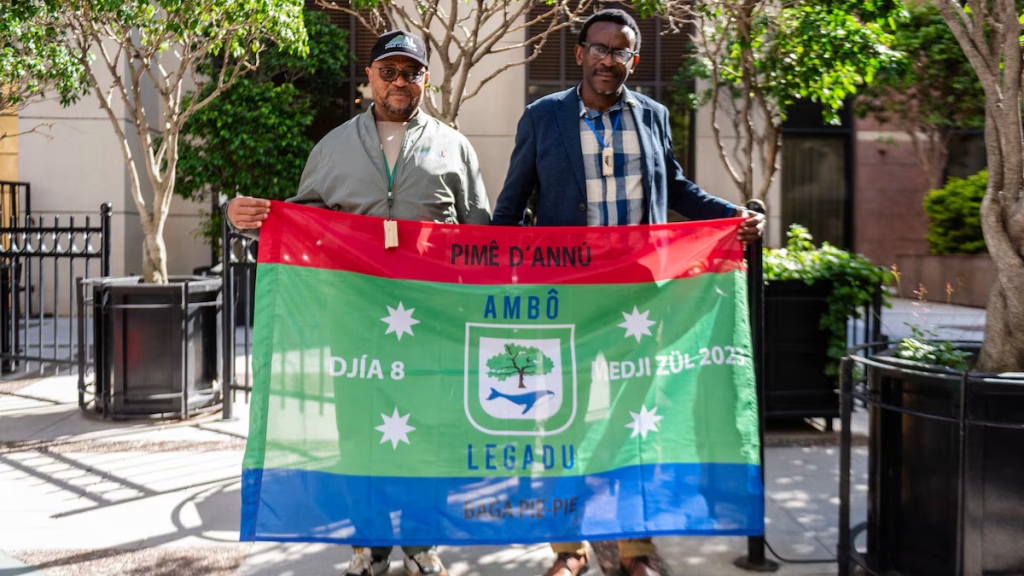
Orlando Cartagena Lagar is the leader of a political movement called Ambo Legadu, which, in 2022, unilaterally proclaimed the independence of Annobón. The 17-square-kilometer, 5,000-inhabitant island is located in the Gulf of Guinea, part of the Central African country of Equatorial Guinea. Its main language is a Portuguese creole known as Annobonese.
The country’s government, however, did not recognize the independence, and Lagar was forced to exile himself to Spain, where he lives to this day.
Cartagena Lagar, who was proclaimed Annobón’s “prime minister” by his movement, has been visiting many countries requesting assistance. This past week, he was in Buenos Aires in an effort to persuade Argentina to support his movement’s cause by recognizing the territory as an “associate state.”
“We ask for Argentina’s political support and we would like to be part of that country, but not to be annexed,” he said in an interview with Radio Rivadavia. “It can be an ‘associated state’, it can be a ‘province’ status. The projects we presented are under study, although we ask for support and visibility.”
The bid has a historical justification. In the 1800s, Annobón was part of the Spanish Kingdom’s Viceroyalty of the Río de la Plata, of which Argentina declared its independence in 1816. “We are brothers, we were part of the same territory, and today we are once again asking for help from Argentina, our brother country,” Cartagena Lagar said.
The political activist accused Equatorial Guinea’s dictator of leading a “brutal” regime as a reason for his movement’s cause. “The dictator is slowly starving us to death and contaminating our lands,” he said, adding that the island is now a “toxic waste dump.”
The situation of Equatorial Guinea
Equatorial Guinea’s government has been characterized as a dictatorship by international observers. The country declared its independence from Spain in 1968. In 1972, local dictator Francisco Macías Nguema declared himself president for life, but was overthrown in a coup in 1979 by his nephew, Teodoro Obiang Nguema Mbasogo, who has been the country’s president since.
In 2024, British newspaper The Guardian reported that dozens of people were arrested to suppress dissent after the creation of Ambo Legadu.
Earlier this month, the Argentine ambassador to Ethiopia, Juan Ignacio Roccatagliata, visited his Equatoguinean counterpart, a move that people close to the matter see as a sign of support from the Milei administration to Equatorial Guinea’s government.
