
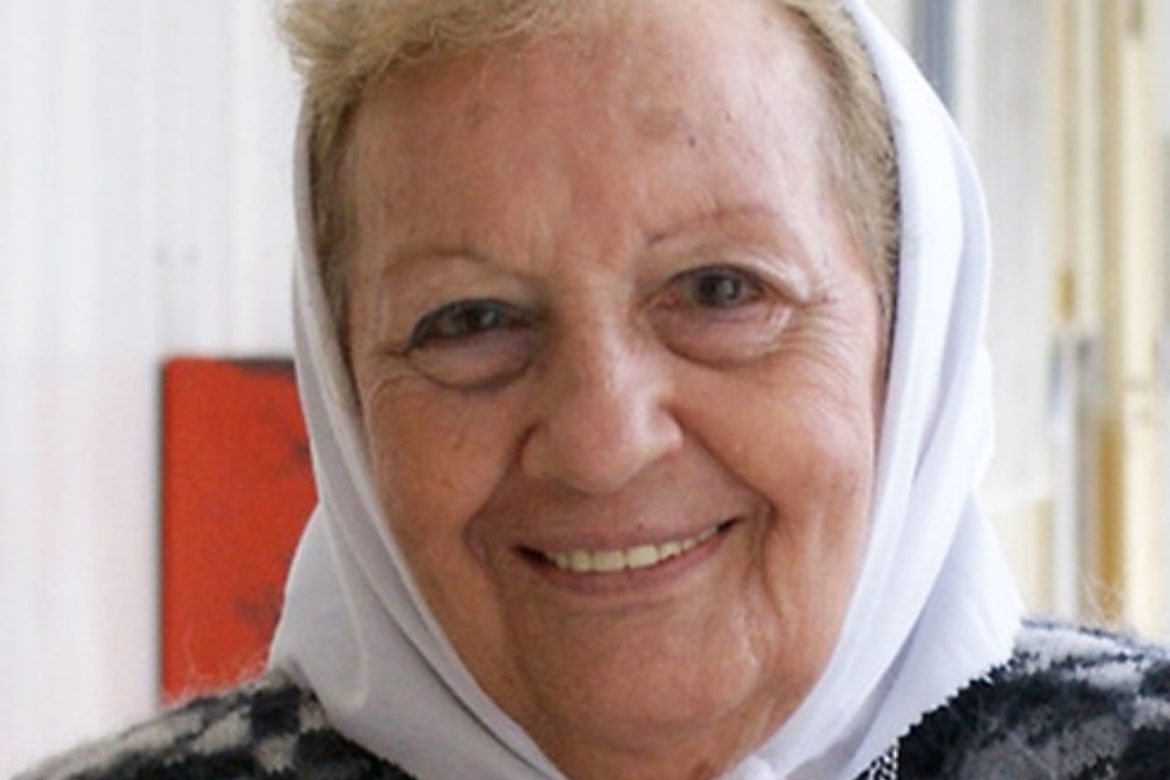
 Martina Jaureguy
 Mother of Plaza de Mayo Carmen Loréfice passed away on Monday at 99. Her son Enrique Jorge Aggio was kidnapped in 1976, and she spent decades looking for him, until the Argentine Forensic Anthropological Team (EAAF, by its Spanish initials) identified his body in 2010.
“She was always proud of her son,” said Mothers of Plaza de Mayo-Founders’ Line in a post on Instagram, bidding farewell to their member.
The organization said that, after her funeral service in Mar del Plata, her ashes will be spread in Plaza de Mayo on Saturday at 3 p.m.
The Buenos Aires and La Plata branches of H.I.J.O.S., the human rights organization that groups children of dictatorship victims, as well as the Center for Legal and Social Studies (CELS, by its Spanish initials) lamented her death on social media posts.
“We learned a lot listening to her,” CELS wrote. “A hug for those who loved her.”
Carmen graduated as a teacher but dedicated herself to be a stay-at-home mom. She had two children: Lilian and Enrique Jorge, who went by just Jorge. He was a union representative in the company where he worked at, and a member of the Montoneros armed organization. He was kidnapped on July 31, 1976. He had two children.
For many years, her mother didn’t know what had happened to her son. Soon after learning of his disappearance, she joined other women who were desperately searching for her children and became one of the founding members of the Mothers of Plaza de Mayo.
Everything changed in 2010 when the EAAF identified Jorge’s body, which was buried in a cemetery in Derqui, around 60 kilometers away from Buenos Aires City.
Through the identification of his body, the forensic anthropologists were able to verify he was one of the 30 victims of what is known as the Fátima Massacre on August 20, 1976.
The Fátima Massacre happened when 30 people, including political militants, activists and union members were taken to a field in the Fátima neighborhood of Pilar, and were executed. Their bodies were then blown up with explosives. At the time, the dictatorship claimed it had been a terrorist attack.
For Carmen, getting her son’s remains back and knowing how he died was a mix of “joy and pain,” she said in an interview for a BA City educational program on memory in 2017.
“Now I have the joy of having a little box at home, on an altar I created where I speak to him, but it’s not the same […] as having my son, because he was full of ideals and life,” she said.
