
 Martina Jaureguy
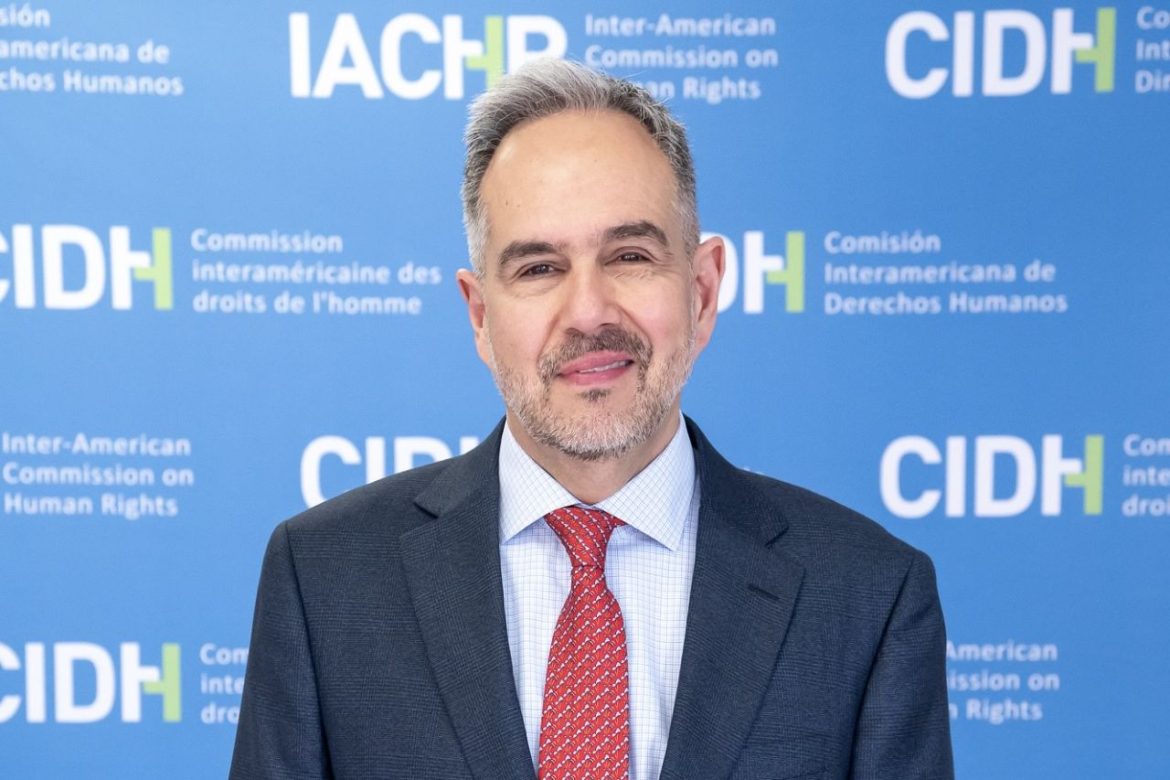
 A sense of “fragility” looms over human rights in the Americas, Inter-American Commission on Human Rights (IACHR) Director José Luis Caballero Ochoa told the Herald in an interview, shortly after the release of their annual report on the region on May 8.
This year’s report emphasized disturbing regional trends such as the militarization of security, the growing power of organized crime, restrictions on the right to protest, escalating hostility against freedom of expression, and the suspension of rights.
Caballero told the Herald about the watchdog’s main concerns and expectations for 2025.
The IACHR is an autonomous body within the Organization of American States. The interview has been lightly edited for length and clarity.
Across Latin America, what makes you worry about human rights?
We’re worried about citizen security models that criminalize people, public security policies that use prolonged states of exception, that involve intimidation, criminalization, and use of prison with no respect for human rights conditions.
Our other major concern is the deterioration of democratic institutionality. There’s a weakening of the bases of representative democracy — that’s to say, the rule of law, checks and balances on power, controls, judicial independence.
There’s also the criminalization of human rights defenders — that’s an attack that really worries us.
Then, there is human mobility. Migration has transformed into something that can be criminalized, that can lead to prison or detention centers, in violation of human rights, or could lead to statelessness, implying a loss of the right to nationality. We’re enormously worried about that.
Are you seeing a rise in rights violations across the region?
We’re seeing a moment of fragility of human rights, because the discourses of some governments themselves are putting human rights second to ideas such as security. They may see human rights as a hurdle for states to develop. I think there could be greater alarm over that. And then there are also the numbers of precautionary measures that we authorize.
Hand in hand with the annual report, we published a report about the human rights situation regarding the elections in Venezuela, with a vast quantity of documentation about human rights guarantees.
There’s also a concern that goes beyond statistics. There are a lot of contexts where the tone and discourse regarding a lack of respect for human rights have been taken into account, too.
Your annual report dedicates sections to Cuba, Venezuela and Nicaragua. Are you seeing the advance of authoritarian regimes in the region?
In chapter 4B of the report, we document serious, systematic violations of human rights and representative democracy. These are included in the Inter-American Democratic Charter, which deals with abusive exercise of power, alterations to the constitutional order, situations where elections are not free and democratic or legitimate, as we determined with respect to Venezuela. There are a series of elements that lead us to determine that a state is in that situation, and will get its own chapter in the annual report, which gives recommendations.
Beyond that, well, there are always authoritarian temptations, aren’t there? The most important thing is that the Commission speaks out, at the right time, ensures its voice carries weight, and warns against countries’ authoritarian temptations.
What we do see is discourse that’s much more skeptical, or denialist, towards human rights. These aren’t easy times for human rights.
What other countries are you watching closely?
The IACHR monitors them all, we don’t have a watch list. That said, some countries are no longer in chapter 4B. Guatemala was in there in 2023, but was taken out last year because it had a really significant electoral process with a lot of legitimacy. It also allowed the IACHR to visit in mid-2024, which is reflected in the report.
When there are warning signs, the important thing is for the commission to express that, make its voice count, make the international community aware, through measures within the judiciary such as precautionary measures, press statements, in its reports.
When it comes to Argentina, what worries you in 2025?
Argentina participated in the most recent hearing sessions — the state and civil society. We have a very long-standing relationship with civil society.
We’re worried about what we said in the report: the Ley Omnibus, the pensions law, the use of inadmissible methods to tackle social protest, the need for journalists to express themselves freely.
Argentina has a very active citizenry and civil society that goes out onto the streets. That’s something the IACHR has warned about, that civil society must be allowed to go into the streets and protest. We’re keeping an eye out, worried that democratic institutionality may be dismantled.
Some institutions, such as the ombudsman’s office for children and teenagers, need to name an ombudsman. We’re concerned that the institutional presence for human rights in Argentina not be reduced, that it not be seen as not worth the effort or a waste of resources. It should be assigned its rightful value.
We’ve also talked about discrimination and how it was removed from gender policies. We’ve seen it, we’ve been documenting it in the past year, and the state knows, because it was present in the hearings.
I hope there will be deeper communication, and receptiveness to what the IACHR is saying.
Have you received a response from the Argentine state about those issues?
Yes. Like most countries, Argentina responds with its point of view. It comes to the hearings and is open to international scrutiny, in terms of responding to the IACHR and its requests.
Repression of protest has continued, as we have seen during the retirees’ marches. Photographer Pablo Grillo was nearly killed after being hit by a tear gas canister. What’s your position on that?
In these cases, and the ones that have been sent to us, we have constant and continuous monitoring. Some things are in the annual report, and we always speak out about this in press releases and other communications with the media.
The commission speaks through various instances, and in Argentina we’ve been staying up-to-date on things.
You may also be interested in: IACHR warns of erosion to women’s and LGBTQ+ rights, memory policies in Argentina
