
 Buenos Aires Herald
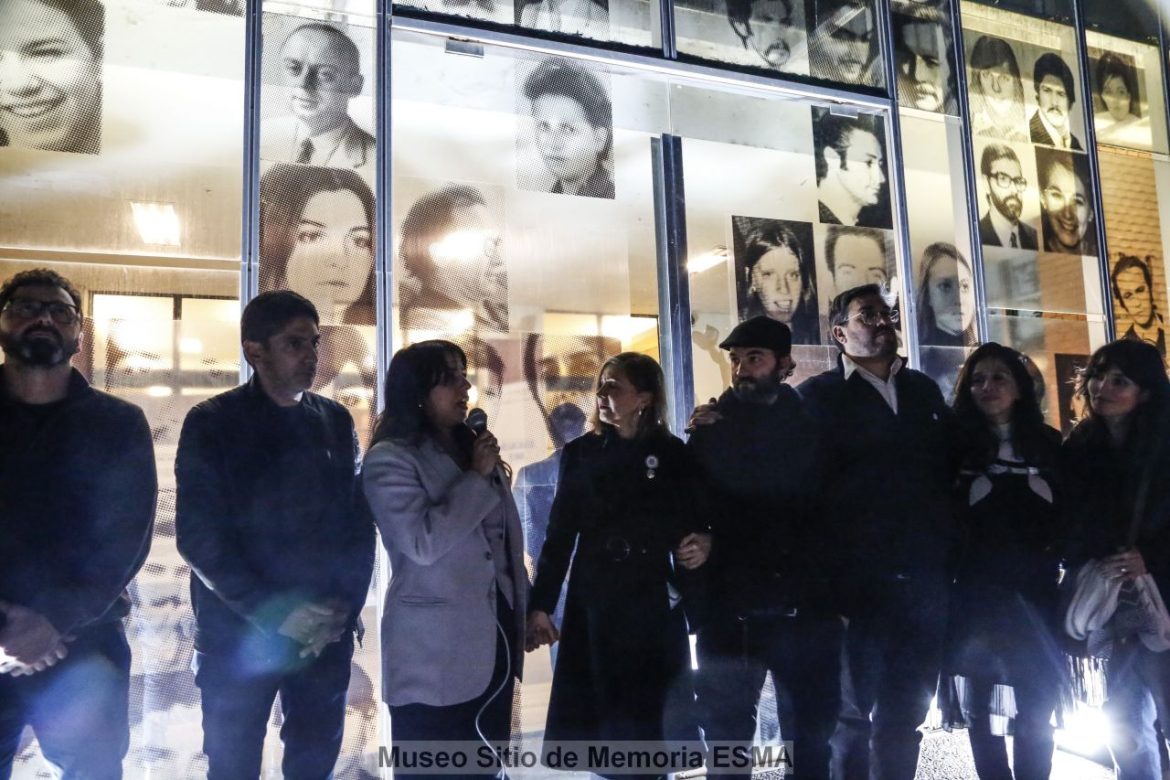
The ESMA Museum and Memory Site celebrated its tenth anniversary on Thursday evening — but the celebration was tainted by grim uncertainty over the institution’s future after the government announced further cuts to Argentina’s human rights institutions the previous day.
The museum and memorial is in the former Navy School of Mechanics’ Officers’ Quarters building, where nearly 5,000 people were kidnapped and later disappeared during the 1976-1983.
Nearly 200 people attended the ceremony, including ESMA death camp survivors, victims’ relatives, politicians and human rights workers.
“Welcome to this joyful but very sad day,” said executive director Mayki Gorosito.
On Wednesday, the government made the surprise announcement that the Human Rights Secretariat, under which the ESMA operates, would be downgraded to an undersecretariat.
A separate decree stated that the museum and the National Memory Archive (ANM) — which keeps essential documents such as the files of the 1985 National Commission on the Disappearance of People — will now be units of the International Center for the Promotion of Human Rights (CIPDH, by its Spanish initials). The CIPDH is a decentralized institution under the Ministry of Justice, created by an agreement between the Argentine state and UNESCO.
CIPDH’s website does not currently name any senior management. According to the decree, all decisions regarding the staff of the ANM and the Museum must be approved by the Deregulation Ministry run by Federico Sturzenegger until the CIPDH’s organization structure is set.
The decision was the Javier Milei’s administration’s latest jab at human rights institutions, following massive layoffs, frozen maintenance funds, and the closure of the Haroldo Conti Cultural Center. The Museum Site has already had its staff reduced by half, and was forced to close on Tuesdays.
“In this sad, regrettable, complex context for public policies on human rights, we need to renew our commitment — translated into action — to the fact that institutions like ESMA are essential for democracy,” said Gorosito.
“We are an institution of the Argentine State, not of a party or a government.”
Gorosito’s speech also recalled the progress of the museum site, highlighting its declaration as a UNESCO World Heritage Site in 2023.
“We reach our tenth year with great accomplishments and multiple obstacles since last year,” she said. “Throughout these ten years, we went from 30,055 visitors in 2015 to 60,000 in 2024, including thousands and thousands of students.”
She stressed the museum staff’s will and mandate to continue working. “Caring for memory, conveying the truth and supporting justice, that’s how I hope we keep going,” she said.
ESMA survivor Ana Soffiantini also spoke at the event, as did judge María Roqueta, whose court tried the case that proved the dictatorship’s systematic plan to steal babies from disappeared mothers.
The ceremony closed with the reading of a poem by ESMA victim Ana María ‘Loli’ Ponce. While detained at the site, she managed to sneak the poems she had written and stashed to survivor Graciela Daleo. Ponce was murdered in 1978. Visibly moved, Argentine actress and playwright Laura Paredes, who played dictatorship survivor Adriana Calvo de Laborde in Argentina, 1985, read Ponce’s poem For Tomorrow.
Memory policies targeted
“Behind every attempt to cut the state in human rights areas is the well-known strategy of hiding what took place here in order to guarantee impunity, and this museum proves we as a society have chosen not to forget,” said Guillermo Pérez Roisinblit, a lawyer and member of the Grandmothers of Plaza de Mayo board.
Pérez Roisinblit was born at the ESMA clandestine center in 1978 after his mother Patricia was kidnapped by an Air Force death squad while eight months pregnant. He was illegally appropriated by an Air Force officer after birth. He was found by the Abuelas in 2000 and recovered his true identity in 2004.
“This place where me and dozens of children were born is now toured over and over again by people who come here to listen, learn and convey what happened,” said Roisinblit. He added that the site’s role is to protect memory from political tides and “arbitrary reinterpretations.”
“Sites of memory are not cultural luxuries or ideological whims,” he added. “They are actual instruments to strengthen democracy and prevent horror from returning with new faces.”
