

 Buenos Aires Herald
Economy Minister Luis Caputo has confirmed that the Argentine government has reached an agreement with the staff of the International Monetary Fund (IMF) for a US$20 billion loan. The agreement must now be approved by the Fund’s board of directors.
IMF spokeswoman Julie Kozack did not give a figure during a Thursday press conference but described the deal as “sizable.”
“What I can say now is that discussions on a new Fund-supported program are very advanced. And those discussions include discussions around a sizable financing package,” she said, but underscored that the final decision over the deal amount would fall to the IMF board.
Regarding the payment schedule, she said: “As with all of our programs, disbursements will come in tranches over the life of the program. But the exact phasing and the size of each tranche is also, of course, part of the discussions that are underway.”
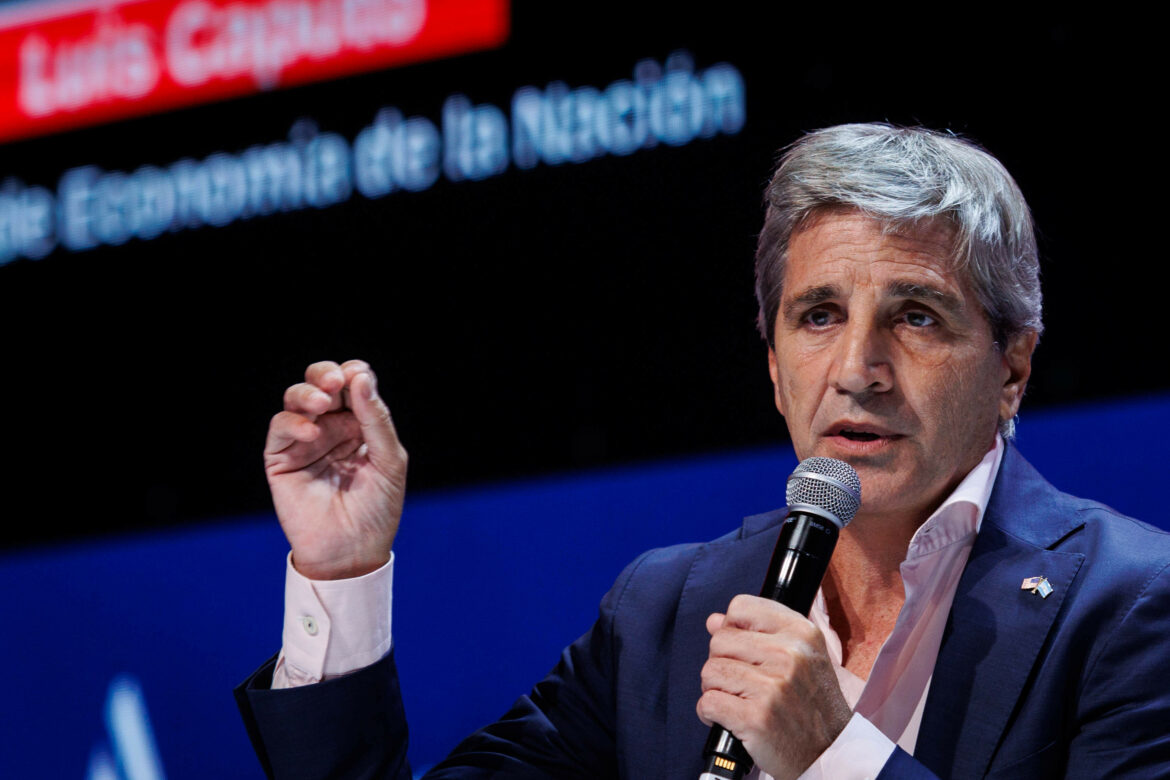
Caputo spoke about the deal during an insurance conference on Thursday morning.
“The sum we’ve agreed on, that the staff will submit for the board’s approval, is US$20 billion,” he said. “As you can see, it’s much higher than the amount that was rumored.”
The minister said the IMF did not place the usual fiscal, monetary, and reserve conditions on the deal. He did not specify whether the government’s current 1% monthly crawling peg — the rate at which it devalues the peso against the dollar — would remain in place.
President Javier Milei also spoke following Caputo’s announcement. In an interview, he said that IMF Managing Director Kristalina Giorgieva authorized the minister to disclose the amount of the loan last night. Milei also emphatically ruled out the possibility of a devaluation, which market sources take for granted. He said that, after the new loan, there will be “a lack of pesos, not a lack of dollars.”
Kozack said that the parties were in ongoing discussions over what policies would be covered by the program but added: “To sustain the gains that have been achieved so far by the authorities, there is a shared recognition about the need to continue to adopt a consistent set of fiscal, monetary, and foreign exchange policies while fostering further and furthering growth-enhancing reforms.”
Additional packages
Caputo also said that the government is negotiating an additional package with the World Bank, the Inter-American Development Bank, and the Development Bank of Latin America and the Caribbean (also known as CAF) “to strengthen the Central Bank’s reserves.”
Gross reserves, according to Caputo, will increase to US$50 billion thanks to these loans. The monetary base, he said, currently sits at US$25 billion at the official exchange rate and at US$20 billion at the blue-chip swap dollar rate. “We will have double the amount of reserves than the current monetary base.”
“Although I can’t give you any more details of the rest of the agreement due to confidentiality clauses, I thought it was important to tell you about the amount,” Caputo said. “Our goal is that, in the future, we can get access to markets again and that Argentina can at least refinance the capital in such a way that reserves continue to back pesos in the Central Bank.”
He continued: “Not only is it different from the over 20 previous deals Argentina has had with the IMF, but it is also different from any other deal the IMF has reached with other countries.”
Caputo explained that while IMF deals typically consist of the lender making gradual disbursements while demanding fiscal and monetary adjustments to put the country’s economy “in order,” this is not the case for Argentina’s new agreement. “We’ve already carried out those fiscal and monetary adjustments,” he said.
After Milei took office in December 2023, the new administration evaluated the possibility of seeking a new loan from the IMF, “which wouldn’t have happened because the Fund would not commit more capital without seeing concrete results,” Caputo said.
Another option was continuing the program from former President Alberto Fernández’s government. “If we focused on the goals fixed for the prior government, we couldn’t have stopped the crisis from happening. It wouldn’t have been enough to stop hyperinflation,” the minister added.
In this scenario, Milei’s government decided to take on “much more challenging goals” and refrain from borrowing more money until the IMF was “convinced” that the administration would be able to comply with those goals. “That’s what we did. We ended the fiscal deficit in a month and ended monetary emission in six months,” Caputo said.