
 Amy Booth
 It was a moment some thought would never come. In December, European Commission President Ursula von der Leyen and the presidents of the Mercosur countries announced that the European Union and Mercosur had reached a deal on a trade agreement that had been 25 years in the making. The deal — formally known as a partnership agreement, since it also encompasses political and other forms of collaboration — could usher in an epoch of closer relations between Mercosur countries, including Argentina, and the EU.
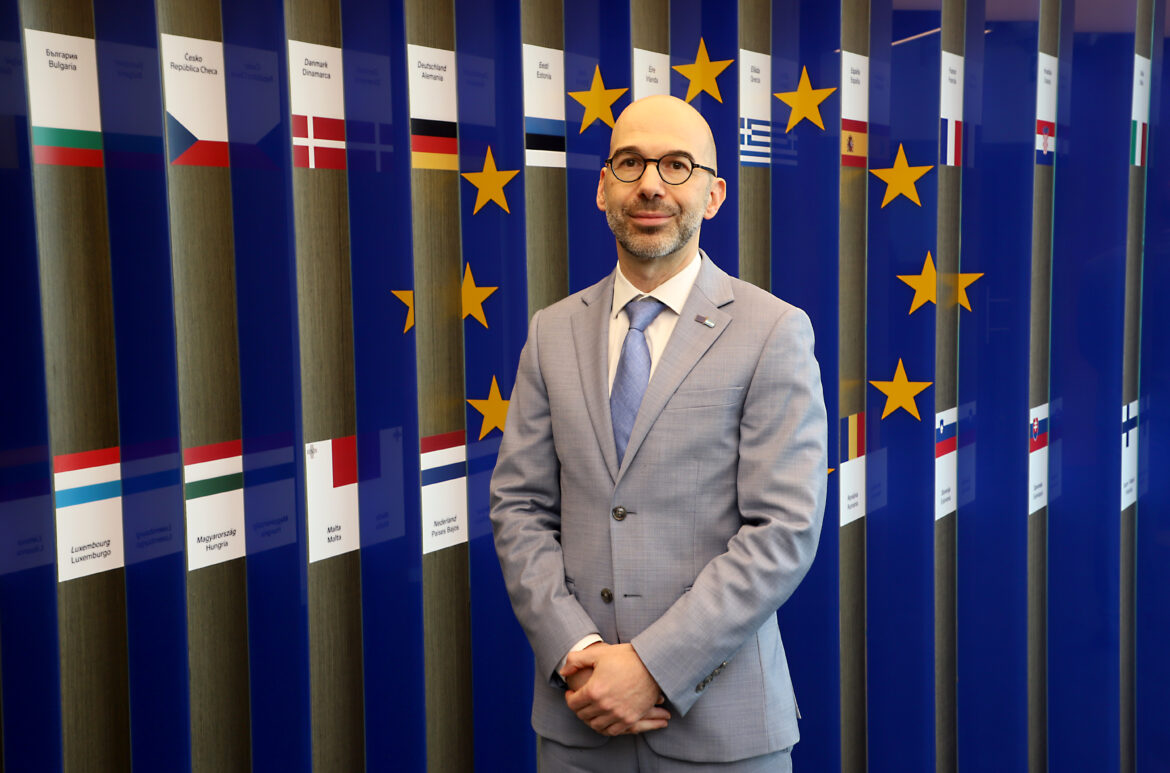
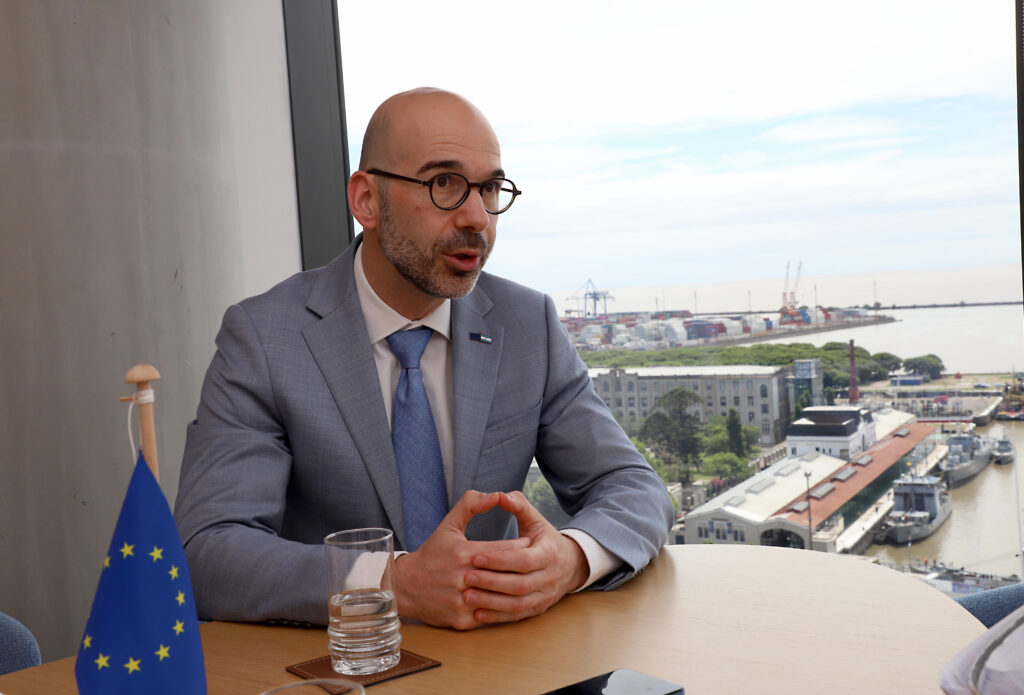
The Herald spoke to Eran Nagan, Deputy Ambassador of the EU in Argentina, about the implications of the agreement and the EU’s role in the country more broadly.
The interview has been lightly edited for length and clarity.
Expectations for the EU-Mercosur deal
How will the EU-Mercosur trade agreement affect Argentina?
I think it was great news for Europe and for the Mercosur countries, including Argentina, that we were able to finalize the negotiations, because it’s good for both sides of the Atlantic. It’s good from a geopolitical perspective: we’re connecting two blocs of democratic countries that share values, respect for human rights, respect for the rule of law. It’s good from an economic perspective, because it will be good for consumers. Prices will go down, both in Europe and in the Mercosur countries, once it’s ratified.
It’s good for the private sector — it will benefit and facilitate trade between the two regions — and it’s good in terms of attracting investment. It will be a guarantee of confidence of the global community in Argentina, and in that sense it will help attract more foreign investment.
The third advantage is that it’s a clear message in support of free trade in a moment where that free trade is somewhat under pressure, with an incoming U.S. administration that looks quite differently at trade. Here we have a clear signal of two major blocks betting on the benefits of free trade, rather than economic nationalism.
The deal restricts the extent to which Argentina can impose export duties, something it has often done. Could that cause issues — and will the benefits outweigh those issues?
I think the association agreement between the EU and Mercosur offers a tremendous opportunity for Argentina. It has been welcomed by industrial organizations like the UIA and the CAC, the umbrella organizations representing much of Argentine industry, as well as the Sociedad Rural, so the agricultural sector.
It’s an opportunity for Argentine industry and agricultural producers to enlarge their markets to a global market that includes more than 700 million consumers on both sides of the Atlantic, almost 500 million Europeans plus the Mercosur countries. So in that sense I think the benefits for this country are very clear and we will have to see now the ratification process will start.
Of course there should be a discussion in Congress in Argentina, as there will be in Europe. And let all the voices be heard. I think the most important thing is that we carry out this debate based on facts, not on feelings or sentiments. I would invite everybody to study the text of the agreement and to take the facts into account when taking positions on it.
Large member states such as France oppose the deal. Is the EU confident it will be able to pass?
I’m confident that it’s possible. Of course, otherwise Commission President Ursula von der Leyen wouldn’t have taken the plane to Montevideo to close the negotiations. It’s true that there is some resistance within a couple of member states, including France.
We’ll see what the European Commission will propose after the translations have been done and the legal scrubbing is finalized. But I can imagine that this proposal coming from the Commission to the European Council will include a split that will enable Europe to provisionally implement the trade part, which will only require a qualified majority in the council, as well as adoption by the European Parliament.
Argentina’s human rights policies
You recently visited the Olimpo former clandestine detention center. What reflections did that inspire?
I’ve been to El Olimpo recently. It was the third torture center I’ve visited since I arrived in Buenos Aires. I’ve also been to El Vesubio and the ESMA. Each of these visits is like a punch in the gut, in the sense that these are places, often in the middle of the city, where horrendous crimes against humanity occurred during the dictatorship.
I would like to commend the people working there, giving tours and keeping the memory alive. Their work is very important. I would also like to commend Argentina as a whole for the way it has dealt with the legacy of the military dictatorship. The process of memory, justice, and truth has been a fundamental building block for Argentina’s democratic society since the dictatorship ended in 1983.
I think other countries that have emerged from dictatorship can learn lessons from Argentina, particularly in ensuring accountability for crimes against humanity and educating youth about the recent past. These are essential tasks to ensure the democratic nature of society and to learn from the crimes of the past.
Over the past year, key human rights working teams have been dissolved, funding cut, and there have been rhetorical attacks from the highest levels of government on Argentina’s memory, truth, and justice policies. Is the EU concerned about how this could impact justice and the human rights principle of non-repetition?
As I said, the policies undertaken by Argentina following the fall of the military dictatorship are indeed exemplary. There is broad recognition of their importance throughout society and their relevance for democracy. Many in the judicial system are still working on ongoing court cases related to the dictatorship, and these things continue irrespective of political context.
And yet, decisions such as dismissing archival experts have made their work harder.
These decisions were taken by the Argentine government in a context of economic austerity. I don’t think it’s up to me to evaluate those decisions, but I do want to stress the importance of memory, truth and justice as a state policy.
Lithium in the limelight
What projects is the EU looking at with Argentina regarding its lithium?
There’s a lot happening under the umbrella of the EU’s Global Gateway agenda, which promotes responsible investment globally. This includes investment in strategic raw materials in Argentina. We signed a memorandum of understanding on strategic raw materials in 2023, when the President of the European Commission, Ursula von der Leyen, was here.
In December, a group of governors from the northwest of Argentina, including Catamarca, Jujuy, and San Juan, visited Brussels during a week on strategic raw materials organized by the European Commission. They also visited a copper mine in southern Spain to explore ways of closer collaboration and to learn from each other’s practices.
I believe there’s an important opportunity for European companies to invest in lithium and other important mining sectors, always with respect for the natural environment, environmental norms, and local communities, and ensuring that the European investments made here should not only extract minerals and ship them to Europe, but also create a value chain here in Argentina, fostering local development in the provinces.
Which major EU-based lithium companies investing in Argentina should we watch over the next 12 months?
I don’t want to name them specifically, but it’s public knowledge that Eramet, a French company, is active in northern Argentina.
From a European perspective, the focus is also on how conglomerates of smaller companies can collaborate on parts of the value chain, whether it’s lithium, copper, or other sectors. The interesting role for the EU is to build connections among various European companies that could play an important role in developing the mining industry in the northwest.
What are the EU’s priorities for the digital transition, and what risks do you foresee?
In terms of regulation, the European approach focuses on putting citizens and consumers at the center of decisions, protecting their rights. The European model for regulating large online platforms and developing artificial intelligence (AI) is based on protecting citizens from potential risks while simultaneously fostering innovation.
There is, I think, a mistaken view among some here in Argentina that the EU is stifling investment in these sectors, but we’re definitely not. On the contrary, we’re stimulating digital and AI development in Europe while protecting us all against the risks involved — and these risks are real.
If you look at the use of disinformation and foreign information manipulation and interference by Russia in Europe nowadays, you see many examples of activities that are undermining democracy. What happened with the Romanian elections in December was clearly an attempt by Russia to influence the outcome of an electoral process.
So, it’s clear that we need to be prepared. We need to regulate to protect against the risks for individual citizens and democratic societies. That goes for the digital domain and future AI applications, which will radically change our lives — often for the better, but we also need to be aware of the risks.

What are the EU delegation’s plans in Argentina for 2025?
We’ll talk a lot about the EU-Mercosur agreement and explain its benefits to stakeholders, policymakers, and decision-makers. We’ll also continue our work on the green agenda and the digital agenda.
In May, we’ll host another 15k, 7k, and 2k run in Buenos Aires to celebrate Europe Month. It’s always a massive event that attracts a lot of people. We’ll organize another European Film Festival in the second half of the year. In June, we’re working towards the first European Theatre Festival, where we intend to bring young playwrights from European countries and have their works performed by Argentine companies.
So, there’s work on the economic, political, and cultural spheres. And cooperation, obviously.
