

 Ariadna Gallo
 The full version of this piece was first published in Spanish by Tiempo Argentino
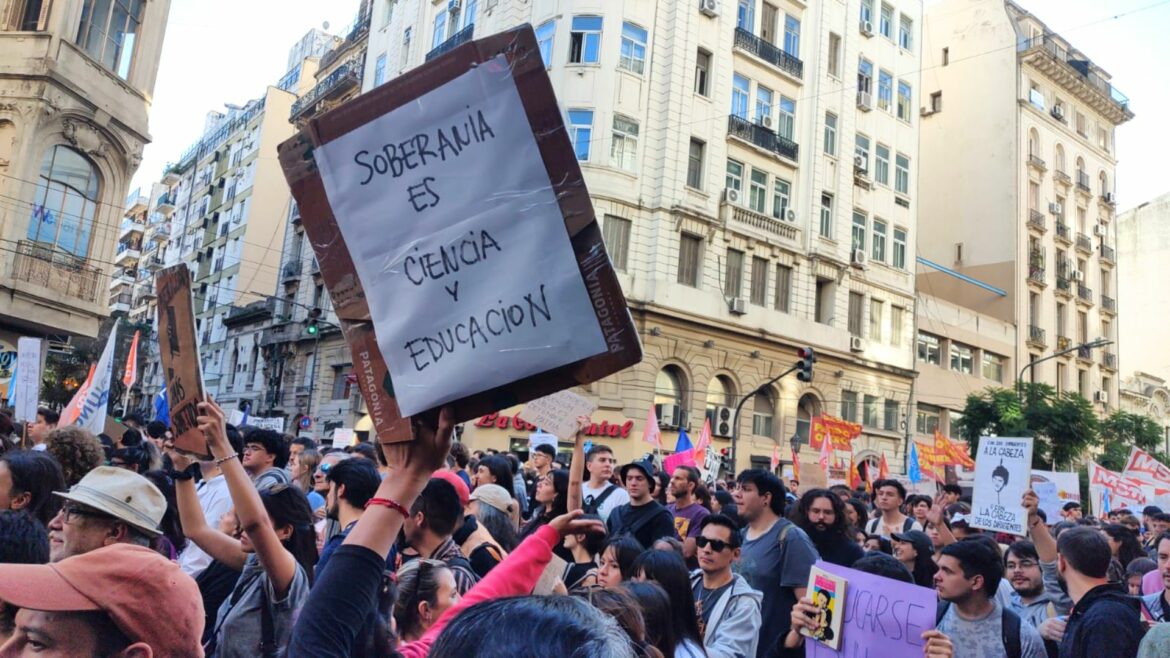
It’s been a deeply troubling time for Argentine public science. Amid a climate of attacks and harassment targeting the sector, something bizarre happened — and I unwittingly found myself at the center of it.
It all started when I came across a YouTube video titled “‘Scientists’ Protest Against Milei Because They Don’t Earn Much (THEY EARN OVER A MILLION).” A photo of me was prominently featured, with the caption “We Can’t Make Ends Meet” — words I hadn’t actually said.
The video was created by libertarian influencer Pablo Martínez, known as “Tipito Enojado” (Angry Little Guy). It was riddled with lies, fallacies, verbal violence, misogyny, and obscurantism, demonstrating how he can publicly ridicule people with impunity. If we didn’t live in an era of post-truth, where terms like “based” (to praise allies) and “owned” (to mock opponents) are thrown around like candy, there would be no doubt that his antics had backfired.
The YouTuber used a video of me during some direct action on the subway with a colleague, speaking in favor of public science and education. He only took the part where I introduced myself, stating that I’m a CONICET social sciences researcher. He sought to portray me as a victim “crying” (sic) about my meager salary, in a failed attempt to ridicule me before his audience.
He deliberately left out the part where I criticized the defunding and gutting of the sector, the arbitrary dismissal of administrative staff, cuts to doctoral scholarships, and the halt in to research grants — issues that impact all areas, particularly the applied sciences, which require expensive inputs, and which people like him see as “useful.”
Then, he went on to violently doxx me, exposing my personal and academic information.
Fodder for digital bullies
In these streams, a presenter like Tipito fuels sad passions — emotions like anger and resentment, which François Dubet (following Spinoza) identifies as mobilizers of political identities. He uses these sentiments to target groups such as us public workers, whom he portrays as state parasites living on other people’s tax money. His audience, immersed in these emotions, seeks confirmation of their biases, rejecting any evidence that challenges their worldview.
In this case, however, his audience was probably disappointed by the information about my academic publications. They expected to revel in scandalous or bizarre article titles, taking them as fodder for digital bullies’ trolling.
It didn’t go as expected. All you can see in the video is a guy who exudes supine ignorance about the subject, showing his audience a political scientist who has spent years researching key issues in her discipline. The “technical” nature of my titles, even read out in a tone of exasperated sarcasm, rendered them impervious to his mockery and utterly useless as a means of ridicule.
Tipito publicly scrutinized my publications’ quality and relevance, urging his followers to compare their salaries to mine. This triggered a torrent of comments attacking me, a researcher with 20 years of experience, earning slightly more than the basic family basket. Users filled the comment section with remarks like “I make AR$350,000 and I don’t complain.”
This reflects a broader reality: wages are increasingly meager, as highlighted by recent INDEC reports. Yet Tipito, servile to the government, doesn’t challenge real economic privilege, which Milei’s government has exacerbated. Instead, his false populist rhetoric encourages impoverished workers to compare their salaries, with a logic of leveling downwards and “not complaining.” They have managed to institute consensual slavery in the name of “freedom,” reinforcing systemic subordination.
The ‘wrong’ kind of research
When it comes to the research Tipito criticizes, we’ve worked tirelessly to explain that academic relevance cannot be judged solely by publication titles. We emphasize the importance of studying controversial topics like queer theory and gender representation. Libertarians, however, ignore such explanations, reducing social sciences to caricatures like that “Batman’s anus” paper, portraying them as immoral expenses in a nation with widespread child poverty.
Yet, social sciences research exists in all countries with a moderately developed scientific system. In this area, CONICET is seventh in the world and first in Latin America and Iberoamerica, according to the SCImago rankings.
Just hours after Tipito expressed his outrage that anyone would dare to study Argentina’s open, simultaneous and compulsory primaries (PASO) in depth, the government announced plans to abolish them. This highlighted the immediate relevance of my work, which systematically examines the implications of open primaries in Argentina.
My research has produced a body of evidence from across the region, showing numerous issues with how Argentina’s PASO are implemented. That evidence goes beyond the presidential spokesman’s budgetary and fiscal arguments. Despite this, the constant debate about whether to keep these elections has been driven by opportunistic political motivations, disregarding such empirical evidence.
CONICET versus wellbeing?
That debate shows that this work is relevant and useful — and if it is not part of national political debate, that speaks poorly of Argentine politics, not of its scientific system.
The libertarian government has developed a narrative that rests on a supposed causal relationship between dismantling state organisms such as CONICET and the anticipated wellbeing of its followers. The trade-off is putting up with present-day hardship without complaint.
Meanwhile, the digital Praetorian Guard guarantees that narrative is disseminated by people like Tipito, even in the face of a staggering transfer of income from the working classes to its upper echelons.
That’s why we have to keep advocating for public science, especially social sciences and humanities. We need complex, evidence-based explanations about our antagonistic reality and our society beset by structural inequality. Otherwise, the only information available to those subsisting on poverty wages will be these streamings, which encourage the oppressed to turn on each other.
The author thanks the Interbarrial Assembly of Parque Saavedra and ATE CONICET Capital for their support.