

 Buenos Aires Herald
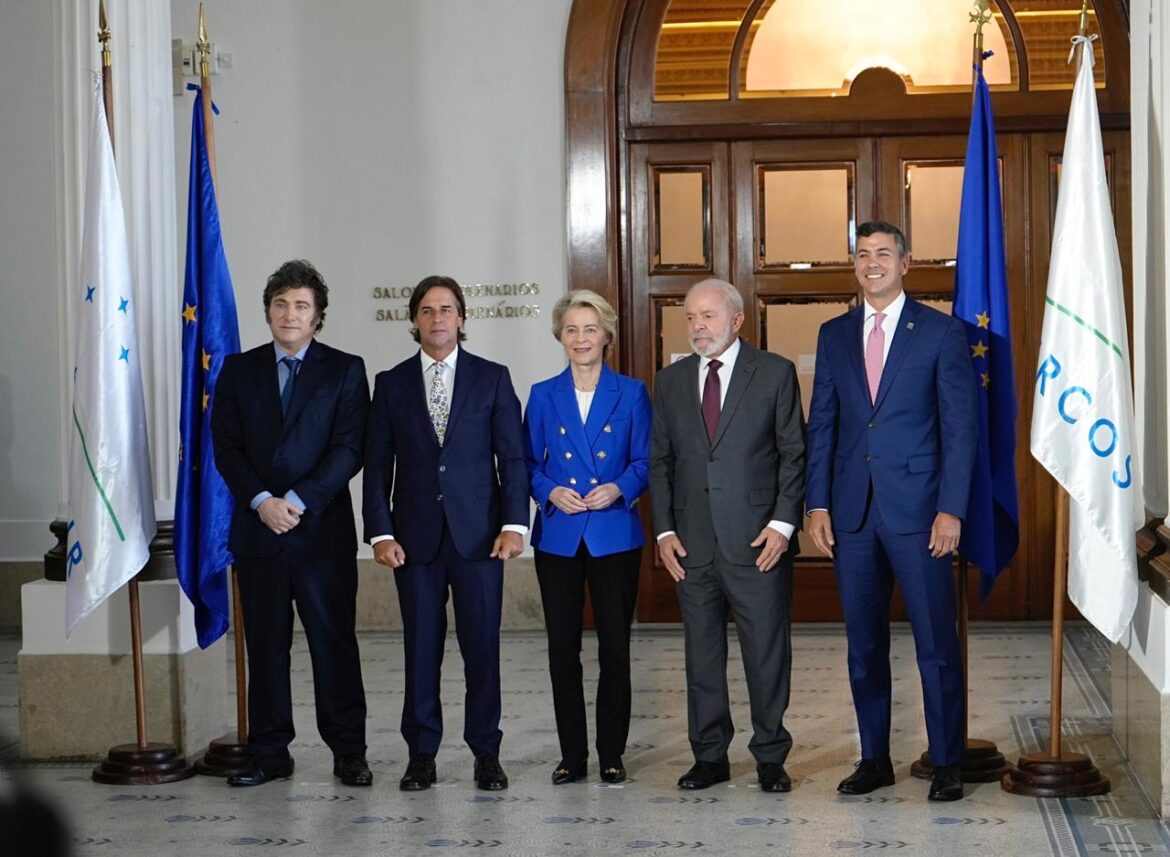
It took 25 years of negotiations, but the Mercosur and the European Union have finalized negotiations for a free-trade agreement. The deal was announced Friday morning in Montevideo, Uruguay, by the presidents of the four bloc countries (Brazil, Argentina, Paraguay, and Uruguay) and European Commission President Ursula von der Leyen.
The agreement was made public during the 65th Mercosur Leader Summit, where Argentine President Javier Milei was named the pro tempore president of the trade bloc. Uruguay President Luis Lacalle Pou, who made the announcement on behalf of Mercosur leaders as host of the summit, called the deal “not a solution but an opportunity.” He also criticized the constant delays in signing the deal, saying that the repeated failures “do not create confidence.”
Von der Leyen praised the deal. “This is a good day for Mercosur, a good day for Europe, and a historic day for our shared future,” she said following the news. “We are focused on fairness and mutual benefit. We have listened to the concerns of our farmers and we acted on them. This agreement includes robust safeguards to protect your livelihoods,” she added. She said the agreement would save EU companies 4 billion euros’ worth (US$4.23 billion) of export duties per year.
“This is a win-win agreement,” she added.
The announcement means that a deal has been reached, but it has not yet entered into force. A group of EU member states led by France opposes the agreement. Ratification of the deal would require the approval of 15 of the EU’s 27 member states, representing 65% of the bloc’s population, as well as a majority in the EU parliament.
A communiqué by the EU said that the agreement would “create new opportunities for all kinds of businesses, by removing often prohibitive tariffs on EU exports to Mercosur.” The agreement will also “help small and medium enterprises export more by cutting red tape” and imply 1.8 billion euros of EU support to “facilitate the fair green and digital transition in Mercosur countries.”
The deal, however, is far from complete. It will now need to be approved in the European Parliament, where France’s steady opposition to the agreement will be one of the main hurdles to overcome.
Milei’s Mercosur presidency
“I think I speak for everyone when I say that, for some time now, Mercosur, as it works today, brings us more problems than solutions,” Milei said when he took over the Mercosur presidency.
During the summit, Milei said he would aim to lower the bloc’s common external tariffs and “explore a regime of greater trade flexibility and autonomy,” allowing each member country to establish its own trade agreements.
“It is not only necessary to promote changes in commercial matters, as the Triple Border [between Argentina, Paraguay and Brazil] has become a sieve for narco-terrorist gangs, which are expanding their spheres of influence in the region every day,” he said. Milei proposed creating an agency with investigators from the three countries.
The summit also exposed the tensions between Milei and Brazilian President Lula Da Silva. Two weeks ago, Milei had decided not to participate in the final photograph of the G20 summit held in Brazil to mark his differences with the host. On Friday, Lula did the same and dropped out of the final portrait of the presidents.