
 Facundo Iglesia
Argentina’s Economy Ministry announced Friday that the public sector had a AR$523.4 billion financial surplus in October — the ninth consecutive month in which the national government registered a positive fiscal balance. Javier Milei, who campaigned on building surpluses, has been able to achieve his aims by enacting abrupt and often draconian austerity measures.
The primary fiscal balance represents the difference between a government’s revenues and its expenditures, whereas the financial balance constitutes that difference plus net interest payments on public debt. The government secured surpluses for each.
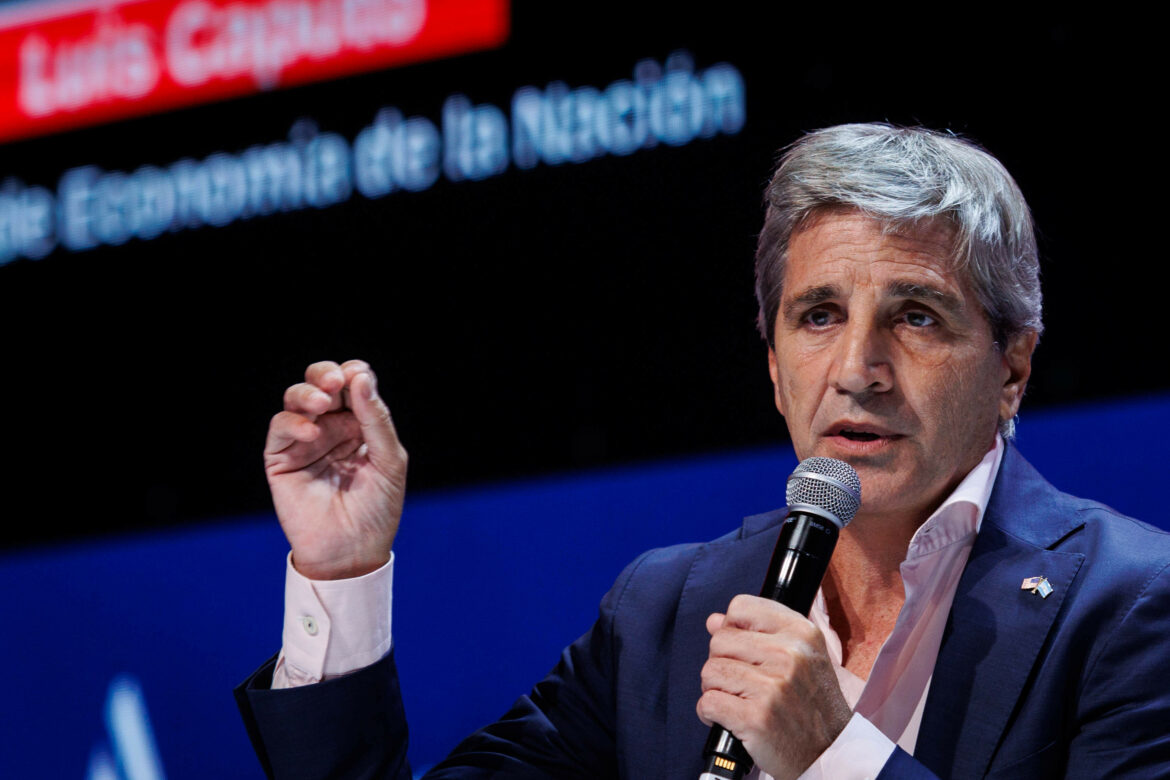
“This compares to a financial deficit for the same month of 2023 of AR$454 billion, which is equivalent to AR$1.3 trillion pesos adjusted for inflation,” Economy Minister Luis Caputo posted on X. “In other words, the difference in financial results versus October 2023 is AR$1.8 trillion.”
According to Caputo, the cumulative financial deficit for the year is AR$2.9 trillion, or 0.5% of GDP.
Total revenues during October amounted to AR$9.3 trillion —an inter-annual growth of 167.8% —while primary expenditures amounted to AR$ 8.6 trillion. This 125.1% increase was 68 points below inflation.
The tax that increased the most compared to October 2023 was export duties, jumping 219.8%. The government paid public debt interests for $223.5 billion.
A report by the Center of Argentine Political Economy (CEPA) found that between January and September of this year, 25.3% of the adjustment in state expenditure could be attributed to cuts to retirement benefits in the form of payments failing to keep pace with higher costs of living. The report added that Milei modified the pension update formula by tying it to inflation, which meant that retirees and pensioners “would not lose purchasing power, but neither would they be able to recover.”
Economist Martín Vauthier said the “financial surplus was achieved through a sustainable program” in an X post shared by Caputo.
“It includes a sharp reduction in government structural expenses and outlays that do not correspond to the [national administration’s] functions,” he added.
Conversely, Sebastián Menescaldi, associate director of EcoGo consulting firm, told the Herald that the surplus could be sustainable if the government modified certain economic policies.
“[They] still need to make tax and social security reforms to give sustainability to the whole process,” he said.”This works in the short term, [but] it seems to me that they have to start working on those areas, and today they are not even looking at them.”
Menascaldi added that the economy ministry’s latest announcement was “good news” and called the surplus “an asset for the government.”
“The balance is good and the year [so far] is very good,” he continued.“The truth is that one did not expect that they would manage to take such strong austerity measures and without that many social problems.”
In the 2025 budget bill, which the government plans to start debating in Congress in the coming weeks, Javier Milei added what he has called “Unbreakable Fiscal Rule” — that the administration must cover debt interests before allocating further spending. Current projections show that such payments will amount to 1.5% of the GDP in 2025, meaning that, as per the new rule, the administration would need to gain a corresponding surplus.
Meanwhile, if the economy continues to contract, the bill would grant the administration higher discretionary power to cut costs to achieve a “zero deficit.”
