
 Luciana Taddeo
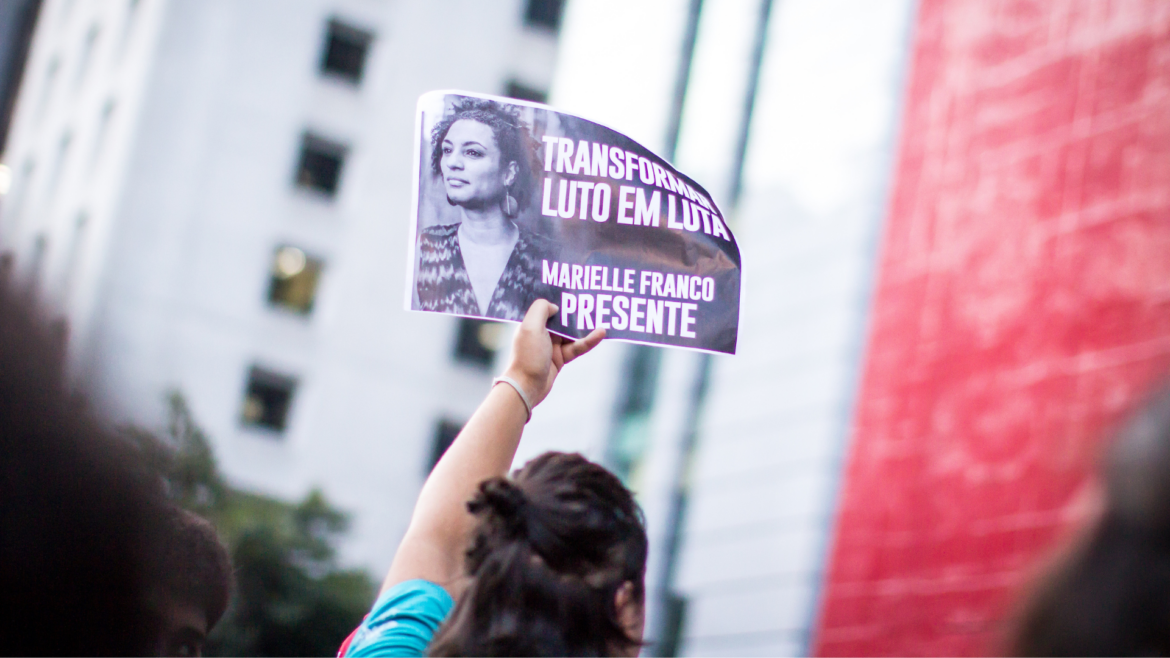
 Six years after Río de Janeiro councilwoman and human rights activist Marielle Franco was murdered in a drive-by shooting along with her driver Anderson Gomes, two former police officers have been convicted and sentenced for the crime.
Ronnie Lessa, who admitted to being the gunman, received a 78-year-9-month prison sentence. Élcio de Queiroz got 59 years and 8 months in jail for acting as the getaway driver.
Despite the tragedy and the sense that other responsible parties are still at large, many in Brazil see a sliver of hope in the sentence. A feeling that it could be a turning point in the way South America’s biggest country deals with persecution and violence against political and human rights activists.
“It’s hard to call it a victory when we’re talking about a conviction for the murder of someone we truly wished were still alive,” said Andressa Caldas, Director of the Mercosur Institute of Public Policies on Human Rights. But in a country that ranks among the deadliest for human rights defenders and where most cases go unpunished, she argued that the conviction has the potential to open a new chapter.
“This is a milestone in Brazilian history.”
This perilous situation is the result of a vicious cycle in Brazilian history. For many years, Caldas argued, powerful sectors have “felt free” to “turn murder into a business and a political strategy with impunity.” When these crimes effectively go unpunished, they fuel these groups’ certainty that they can continue carrying on their misdeeds.
A study carried out by Brazilian NGOs Land of Rights and Global Justice registered 1,171 instances of violence against human rights activists in the country between 2019 and 2022. The study reported 169 murders and 579 threats, as well as an intensification of territorial and environmental conflicts.
Lessa testified during the trial that Franco, a gay, Black woman from a left-wing political party, had become a “thorn in the side” of these powerful groups. She was blocking Río de Janeiro militia — armed paramilitary groups chiefly made up of members of security forces that operate illegally and control entire communities — from selling land by asking community leaders to oppose the operation.
Caldas, who was Franco’s friend, called the conviction a wake-up call and a wrinkle in the ongoing narrative that those responsible for political crimes go unpunished.
“People often say that Brazil is a country of impunity, but that’s not entirely accurate”, she emphasized, pointing to prison data showing that the country ranks among the world’s highest in incarcerated population.
“Brazil is actually a country that severely punishes certain population segments, especially young, black people living on city outskirts for property crimes,” Caldas explained. Powerful and wealthy groups who commit serious crimes, including murder, however, are rarely held accountable.
For Caldas, uncovering these crimes and the intricate coordination between death squads, mercenaries, hitmen, and those who hire them — which is the next step — is a major leap forward.
During the reading of the jury’s decision last week, Judge Lúcia Glioche stated that, despite the years that had passed, the sentence was “a message.” She added that the intended recipients were not only Franco’s executioners but also the “many Ronnies and Élcios who are out there and still roam free.”
“Justice may sometimes be slow, blind, unjust, and crooked, but it comes,” she said, adding that it “even reaches even those who, like the accused, believe they will never be touched.”
Attention will now turn to the upcoming trial of the alleged masterminds. A quest to finally reach the so-called Brazilian “rotten powers,” a characterization popularized by singer and songwriter Caetano Veloso referencing unjust, immoral, or corrupt authorities or power structures. The accused so far are a Congressman, a member of the State Audit Court, a police chief, a major, and a police officer. No trial date has been set yet.
Over the past 25 years, Caldas has seen many criminal cases against human rights defenders where the perpetrators are convicted, but the masterminds manage to delay punishment for decades or even outright elude it.
“Now is precisely the time to be more attentive,” she said, referencing the fact that it remains to be seen if this case can become a deterrent for political violence.
Caldas also expects a deep investigation into the funding of the plot. To get a sense of the economic magnitude of the crime, Lessa confessed that he was promised close to 25 million reais (around US$4,3 million) as payment.
“In the coming months, we need to investigate and punish this network in an exemplary way,” she said, emphasizing that bringing the masterminds — who she claims are politicians — to justice “will make a huge difference.”
For Caldas, this is how Brazil will be able to turn the page on political crimes and dismantle the normalization of barbarity which, sadly, is an intrinsical part of the country’s history.
