
 Juan Décima
Argentine President Javier Milei has never been shy about his admiration for the United States. On the campaign trail he called it a “model” for economic freedom and repeatedly singled it out as the country he most intended to strengthen ties with. As president, he has traveled there six times, making it by far the country he has visited most.
While his trips show that he is prioritizing relations with the U.S., they also reveal that he is not above picking sides. During his stops in Washington DC, Austin, Miami, Los Angeles, San Francisco, and New York, he has met with officials from the Biden administration only once. The five other occasions have included right-wing conferences and award ceremonies from libertarian think tanks and institutions, as well as three separate meetings with X and Tesla owner Elon Musk.
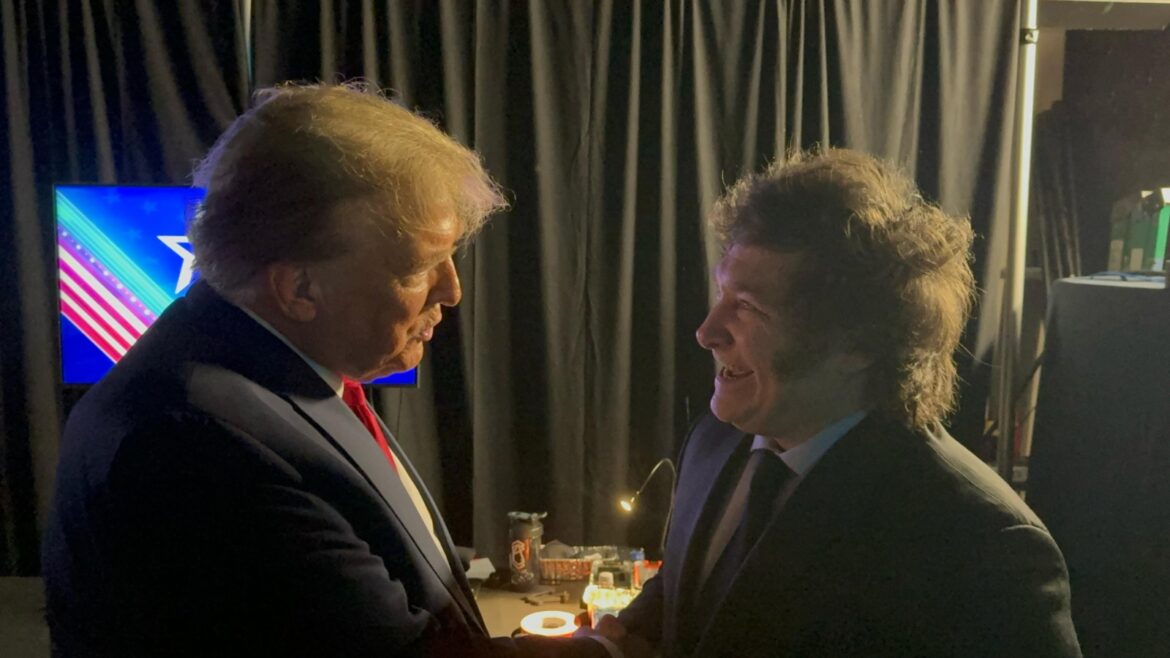
One needn’t look too far to notice that all these roads lead to the same place. Or in this case, man: former U.S. President and current Republican candidate Donald Trump. And with the U.S. November 5 election just days away, it’s time to see if Milei’s chosen path will pay off.
“Milei has shown that he is willing to give the United States what it wants regardless of who the president is, but there are a couple of specific reasons why he wants Trump to win,” International Relations scholar at the University of Rosario and Argentina-U.S. relations specialist Anabella Busso told the Herald.
On one hand, he is betting that the U.S. Department of Treasury in the hands of a Republican administration can help sway the International Monetary Fund (IMF) to release fresh funds for Argentina. This would be a key step for lifting the currency controls known as cepo, which analysts, economists, and even foreign diplomats say is necessary for his economic plan to eventually work.
But Milei is also counting on a Trump victory to legitimize his status as a far-right icon and cement alliances among actors engaged in the same culture wars as him. This goes not only for political figures like Spanish party VOX and former Brazilian President Jair Bolsonaro, but also for Musk, who is in lockstep with the Republican candidate.
This formula, however, is not without risks. Trump is on the opposite end of the spectrum from Milei on many issues, a protectionist in economic terms who has shown affinity for leaders that can hardly be included in the “free world” the Argentine president claims to love. And this is to say nothing of China, where Trump will come in as a hardliner just as Milei is beginning to change his tune on Beijing.
“Things are not as straightforward as they might seem,” Busso warned.
Would a Trump win open the doors to fresh funds?
President Milei has been adamant since the beginning of his administration that his government needs money if the cepo is going to be lifted. And the most likely source for those funds would be the IMF. In January, he hinted that a US$15-billion loan from the Fund might be in the works and that, if it materialized, the restrictions would quickly cease to exist.
“The faster we get that money, the faster we will be able to lift the cepo,” he said.
The IMF, however, has been reluctant to go beyond platitudes and anything else except previously agreed-upon disbursements. Former director of the lender’s Western Hemisphere Department Alejandro Werner said in September that the Fund had “doubts” about the economic program and that if currency controls remain in place, any further agreements would likely circle around refinancing and not new funds.
The Argentine government’s expectation that negotiations could liven with Trump in the White House is based not only on wishful thinking, but also past experience.
“Milei’s bet is to rekindle the type of relationship Mauricio Macri had with Trump when they were both presidents,” Busso explained. By 2018, when they were both in office, Argentina had defaulted on its debt seven times, including once in the last 20 years. Despite this, the IMF gave Argentina the biggest loan it has ever given any country: US$57 billion.
“Argentina got that money due to political pressure by Donald Trump to try to get Macri reelected,” she noted. In 2023, Argentina’s General Auditors’ Office revealed that the agreement with the IMF had broken several laws and protocols.
The Fund has reasons of its own for wanting to avoid a financial crisis in Argentina. As the international lender of last resort, a default disaster in the country like the 2001 crisis could stand to tarnish its reputation and credibility.
“He is counting on the Fund having an interest in not seeing Argentina’s economy collapse,” explained Michael Paarlberg, associate professor of political science at Virginia Commonwealth University and former Latin America advisor to Senator Bernie Sanders during the 2020 U.S. Democratic primary.
And while the IMF is, in theory, an independent body with its own assessment processes, the U.S. Treasury can effectively “put its thumb” on the scale of lending decisions. The IMF requires 85% of its members’ votes to pass reforms and decisions. Under the organism’s quota system, the U.S. has 16.5% of the vote, effectively making it the only country to hold veto power.
Paarlberg was quick to point out that that is the extent to which Milei can expect economic cooperation.
“Trump is a nativist and economic nationalist, interested more in protecting U.S. industries than promoting global free trade,” he said, adding that neither Republicans nor Democrats, in fact, are interested in pursuing new free trade agreements at the moment.
“Both will be oriented toward industrial policy and nearshoring, something countries neighboring the United States are better positioned to take advantage of than Argentina.”
Two peas in a pod
Like most far-right leaders, Milei built his political brand following the Trump model. From a violent social media-based communication style to fierce opposition to progressive causes like climate change and gender issues, the two leaders are often like two peas in a pod. The Argentine president has said that he and Trump are the “two most popular politicians in the world.”
Milei’s belligerent rhetoric, denunciation of “socialism,” and opposition to the United Nations’ 2030 Agenda for Sustainable Development, however, have left him mostly isolated on the international stage as the global agenda is currently focused on many of the issues he despises. In his almost 11 months in office, he has had spats with the leaders of Bolivia, Mexico, Colombia, and Brazil, as well as a full-blown diplomatic crisis with Spain.
Having the most powerful president in the world as an ally would come in handy.
“A Trump win would legitimize far-right world leaders and consolidate their network,” Busso said, pointing not only to Milei but also factions in Europe and Latin America. In the case of the Argentine president, this would mean validation not only for his ideas but also for his constant denigration of state institutions like public hospitals and universities.
“Milei’s attacks on institutions are a reflection of Donald Trump’s argument that the U.S. system is broken and therefore needs to be torn down,” she explained, adding that a new Republican administration would lend huge weight to this discourse and allow Milei to present himself as “the most successful disciple.”
Trump’s win would also signal the political ascent of Elon Musk to the highest echelons of power in Washington, Busso points out. The Tesla and X owner is the most visible face of the rise of tech companies as geopolitical actors and, coincidentally, the one who has met the most times with the Argentine president.
“As a self-described anarcho capitalist, Milei is aligned with this vision of tech utopia and these companies’ intent of replacing the state,” she added.
Paarlberg, on the other hand, argued that Trump is guided by “America First and whatever benefits himself or his family.” This is not to say that Trump will not work out deals or cooperate with other world leaders, but not out of ideological affinity nor consistency.
“Milei should be realistic about the likelihood of Trump going to bat for him, without a personal incentive to do so.”
With Democrats, business as usual
A Kamala Harris presidency would likely develop along the same lines as the last year of the Biden administration. Despite differences on issues like climate change, Argentina will remain fully aligned with the United States’ agenda of containing China in the ongoing security competition between the two countries.
“That agenda includes 5G technology, natural resources, artificial intelligence, space exploration, and key infrastructure,” Busso explained, adding that Argentina’s cooperation with the U.S. will be chanelled mainly through the Foreign and Defense Ministry.
Argentina’s relationship with China remains an open question. After months of fierce criticism, including his refusal to deal with “communist” countries and accusations that Beijing “murdered its citizens,” Milei recently shifted gears and called China “a very interesting business partner.” Although it has not been officially confirmed, there is growing talk that he might visit Beijing in early 2025.
For Paarlberg, this dynamic of initial tough-talk to later make nice is not new.
“Much like the U.S, and Brazil, Argentina’s relationship with China will be a dance, with posturing for the party base and negotiations for domestic businesses,” he noted, adding that, despite their differing views, Milei is underestimating Harris’s willingness to do business with him.
Democratic administrations, he argues, are usually more attuned to the repercussions of other countries’ economic maladies for global markets and are thus incentivized to support governments, including those not politically aligned with them.
“It’s doubtful that the differences between Milei and Harris will matter much to the immediate shared goal of macroeconomic stability.”
