
 Agustín Mango
Long before Jorge Luis Borges became one of the world’s most influential writers in the Spanish language, English was already woven into his life. It was the language of his family, his earliest readings, and, eventually, many of the literary traditions that shaped his imagination.
According to Borges biographer Lucas Adur — author of Jorge Luis Borges: a literary fate, published by Cátedra — English provided Borges with his first literary education, served as a language of intimacy, and helped forge the distinctive style that would make him Argentina’s most celebrated writer.
“It was a family matter: Borges was bilingual since birth,” Adur told the Herald.
Both Georgie and his sister Norah would usually speak English at home. The language came primarily through his grandmother, Fanny Haslam, an English woman from Northumberland, and his father, Jorge Guillermo, who was raised by Fanny after his father died.

In his autobiography, Borges traced his bilingualism to his two grandmothers, though with a touch of the wit that often colored his recollections. “He said: ‘I knew he spoke one way to my English grandmother — I later learned that was called English — and in another way to his Argentine grandmother — what I later learned was called Spanish.’,” Adur recalls.
English was also Borges’ language of intimacy. “With Estela Canto, Borges often spoke and corresponded in English. In the postcards he sent her, his tone could become almost embarrassingly sentimental. One could say that when it came to his most emotional — even saccharine — expressions, he switched to English,” says Adur.
Literary initiation
Although he learned to read and write in Spanish, Borges spent much of his childhood outside the formal school system. His father, distrustful of public schools and their conditions, delayed his enrollment, and Borges was largely educated at home by an English governess while exploring his father’s extensive library — which Adur describes as “a key” in the writer’s literary initiation.
Borges spoke of his literary initiation in different ways. One is centered on his grandmother and the Bible.
“For Borges, the Bible was the King James Bible. It was an English book, which Fanny knew by heart. He once joked, ‘Perhaps I entered literature by way of the Holy Spirit’,” Adur says.
Meanwhile, his earliest literary experiences were classic English-writing authors — Mark Twain, Rudyard Kipling, H.G. Wells, and much of 19th-century English-language literature. The first novel he ever read, according to Adur, was an original version of Tom Sawyer.
Years later, Borges’ work would spread in the U.S. quite differently from the way it did in Europe — where he was being read by scholars like Michel Foucault or Gilles Deleuze.
In the U.S. and the U.K. his first “fandom” included weird fiction authors like Ursula K. Le Guin, William Gibson, or Philip K. Dick. “As an academic star in the U.S., Borges was not solemn at all. His work resonated there in the science fiction realm,” says Adur.
His first story to be translated into English, The Garden of Forking Paths (El jardín de los senderos que se bifurcan), was in fact first published in a pulp magazine of detective stories.
While his Spanish-language reading largely mirrored that of his Argentine contemporaries — works such as Facundo and Juan Moreira, rooted in realism and national history — English literature exposed him to a wider range of genres, including fantasy, science fiction, adventure stories, and poetry.
“He was an English reader first and read in Spanish afterwards,” says Adur. And in that literature, the biographer says, lies the essence of Borges’ influence, the differential that would shape Borges as a unique author.
First writings
The first thing Borges wrote, in fact, was a small Greek mythology handbook in what he called “a very clumsy English,” with Spanish intromissions. Two things about it stand out: the fact that it was not fiction nor poetry, but a small encyclopedia, the genre Borges would later use to single-handedly expand the realms of literature. And the detail that he wrote that at the age of six.
“His first try is in English, which makes sense since it was his literary, reading language,” says Adur. And clarifies that, nevertheless, Borges wrote very little in English, only a few poems and his Autobiography.
He then turned to an intentionally archaic, Cervantes-inspired Spanish, producing juvenile works that sought to imitate the language of the Spanish classics. The effort stemmed from a desire to grant literary prestige to Spanish, which he associated with everyday domestic life — the language of the help — while English carried the authority of the Bible, poetry, and his grandmother’s stories.
The first text Borges published is, actually, a translation of Oscar Wilde’s The Happy Prince, when he was almost 11.
In 1935, Borges wrote The Approach to Al-Mu’tasim (Aproximación a Almotásim), which is now regarded as the foundation of his poetics. Structured as the critical review of a novel by a Hindu attorney (invented by Borges), the narrator quotes the imaginary English novel and translates into Spanish, “as if he needed an English original that would enable him to write in Spanish,” according to his biographer.
“I think that’s the key Borges ultimately found: a Spanish that had gone through English. A good way to summarize his poetics is: reads in English, writes in Spanish.”
Old English and Peronism
From his public lectures in the 1940s and 1950s to his professorship at the University of Buenos Aires and later courses at other institutions, Borges devoted much of his academic career to the subject and even authored two introductory manuals on English literature.
In these classes, he dived into his last favorite topic: the Old English language (or Anglo-Saxon), which he began to study around 1960. It was actually in a study group on Old English that he met his future partner María Kodama.
Anglo-Saxon literature provided Borges with one of his recurrent favorite tropes, a fascination for warriors, fearless heroes. It also rescued him from a conundrum regarding this worship of courage.
“For Borges, that was personified by the compadritos.”
A typical cultural character of 19th-century Buenos Aires, compadritos served as a bridge between the rural gaucho and the emerging urban areas. Often dockworkers, cart drivers, or slaughterhouse laborers who lived on the outskirts of Buenos Aires and frequented milongas, they were known for their pride and skill with a knife.
“That urban Buenos Aires mythology suddenly turns against him,” says Adur. The reason: Peronism’s empowerment of the working class.
In 1945, thousands of workers flooded into Buenos Aires to demand the release of General Juan Domingo Perón. Images of demonstrators cooling their feet in the fountains of Plaza de Mayo became one of the defining symbols of the movement and, for many anti-Peronist intellectuals, a source of lasting unease.

The writer’s old heroes were now demanding a role in the urban landscape, and Anglo-Saxon literature provided him with that same heroism, without his much-dreaded Peronism attached.
“Borges found that same fascination for courage, but without any political issues,” says Adur. “Characters that wouldn’t sink their feet in the fountains.”
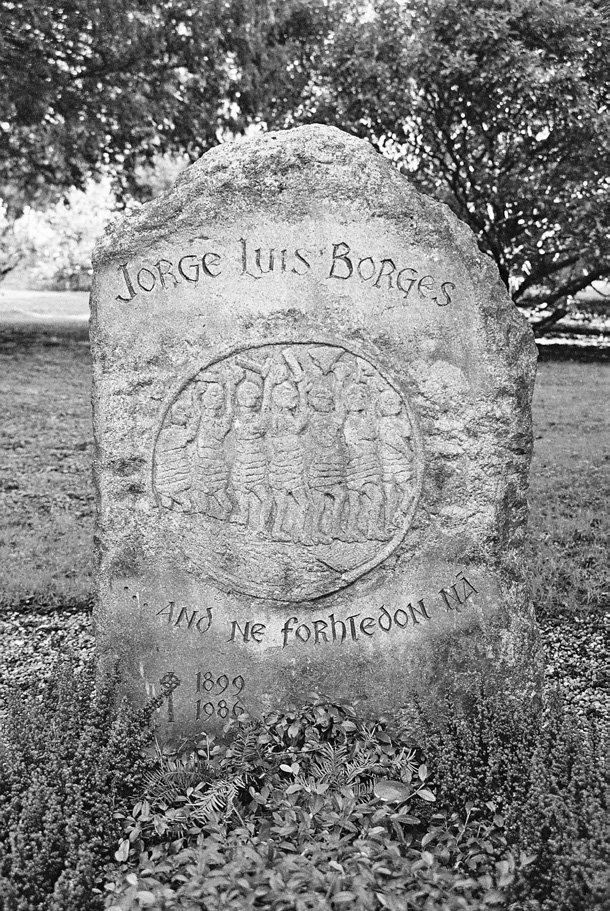
At the Cemetery of Kings in Geneva, Borges’ tomb remains the ultimate proof of the writer’s idiomatic passion. Featuring a Viking ship and seven Norse warriors marching into battle, the carved gravestone bears an Old English inscription taken from the epic poem The Battle of Maldon: “And they were not afraid” — Borges love of language and myth-making blended into one last piece of writing.
