
 Facundo Iglesia
A criminal court has suspended the extradition trial of five Brazilians who were arrested in Argentina after being sentenced for their role in the 2023 storming of three government buildings. The proceedings were halted after one of the defendants asked the presiding judge to recuse themselves.
There is still no new date for the trial to resume, and no certainty on whether they will be sent back to Brazil or not.
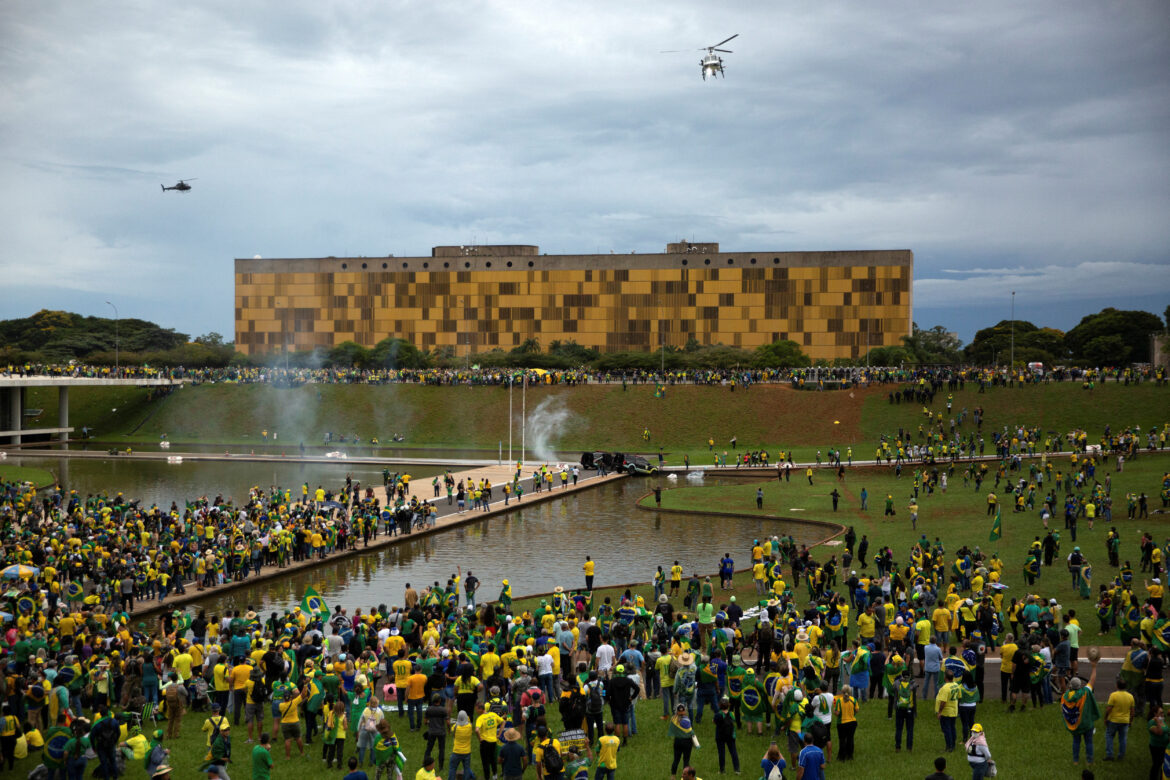
Following Jair Bolsonaro’s defeat in the 2022 presidential elections, a mob of his supporters attacked three federal government buildings in Brasilia to protest the newly elected President Lula Da Silva on January 8, 2023. Brazil’s Supreme Court Justice and electoral authority, Alexandre de Moraes, considers the attack part of a plot that would ultimately end with a coup.
The Brazilian judiciary has already convicted hundreds of people involved in the riots for crimes ranging from vandalism to insurrection, with sentences that go up to 17 years in prison. Bolsonaro himself is facing trial as he was deemed part of the plot. He has also been barred from public office until 2030.
At least 56 Bolsonaristas who participated in the stormings and escaped to Argentina after being sentenced remain at large in the country. According to official data, 181 Brazilians living in Argentina requested political asylum in 2024 through the National Refugee Commission. No request has yet been granted.
The extradition request
In October 2024, the Brazilian government formally requested that the Argentine Foreign Ministry extradite 61 of those living in Argentina. Argentine Federal Judge Daniel Rafecas requested their arrest the following month. Five of them were arrested who, at the time of writing, remain in the Ezeiza federal prison.
The extradition trial, originally set for June 18 by Rafecas’ court, has been postponed three times so far. The first came on the heels of a planned to the courts by former President Cristina Fernández’s supporters, the second after the Brazilian government requested to be a plaintiff, and the third after one of the detainees’ attorneys asked for the judge’s recusal.
The five fugitives set to stand trial are Joelton Gusmão de Oliveira (sentenced in Brazil to 17 years), Rodrigo de Freitas Moro Ramalho (14 years), Joel Borges Correa (13 years), Wellington Luiz Firmino (17 years), and Ana Paula de Souza (14 years). Firmino’s defense, led by attorney and former La Libertad Avanza candidate Francisco Onetto, is the one that petitioned for the recusal.
According to Rafecas’ three-page suspension request, which the Herald has seen, the trial will be carried out once the Cassation Chamber solves four requests — the judge’s recusal, the intervention of a collegiate court in the extradition trial, a request that the case be thrown out over a lack of jurisdiction, and a review of a rejected evidence offering.
Not everyone is happy with the suspension. Carla Junqueira, the lawyer of a detainee named De Souza, told the Herald that her client is “very angry” as there was no consensus over that strategy. Junqueira said they would like the hearing to be carried out “as soon as possible.”
“It is an awful legal limbo — she can’t take it anymore,” Junqueira told the Herald, saying that her client is going through several health issues.
If Rafecas’ court approves the extradition, the detainees’ defense team would have to appeal directly to the Supreme Court.
Despite being a Bolsonaro ally, Argentine President Javier Milei has not had a public role in the case. The Bolsonaristas fled to the neighbouring country with the hopes that Milei’s alliance with the former Brazilian president would benefit their situation. According to sources from their camp contacted by the Herald, many of the fugitives are disappointed in the Argentine far-right leader. De Souza is among them, Junqueira said. However, she theorized that Milei could be waiting for the judicial proceedings to end before acting.
The legal proceedings involving Bolsonaro and his supporters are getting traction in other global far-right corners. U.S. President Donald Trump recently imposed tariffs on Brazil, partially on the grounds that the Brazilian judiciary is persecuting former President Jair Bolsonaro. “[It] is an international disgrace. This Trial should not be taking place. It is a Witch Hunt that should end IMMEDIATELY!” said Trump.
According to Junqueira, De Souza’s conviction was a summary condemnation and violated her rights to due process. She also said that “serious accusations of political influence” leveled against Alexandre De Moraes, the judge who convicted the Brazilians, could potentially render the sentencing invalid.
Next week, De Souza has new interviews with CONARE, the Argentine state’s body in charge of political refugees, with the hopes of getting political asylum.
The attorney explained that her asylum request is currently pending. If granted, it would create a presumption that De Souza is a political prisoner. That would invalidate the conviction and thus end Brazil’s right to extradition, Junqueira said.
