

 Buenos Aires Herald
Reporting from Argentina by Facundo Iglesia
Venezuelan leader Nicolás Maduro has been sworn in for his contested third term amid massive protests and accusations of fraud from the opposition and regional leaders. He will serve a six-year term, extending his rule until at least 2031.
Maduro took the official oath in front of the National Assembly on Friday shortly before 11 a.m. Venezuelan time. He gave a speech in which he promised to “uphold the Constitution and all the laws of Venezuela.” Maduro also paid homage to past leaders like Simón Bolívar and Hugo Chávez, and promised that this term would be a “period of peace, prosperity, equality, and new democracy.”
Maduro also discussed Argentine President Javier Milei in a speech after the ceremony, calling him “a Zionist Nazi” and “a social sadist.” The strongman called Milei the world leader of the far-right and accused him of working with “the North American empire” to “impose a president on Venezuela.”
The re-inaguration ceremony was held against the backdrop of high tension in the streets of Venezuela. The situation seemed to reach a boiling point on Thursday afternoon when the campaign of opposition leader María Corina Machado reported that she had been “violently intercepted” leaving a rally. Although she was released shortly afterwards, the incident created widespread concern as crackdowns have intensified in recent weeks.
María Corina Machado speaks out
On Friday afternoon, Machado said in a video uploaded on social media that she was “brusquely” dragged from the motorbike she was riding and put on another between two men, who then suddenly said they had an order to release her. She said that they made her record the proof-of-life video that the government disseminated on social media on Thursday.
“I am fine now, although I have severe pain and bruises in some parts of my body,” she said.
Machado said that Thursday’s events demonstrated “the profound contradictions” and “divisions” within the Venezuelan government and that Maduro’s inauguration meant crossing “the red line that makes the violation of the constitution official.”
“Maduro consolidated the coup d’état and the violation of our constitution. It is time to do whatever is necessary to restore it,” she said.
Machado’s front Plataforma Unitaria Democrática (Unitary Democratic Platform) published a statement on X saying that Friday marked the beginning of a “new phase in the fight for democracy and freedom in Venezuela.” They added that the true winner of July’s presidential elections was opposition candidate Edmundo González Urrutia, and not Maduro.
Machado said that González Urrutia would not enter the country “to take office” for the time being, as previously announced. She said it would not be “wise” as the government closed its airspace and activated military defense systems in an “act of delusional paranoia”.
Venezuelans in Argentine march against Maduro
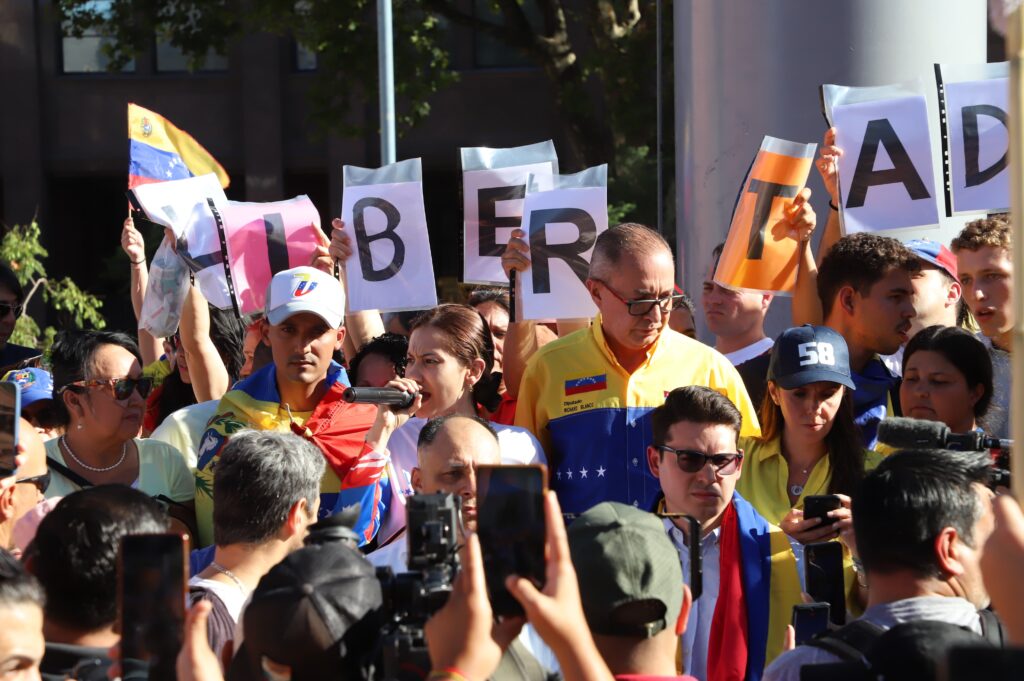
“Free Corina!” a crowd waving Venezuelan flags or with them tied around their necks chanted in Plaza de Mayo on Thursday, in front of the Casa Rosada. As in other countries, members of the Venezuelan community in Argentina had organized a rally against Maduro in Buenos Aires roughly at the same time Machado was having hers in Caracas. However, after news of Machado’s detention broke, the protest’s chants started to demand her release.
People in the Plaza were speaking about Machado’s detention before it was confirmed. Some were selling tequeños and Venezuelan empanadas and flags. Argentine Chief of Staff Guillermo Francos was in the Plaza showing his support, as well as lawmakers from the PRO party.
“I can expect the government to do anything, because I already lived it with my brother,” Mariela Estanga, a Venezuelan 39-year-old copywriter, told the Herald about Machado’s detention during the protest. Estanga was referring to her brother, Jhonnathan Daniel Rodriguez, who she claims was imprisoned after the July elections.
“He is autistic, a fisherman and a barber, but the regime says he is a terrorist,” she said, joined by her three children, one of which was born in Argentina and holding a sign reading “Free my uncle.”
Graphic designer Greis Orozco, 39, who has been living in Argentina for the last 19 years, held a sign saying Maduro basura, vos sos la dictadura (Maduro, trash, you are the dictatorship). The phrase originated in Argentina and is used to criticize politicians in the country.
“I’m half Argentine, half Venezuelan,” Orozco explained. “I saw how my country was destroyed from here.”
Freddy Rojas, who worked in the Education Ministry under Hugo Chávez, stopped supporting Chavismo after the Maduro administration discontinued social programs and started persecuting opposition members and former allies. Rojas said the attack on Machado could turn against him as it could enrage people who support the opposition leader.
“It is typical of totalitarian regimes. You do not have the right to think differently. Not to speak, but to actually think differently. Speaking carries a risk of punishment, of prison, of persecution. Far from benefiting the regime, María Corina’s arrest harms it,” he told the Herald.
