

 Andrea Monasterios
 Bolivia’s three-term former President Evo Morales is on a quest for a fourth round in office.
The leftist leader rewrote the country’s constitution and oversaw a fourteen-year cycle of economic growth and redistribution before being forced out amid disputed allegations of electoral fraud in 2019.
But this time, his greatest foe could be a man who was once one of his closest allies: President Luis Arce. Morales’s former economy minister who served in his cabinet for most of his presidency, Arce is a mild-mannered economist widely credited as the architect of Morales’s economic policies. He won the 2020 presidential elections in a landslide as the candidate for their Movement Towards Socialism (MAS, by its Spanish initials) party. But scarcely had he assumed office when cracks began to appear.
Those cracks became fissures, and finally, on February 27, Morales announced that he was splitting with the MAS, which has ultimately remained on Arce’s side.
Morales’s challenges go beyond the political arena: he is facing an arrest warrant on charges of aggravated rape and human trafficking. To elude detention, he has remained sequestered in the tropical region of Chapare, where he surged to political prominence as a coca growers’ union leader, and still commands a diehard support base. To avoid leaving friendly territory, he made his MAS resignation official by sending an ally with his power of attorney.
So how can Morales run again?
Despite this, Morales has found a path to a presidential run: this time, by joining an obscure political setup known as Frente para la Victoria (FPV). They have no ties with the former Kirchnerist coalition of the same name in Argentina. On paper, they are a registered political party who can field candidates. However, Bolivian journalists have found that most of its leadership is linked with a single family that has ties to religious conservative agribusiness groups — a far cry from Morales’s Indigenous socialist convictions.
In the 2020 elections, FPV’s presidential candidate was Chi Hyun Chung, a South Korean doctor and evangelical pastor who became a Bolivian citizen after his family moved to the country. He came a distant fourth, with 1.55% of the vote.
“FPV is a name that’s about to die. It’s a win for them just having Morales there,” said political scientist and content creator Natalia Aparicio.
The radical shifts in political profile have led to accusations that the FPV is renting out spots on its political tickets.
You may also be interested in: Understanding the statutory rape accusations against Evo Morales
Who’s running in Bolivia’s elections?
Bolivia’s presidential elections will be held on August 17. The MAS has yet to announce its candidate: Arce could run again, but given his dismal public image, it’s not clear whether he will. The country is sliding into an economic crisis, denting his credentials as a competent economic steward.
One possibility is 36-year-old senate president, Andrónico Rodríguez, a politician and coca growers’ union leader, who has long been touted as the face of the next generation of the Bolivian left. He has had close ties with Morales in the past, but is also being courted by Arce. He holds strong appeal among urban progressive voters, according to Aparicio.
Several mostly right-wing opposition fronts are opening up to challenge the ruling party. These include former President Jorge “Tuto” Quiroga and Chi Hyun Chung. On the left is Evo Morales.
Is it legal for Morales to stand?
The FPV can field any candidate who meets the legally-required conditions. However, in 2023, Bolivia’s Plurinational Constitutional Court ruled that presidents cannot serve a third term, consecutive or otherwise. They ratified that ruling in 2024.
Morales left Bolivia’s presidency more than five years ago. However, his candidacy is a political sore spot in the country, after a series of maneuvers to extend his presidency last time he held office.
The constitution currently states that the president and vice president “can be re-elected just one time continuously.” Morales ran for his third consecutive term by arguing that his first term in office did not count towards the limit because it preceded the rewriting of Bolivia’s constitution and its refoundation as a Plurinational State.
Then, in 2016, the government held a referendum on whether to modify the constitution to allow presidents to run for two consecutive re-elections, which would have paved the way for Morales to stand in 2019. The population rejected the proposal 51%-49%. While the referendum was binding, Morales ran again anyway after his lawyers argued that blocking him from running would violate his right to political participation.
In 2019, the Inter-American Court of Human Rights (IACHR) ruled that “indefinite re-election is not a human right and that allowing it undermines democratic principles,” lawyer Rafael Subieta Tapia pointed out. Morales’s supporters, however, argue that this cannot be extended to candidates serving non-consecutive terms.
So what happened?
In October 2023, an assembly in the Cochabamba tropics elected Morales president of MAS and future candidate for the 2025 elections. But then, in May 2024, the party’s pro-Arce faction held another MAS congress in El Alto. This time, close Arce ally Grover Garcia was elected party president. The TSE did not recognize either assembly and asked the two factions to come to an agreement, which did not happen.
Finally, after a failed attempt to arrest Morales in October 2024, the constitutional court judges formally recognized Garcia as president of MAS in November. (These same judges had ruled that a president cannot serve more than two terms in office.) Morales blasted their ruling as an illegal “blow to the revolution and the process of change” and claimed their decision was designed to stop him running for the presidency.
On February 20, at an event in Lauca Ñ, in the Cochabamba Tropics, Morales announced his alliance with FPV and signed an agreement with its leader, Eliseo Rodríguez. He called for a large mobilization to La Paz to register his candidacy and added that his team would hold a re-foundation event in late March. He also asked his followers to wait and see what his party’s definitive name will be before joining FPV. Coalitions must be registered by April 12.
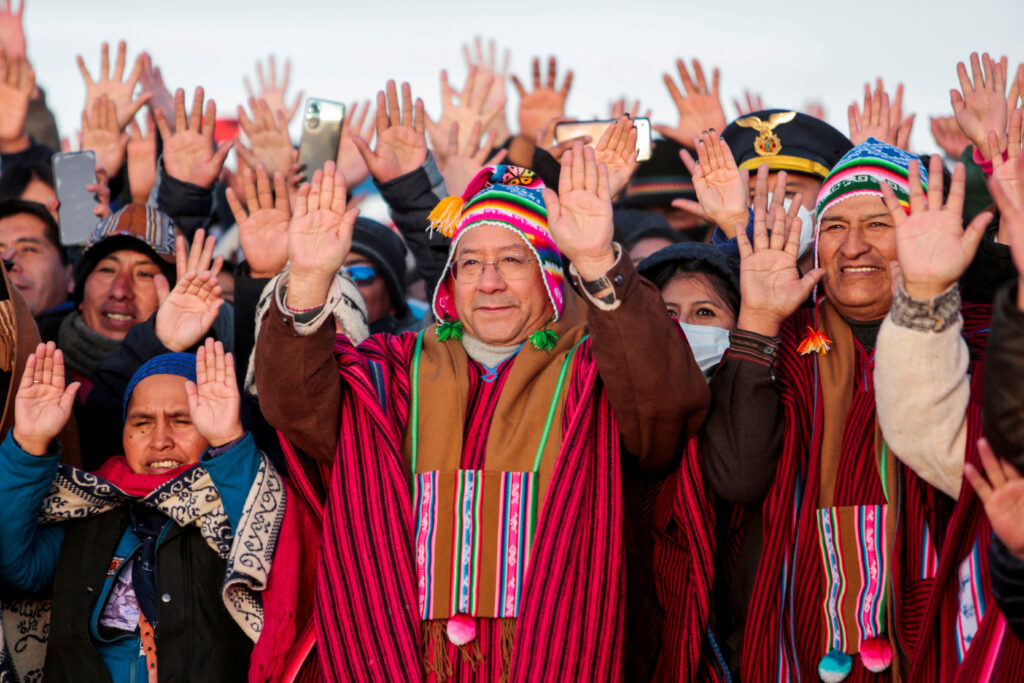
According to political communications consultant Juan Luis Gutierrez, the fragmentation of the MAS can be traced back to the un-healed wounds of the 2019 elections and the violence that followed.
Recently, the Arce government has been unable to govern in Bolivia’s legislature due to a lack of support. Instead, they have been governing through the judiciary.
Gutierrez argues that it is a political mistake for the MAS to break with its past and not involve anyone from Morales’ administration, since the large margin by which it won the 2020 elections comes in part from the union structures that recognize Evo Morales as their leader. For Aparicio, meanwhile, “Evo Morales’ main political mistake is believing that everyone still has to pay him loyalty.”
On May 17, the official candidacies of all parties will be presented. Subieta warns that considering the political panorama and Morales’ historical approach to unfavorable judicial or electoral decisions, there is a high probability of protests and civil unrest as a pressure tactic against the electoral authorities. Gutierrez agrees. “The moment he is not a candidate, he will invoke all [his followers’] social discontent,” he said.
How have the statutory rape allegations hit Evo?
According to Gutierrez, Morales represents Bolivia’s misunderstood, marginalized classes. Today, his figure has become uncomfortable even for progressives. “Little by little, left-wing intellectuals have begun to lose support for Evo,” he said.
Aparicio explains that Morales’ image deteriorated significantly after the statutory rape allegations, especially among left-wing urban voters. “You have to understand that the second most committed crime in Bolivia is rape and it is very normalized, especially outside the city,” she said. “Many feminists who previously supported Evo Morales took a step back because of this.”
Among voters and former allies alike, there is a growing perception that Morales’s cycle has ended, according to Aparicio. Uruguayan former leader José “Pepe” Mujica, an ally during the pair’s respective presidencies, said in a November interview: “There’s a time in life to come and another time to go […] What Evo is doing is unbelievable.”
However, with five months to go until the elections, the political playing field remains wide open. With many candidacies still to be announced, all bets are off on what comes next.
