
 Martina Jaureguy
 Updated at 4 p.m.
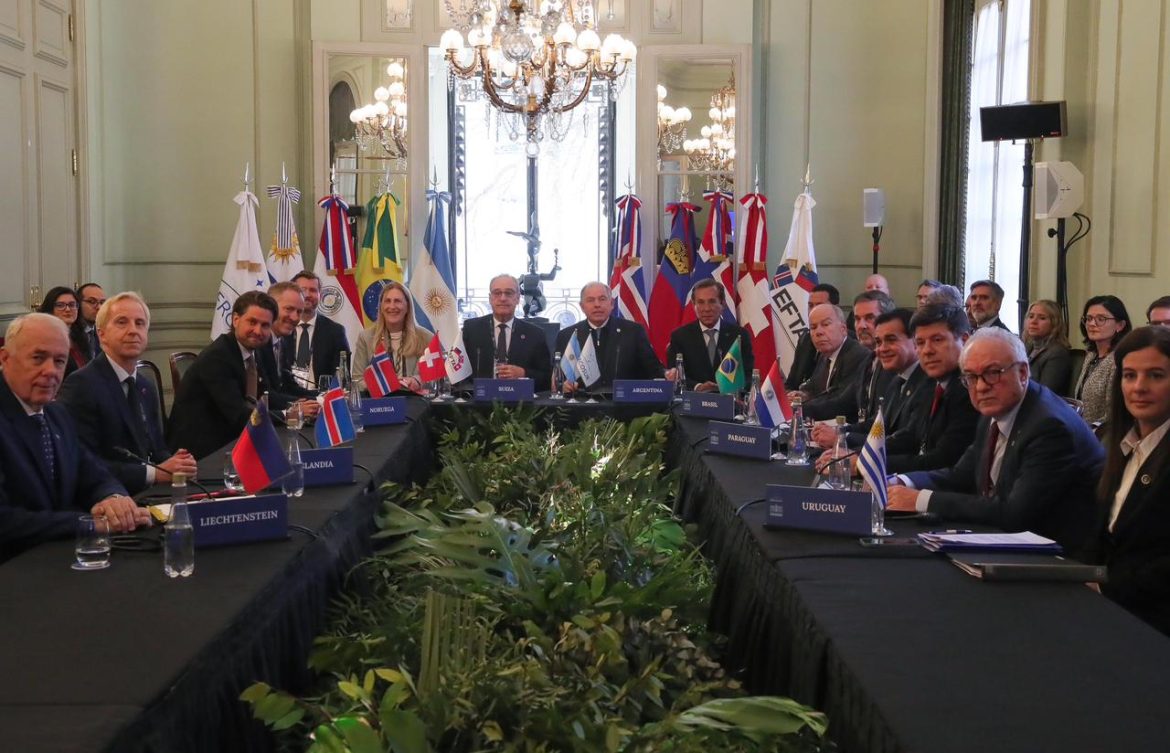
The Mercosur and the European Free Trade Association (EFTA, made up of Iceland, Liechtenstein, Norway, and Switzerland) announced on Wednesday that they had successfully completed negotiations over a free trade agreement. The news was announced by Mercosur foreign ministers and EFTA representatives following a meeting held in Buenos Aires during the South American bloc’s summit.
In a joint press conference the Herald attended, Swiss Vice President Guy Parmelin described the deal as a “major milestone” in the relations between the blocs and “one of the world’s largest free trade tools.” He also said it is “fair and balanced.”
“Mercosur countries receive preferential access to EFTA’s high-income markets of over 14 million consumers, including duty-free access for all industrial products and tariff preferences, quotas, or even full liberalization for key export products such as beef, coffee, or red wine,” Parmelin added.
It’s still unclear when the deal will take effect, given that it needs parliamentary approval from each of the signing countries. However, Swiss Secretary of Economic Affairs Helene Budliger Artieda said in the press conference that the deal is “a complete priority for the EFTA countries.” The Norwegian delegation later told the Herald that the process will likely be done in the first semester of 2026.
The Mercosur-EFTA FTA
According to a joint communiqué, the Mercosur-EFTA Free Trade Agreement will create a free-trade zone of almost 300 million people and a combined GDP of more than US$4.3 billion. Both sides, it said, will benefit from improved market access for more than 97% of their exports and increased bilateral trade for businesses and individuals.
The agreement went on to say that the agreement will grant “improved market access,” as well as greater predictability and legal certainty in trade between member countries.
The deal will include trade in goods and services, as well as directives concerning issues such as investments, intellectual property rights, government procurement, and sustainable development, among others.
In response to a question posed by the Herald regarding potential productive sectors to be impacted within Mercosur members and, particularly, Argentina, Budliger Artieda said that EFTA “already is a considerable investor in the private sector of the four [Mercosur] countries.”
“EFTA countries are the third largest investor in Brazil and fifth in Argentina. Without a doubt, this agreement will boost interest,” the Swiss representative said. “We have noticed that, within our private sector, trade and investment go hand-in-hand. We have fought so hard to reach this agreement because there definitely is an interest from EFTA businesses, in particular from Switzerland, not only in Argentina but in the entire region.”
Norway and Argentina’s Vaca Muerta
In an interview with the Herald outside the San Martín Palace, Norwegian State Secretary for Trade and Industry Vegard Grøslie Wennesland said that the Mercosur-EFTA FTA will “remove trade barriers” between countries and that, once confirmed, it will make it easier for bloc members to “cooperate and invest.”
“We have a lot of Norwegian companies who are experts and world-leading [actors] in the energy sector — oil and gas, LNG — and I see huge opportunities for more cooperation as part of this agreement,” he added, referencing Argentina’s oil and gas field Vaca Muerta, the largest in the region and one of the most important in the world.
Between late 2024 and early 2025, Argentine companies Pampa Energía and YPF joined Norwegian company Golar LNG and Argentina’s Pan American Energy LNG project Southern Energy in Río Negro province, in Patagonia. British Harbour Energy is also part of the project.
YPF’s judicial situation saw a new turning point this week after New York Judge Loretta Preska ordered Argentina to hand over 51% of company shares to a hedge fund. The Norwegian delegation had no comment to make about if and how this could affect investments and the Southern Energy project.
Norwegian Ambassador to Argentina Halvor Sætre mentioned that the maritime and agricultural sectors are interested in developing businesses with Argentina and other Mercosur countries. Referencing specific companies, he mentioned Norwegian fertilizing company Yara.
You may also be interested in: Argentina’s Southern Energy confirms second floating LNG facility
Although the delegation said the FTA is not particularly related to the tariff war started by U.S. President Donald Trump and has been in the works for a while, they highlighted the importance of such agreements in the current situation. “We have shown now that you can reduce tariffs and have increased cooperation,” Secretary Wennesland said.
“I think that’s more important than ever in the times we are living.”
The EFTA is made up of Iceland, Liechtenstein, Norway, and Switzerland, which are not part of the European Union. Initial talks began in 2015 and formal negotiations in 2017, but things had been on standby since 2019.
The two blocs relaunched negotiations in 2024, with Argentina leading the way for Mercosur and Switzerland for EFTA.
