
 Amy Booth
 by Amy Booth and Facundo Iglesia
Ecuadorians head to the ballot box on Sunday to elect their next president in elections that will be dominated by the explosion in violence linked with organized crime that has rocked the country for the past six years. Conservative incumbent President Daniel Noboa’s main rival among a list of 15 will be Luisa González of the leftist Revolución Ciudadana party, which is led by former President Rafael Correa.
To win on Sunday, candidates need either an outright majority (50%+) of valid votes or 40% with a 10-percentage-point lead over the second-placed candidate. If neither wins in the first round, a run-off will be held on April 13.
The winner will take office on May 24 and serve until May 24, 2029.
Recent polls show a small lead for Noboa over González. All other candidates are polling in the single figures. González lost the 2023 elections with 48% to Noboa’s 52%.
Ecuador’s youngest-ever president, at 37, Noboa has been in office just a year and two months. He won the snap May 2023 elections his predecessor Guillermo Lasso had called for after invoking a constitutional clause known as two-way death, which also dissolved the national assembly.
Noboa is the son of Álvaro Noboa, a banana business giant who also ran for president several times. He studied administration in New York before entering the family business and also holds a master’s degree in political communication from George Washington University.
González, 47, is a lawyer with postgraduate degrees in management and development economics. She held a number of senior government positions during Rafael Correa’s decade-long presidency and has promised to bring back some of the social policies from his terms in office.
Correa is a polarizing mentor. Supporters view him as a progressive leader whose redistributive policies helped the poor and strengthened the healthcare system. However, he was convicted of corruption and sentenced to eight years in prison in 2020 and is currently living in exile in Belgium. Correa has claimed the case against him is politically motivated.
What is each candidate proposing?
Despite the candidates hailing from opposite ends of the political spectrum, both of their platforms focus on fighting organized crime, improving energy generation, and expanding economic opportunities. Analysts agree that neither proposal is entirely clear.
“[Noboa’s] approach in office has been pretty improvisational — he’s kind of a center-right conservative, but he’s also carried out some populist economic measures. It seems like he’s making [things] up as he goes along,” Will Freeman, a Latin American Studies fellow at the Council on Foreign Relations, told the Herald.
“With Luisa González, the only thing I can say for certain is that Correa will find a way back to the country if she wins, and he will have great political power,” he added.
Economist Alberto Acosta Espinosa, who served as head of Ecuador’s Constituent Assembly in 2007-2008, also contended that a González victory would mean that Correa would be in power. He did, however, leave potential room for alliances if González makes it to a runoff.
“Correísmo is not left-wing strictly speaking, but it could try to make a broad alliance with the left,” he added.
Acosta Espinosa, who was also part of the Correa administration in 2007, said that the elections have been greatly polarized between the two candidates, with media and financiers brushing off indigenous leader Leonidas Iza’s candidacy.
“They did not want the risk of a third candidate emerging and breaking the control of the dominant groups in the country,” he said.
A daunting task ahead
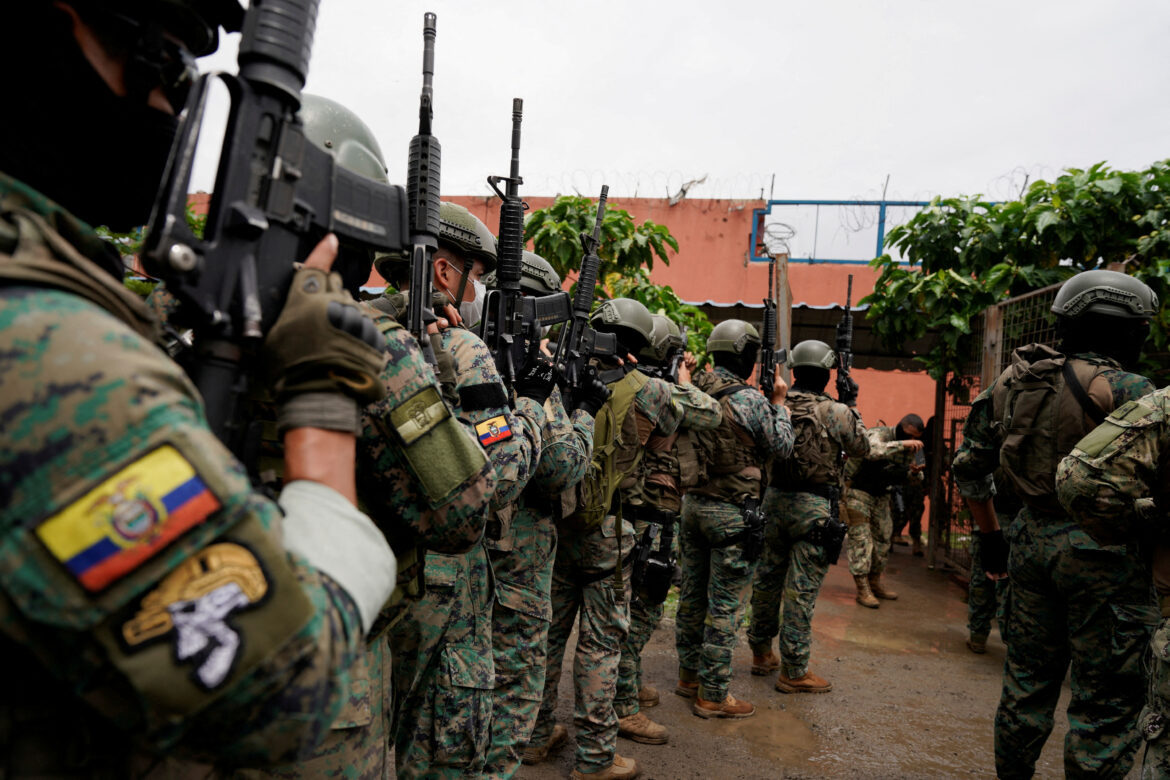
The victor will face the daunting task of tackling an explosion in violence related to organized crime and the drug trade. The homicide rate in the country skyrocketed from 6 per 100,000 in 2018 to 47 per 100,000 in 2023, the highest of any country in Central and South America, according to think tank InsightCrime.
There are many reasons for the wave of violence. According to Freeman, infighting inside criminal gangs is one of them.
“You had ‘disorganized crime’ in 2024,” he said, explaining that they are now seeing smaller and more fragmented gangs fighting each other. And because jails are better controlled and gang leaderships are more isolated, lieutenants are forced to figure out ways to make money on their own.
For Acosta Espinosa, the disappearance of many government entities in charge of combating violence was the result of policies carried out by Lasso and Noboa’s aimed at “reducing the size of the state as much as possible.” The cuts also damaged the economy altogether, making the drug business more attractive to greater parts of the population.
“We do not have a simple austerity policy, but a productive ‘austericide’ that generates a brutal increase in unemployment,” he added.
No social sector has escaped the wave of violence. During the 2023 election campaign, anti-corruption presidential candidate Fernando Villavicencio was murdered outside a campaign event. In January 2024, a live broadcast by Ecuadorean television station TC was interrupted by masked gunmen who stormed the studio and took the workers hostage. Days later, the prosecutor investigating the attack was killed.
InsightCrime projected that the rate had dropped to 38 per 100,000 in 2024.
In September, 62% of respondents to an IPSOS poll cited insecurity as their top concern. It was followed by unemployment and shortages of electrical power.
The dire situation has some calling for peculiar solutions. In January of last year, certain sectors were proposing that Noboa become “a Mikele,” meaning a mixture of Argentine President Javier Milei and Salvadoran President Nayib Bukele. “A neoliberal like Milei and an authoritarian like Bukele,” Acosta Espinosa explained.
For Freeman, in any other situation, this scenario would likely mean a landslide victory for the opposition. But polls are not showing that.
“González might win the first round if she’s lucky, but the second round will probably look like every election of the past seven years, where the anti-correistas are a pretty strong block,” he said. The sentiment is so strong that even the fact that Correa managed to significantly reduce crime when he was in office has not seemed to tilt the scale in favor of his party’s candidate.
“You have economic stagnation, horrible crime that hasn’t gotten better, and 14-hour blackouts. I mean, it’s apocalyptic — how can you lose that if you’re the opposition?” Freeman asked, adding that the situation suggests that Correísmo has some “reckoning” to do.
“If they don’t reform themselves, they will keep losing even though they are in a dream position to win.”
