
 Amy Booth
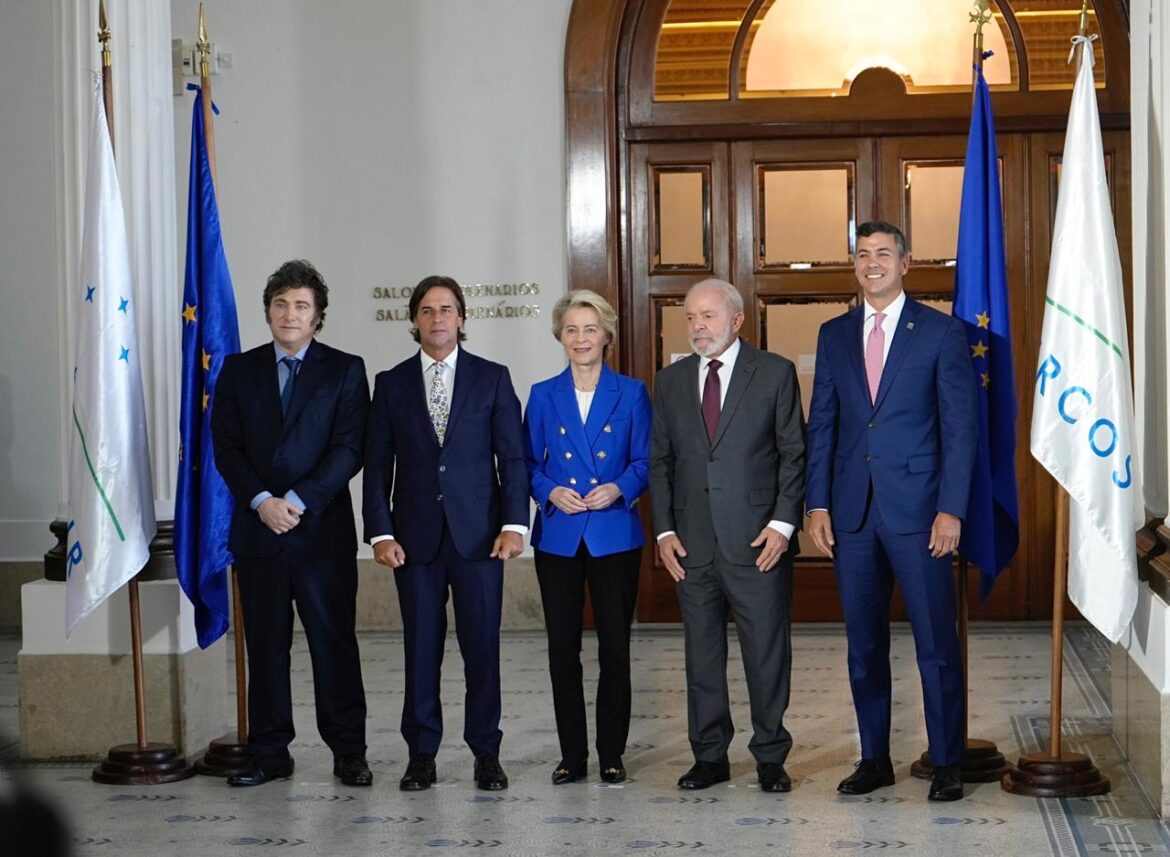
 After a quarter of a century of negotiations, Mercosur leaders and the European Commission President Ursula von der Leyen announced they had reached a trade deal on December 6.
They promised the deal, if passed, would offer broad economic benefits to the blocs’ combined population of over 700 million people. However, fierce opposition, particularly from European farmers, means it could be voted down by the European Council or Parliament, and environmental and rights watchdogs such as Greenpeace have blasted it as “harmful.”
The Herald spoke to Chris Horseman, an independent EU agriculture and trade policy specialist working with S&P, Borderlex, and other business intelligence services, about the next steps, the potential pitfalls, and what the deal means for Argentina. It has been lightly edited for length and clarity.
An initial agreement had been reached in 2019, but then progress stalled. What are the most important new aspects of the deal that was announced in 2024?
The main changes are a series of commitments made by the Mercosur countries, particularly in the area of sustainable development. That is very specifically targeted by the EU, because there’s been so much opposition to the agriculture market access provisions. Brazil and Amazon deforestation, particularly, have been under the spotlight. There was a very strong political imperative to go back to the Mercosur countries, particularly Brazil, and get commitments that would reassure European public opinion. That has apparently been done in the form of an agreement that there will be no backsliding on the deforestation agreements.
Another significant change is that upholding the Paris Agreement on climate change is now an “essential” part of the agreement. That means either party has the right to suspend the deal if one of the other parties doesn’t uphold its Paris Agreement targets. So, if any country goes rogue and decides it doesn’t want to bother controlling its emissions, then there is the power of sanction, ultimately going as far as suspending the agreement.
It’s hoped these fairly major changes will pacify European public opinion on the agreement and thereby allow it to be ratified.
Does that mean that if, for example, Bolsonarismo were to return to power in Brazil or Argentina’s Javier Milei were to pull out of the Paris Agreement like Trump did, that could put the agreement in danger?
Yes. There would be a lot of hoops to jump through before we reached that point, but that’s the thrust of the new accord. If a party does what Trump did in 2016 and leaves the Paris Agreement, then the [free trade] agreement can be suspended for that country. The same is true if it stops being a party “in good faith,” meaning it’s still there but not following the rules.
This is actually quite a strong commitment. The only other EU free trade agreements that have this clause are the agreement with New Zealand and with the United Kingdom, both of which would have absolutely no interest in undermining the Paris Agreement in any case. So it’s quite a big commitment for Mercosur’s countries to have made.
Did Brazil’s presidential transition from Bolsonaro to Lula smooth the way?
Almost certainly, yes. During Bolsonaro’s time, the whole thing was in limbo. It’s only really since Lula came back that the talks on additional protocols to the 2019 agreement picked up speed.
How long will legal revision of the deal take?
With legal scrubbing, as it’s known, you’re never quite sure what you’ll find, but normally it’s fairly procedural. It will probably take four or five months until everything has been gone over with a fine-tooth comb. In the EU, everything has to be translated into all of the EU languages.
We’re talking probably between April and June before we’ve got a text that can be presented to the various parties for signature and hopefully, eventually, approval and ratification.
European farmers are concerned the market will be flooded with cheap goods, risking their livelihoods. Can you tell us more about those concerns?
This is the biggest liberalizing agreement the EU has ever undertaken, if you exclude the deal with the UK, where there was already tariff-free trade in everything. The Mercosur countries are major exporters of a lot of products that compete with European products, which has not been the case for many of the EU’s free trade agreements until now.
Although it’s a very good deal for EU agrifood exporters, it’s also quite a challenge for the farm community because you’ve got some fairly substantial tariff rate quotas [which allow a set quantity of certain products to be imported for reduced duties]. For example, changes to beef quotas could allow Mercosur producers to consolidate their market share and export at a lower price. These issues worry European farmers.
They also maintain that production, environmental regulation, and food safety standards are not as high in Mercosur countries as in the EU. There is some truth to that, although if you export food to the EU, you have to comply with EU food safety regulations, free trade agreement or not. Really, this is just a late flourishing of good old-fashioned European protectionism.
Ultimately, there will be a battle between the European countries who see the new Mercosur agreement as being a very good deal economically, with many benefits in terms of exports and investment, and those who are really just worried about their farmers’ reaction.
Would the deal prevent Argentina from implementing policies such as export duties, irrespective of who might be in government in future?
Yes, there are binding limits on export taxes. For Uruguay, Paraguay and Brazil, they’ve been banned completely. Argentina is quite keen on export taxes, so that’s not the case for Argentina, but the extent to which export taxes can be applied has been limited. That’s quite a big deal because for products that European industries are dependent on, particularly soy, that puts a cap on the price, so it’s quite a big commitment for the Argentines to have made.
Any future Argentine government would know that if they went against this agreement, then there would be consequences. There would be various hoops to jump through, but if a party is deemed to have breached a free trade agreement, then ultimately, sanctions can be applied. Argentina would lose some of the benefits it has elsewhere in the agreement. It’s possible that a future government might choose to withdraw from the agreement completely, but the whole dynamic is to sort of pull people in and make governments commit to policies that are economically beneficial or deemed politically beneficial.
What are the main challenges to implementing this deal?
On the Mercosur side there were four governments — soon to be five, I believe, because Bolivia wants to join the pact — that have to coordinate. That’s not always a very exact science. Mercosur has been a slightly fractious band of brothers and sisters until now.
On the EU side, it’s quite simple. The agreement, once it’s been finalized, has to be signed by the European Council and approved by the European Parliament. Neither of those things are a given, since countries including France, Ireland, Austria and Poland say they’re unhappy with it. They’re under a lot of pressure from their farming lobbies to block the deal. The European countries, between them, might muster a blocking minority when it goes to a vote in the European Council.
It could also be voted down in the European Parliament. It’s a yes or no vote, and there has to be a simple majority in favor for it to pass. The biggest grouping in the European Parliament, the European People’s Party, is in favor. But a lot of the MEPs on the far left and the far right are strongly opposed. So again, the mathematics will be complex.
Given that the commission has gone to all of this trouble to renegotiate the original agreement, I think it’s more likely than not that this time, it will get signed off, but it’s not a foregone conclusion.
Do you think this deal will go through, or could it turn out that ultimately, this was just too complex and ambitious a project to push through?
That’s been the big question over the past five years. These commitments on deforestation, the Paris Agreement, and so on have now been reached. If the Mercosur agreement is not approved at the European level, then that will be… not exactly a nail in the coffin for inter-regional trade agreements but a big blow. There’ll be a lot of political pressure to get this over the line. A lot of people in industry and government are advocating very strongly to get this agreement done.
It’s possible that it’s a step too far. It could be just too complicated, too politically tricky, to get an agreement between 27 countries on one side and four or five countries on the other. If that’s the case, then where does that leave Mercosur as a trading bloc? Will countries start wanting to do individual trade deals? Uruguay made noises along those lines.
Ultimately, a lot hangs on whether it crosses the finishing line or not.
