
 Facundo Iglesia
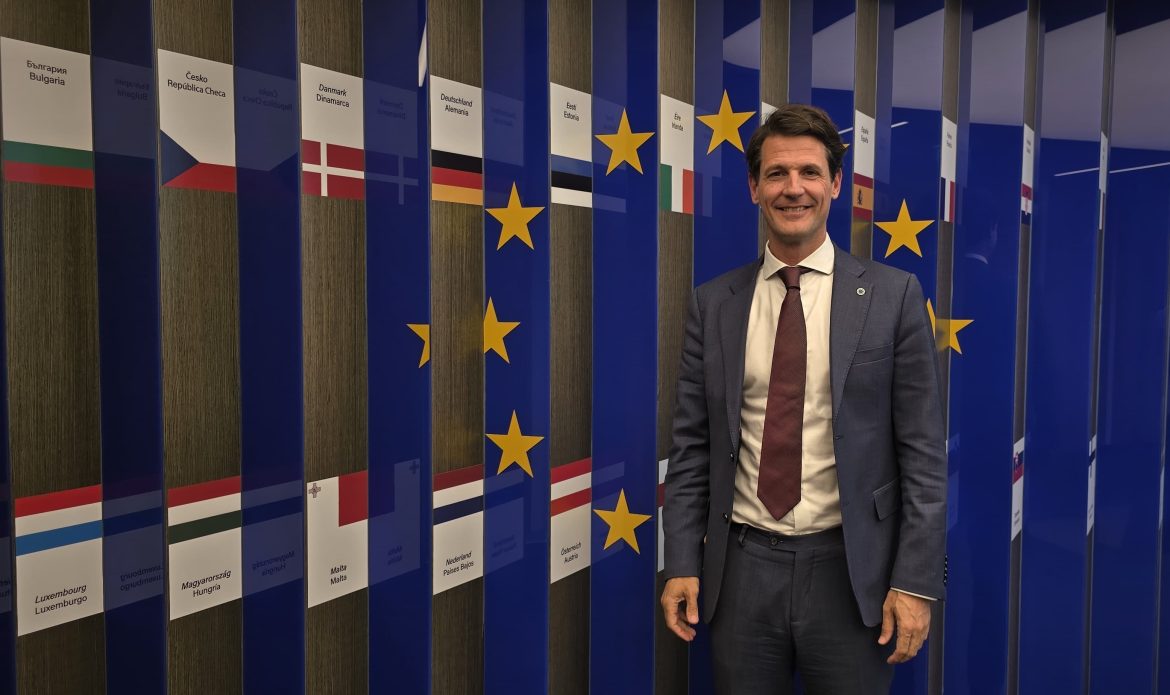
Pelayo Castro Zuzuárregui is the Americas Director at the European External Action Service and leads the relationship between the European Union and Latin America. Last week, he visited Buenos Aires, meeting with national government officials and representatives of civil society. A few hours before departing for Chile, he spoke to the Herald about his visit to Argentina, which came at a turbulent moment for world politics.
In an interview about the EU-Mercosur trade agreement, relations with President Javier Milei, United States President Donald Trump’s tariff policies, and the ongoing crisis in Europe, Castro described Argentina as a “trustworthy partner in an unpredictable world” and “a priority.”
He said his visit demonstrated the bloc’s will to build on a relationship that is “far from reaching its potential.”
It has been lightly edited for length and clarity.
What place does the recently-reached agreement between the EU and Mercosur have in the bloc’s relationship with Argentina?
We think that the agreement between Mercosur and the EU is strategic in order to reach that relationship’s potential. We diplomats over-use that word, but if there’s one area I think we can call “strategic” without a shadow of a doubt, it’s this.
What challenges remain when it comes to the agreement entering into force?
The conclusion of the negotiations of an agreement that we have been seeking for 20 years was announced and finalized in December of last year. Put simply, what comes next is the approval of the agreement that has been negotiated. And that is the decision that our member states will make in a referral process that is by qualified majority.
It’s not up to me, because I’m not the one making the decision, but I believe — having participated in that negotiation for years — that this agreement is even more important than when we started negotiating it. In the turbulent world we live in, the EU and Mercosur would send a very powerful message to the international community: that at this moment of distrust, barriers, tariffs, and protectionism, we are creating the largest free trade area, with economic and investment ties, in the world, comprising between 700 and 800 million people.
That’s why I’m hopeful and confident that this agreement will come to a successful conclusion. Because in a world of giants, Mercosur and the European Union can strengthen one another.
When would it be voted on?
I think we aspire for the signing of the agreement to be at the end of this year.
You mentioned Trump’s tariffs. How is the EU negotiating those? What do you mean by a risk factor in a turbulent world?
The European Union does not want a trade war — quite the opposite. The European Union is open for business. What we want is to strengthen our economic, trade, and investment relations with our partners around the world because we are an open economy.
I believe the European Union has been firm and consistent in stating: “we do not want tariffs.” They are a tax on our citizens and our businesses, they compromise value chains, and they reduce consumer choice, jobs, and opportunities for our people.
Because we are aware of this, we are doing everything possible to seek a negotiated solution, without giving up, with all the necessary firmness, on defending our interests. And that, I believe, is the message with which we approach the United States, which for us is a fundamental partner on all levels, including economic, trade, and political.
It’s the 75th anniversary of the Schuman Declaration, which laid the groundwork for the European Union. What are your main challenges, thinking in terms of the emergence of so-called illiberal states, the far right, and anti-European positions?
The doomsayers have been predicting the end of the EU for years, if not decades, and they have been wrong every time. You’ll remember: the economic crisis, the euro crisis, Brexit, the pandemic. And at every moment, many voices — often from supposedly well-informed platforms — have claimed that the EU was falling apart. What has happened has been exactly the opposite, because as our founding fathers used to say, the EU is built through crises. The present moment is no exception.
What does that crisis consist of?
I believe we are in a moment of international transition. For Europe, the first shock of this crisis — which I think is defining — is Russia’s aggression against Ukraine and the way that has made the EU aware of its vulnerabilities and dependencies, including energy. Therefore, it is also aware of the need to become stronger, to diversify its relationships, and to take responsibility for its own security.
There is a whole series of major transitions: technological change, climate change, the emergence of economic security as a major issue — from the pandemic to what has happened with global supply chains. All of this is also leading us toward a more multipolar world, but a less multilateral one. And that is a challenge for the EU, because we have a deeply multilateralist vocation.
President Javier Milei has shown strong support for U.S. President Donald Trump. Has the relationship between Argentina and the EU changed with the rise of Milei and his connections to these “prophets of doom,” as you called them?
Diplomatic relations are always evolving. Fortunately, the EU and Argentina are democratic, open societies — we have elections, we can be thankful that our governments change, and that is something that strengthens us. We need to have some perspective and look at the breadth and depth of this relationship.
Of course, Argentina is sovereign in establishing its relations and may have a — if you want to call it — privileged relationship with the U.S. But from my point of view, humbly, that is no obstacle to also having a deep, constructive relationship with the EU across a broad range of issues.
What does that relationship consist of?
The EU is Argentina’s third-largest trading partner and, in terms of our overall investment portfolio, we are the largest investor in Argentina. We have over 800 companies in Argentina, some of which have been here for more than a century. They generate more than 215,000 direct jobs (not to mention the indirect ones) and operate across a very wide range of economic sectors, many of them with high added economic value.
The good news, and I believe this is encouraged by the government’s economic reforms, is that we are seeing even greater interest from European companies in doing business in the country, in investing, and in making long-term commitments. I believe we’re beginning to see that economic movement.
Which sectors are under consideration for the most investments?
Energy, auto, mining, and green hydrogen. Highly strategic sectors for the country’s economy.
And what about defense and security?
Public security and the fight against organized crime are topics I have discussed more extensively with the Minister of Security and her team. And we are also working on an agreement with Europol.
Latin America is often presented in geopolitical terms as the scene of the dispute between the U.S. and China, and the EU is not mentioned. What’s your response to that analysis?
Respectfully, I would say that I do not agree with that view of reality. And I refer to the facts, because they are very stubborn: if I walk around this city and see the products, the references, the television, the art and culture, what I see is an impressive connection between Argentina and Europe.
It is not for me to judge the relationship with China or the United States, but one would have to compare the accumulated investment of the European Union and its diversity in the Argentine economy with that of other partners. I believe that sometimes people get caught up in headlines, but reality tells a different story.
