
 Buenos Aires Herald
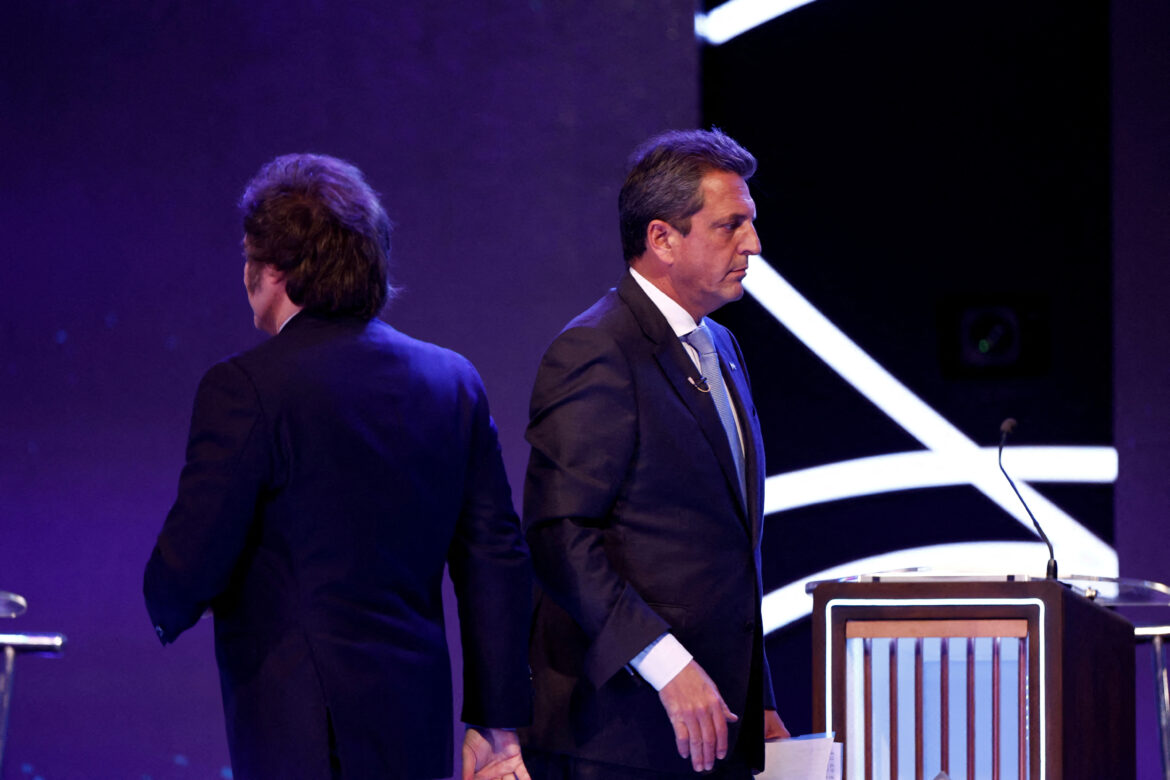
Presidential candidates Sergio Massa (Unión por la Patria, UxP) and Javier Milei (La Libertad Avanza, LLA) will meet Sunday for their only one-on-one debate before the November 19 run-off. The event will take place at the University of Buenos Aires Law School and is scheduled to start at 9 p.m. All major television networks are expected to broadcast it.
Massa and Milei will discuss their proposals and ideas across six different topics chosen by the National Electoral Chamber (CNE, by its Spanish acronym): economy; foreign relations; education and healthcare; production and labor; security and human rights; and democratic coexistence. The debate is organized by the CNE and participation is legally required.
The debate is designed to provide a neutral environment for both participants to receive equal exposure. Given that their are only two candidates now, their will be a change in format from the two presidential debates carried out before the October 22 election.
Both candidates will be given a minute to make their initial presentation. The first three topics will be debated in the initial segment, and the final three in the second. Each candidate will have six minutes to speak about each subject. They can use their time however they wish, but are not alowwed to speak for more than two minutes at a time. Debate moderators will intervene if either of them go over this limit. If a candidate does not use his allocated six minutes on any given subject, he loses that time, meaning he cannot add it to another topic.
They will also be allowed to interrupt each other and ask questions freely, as well as move around the stage. This is a major difference from the two first debates, when each of the 5 candidates was restricted to their lectern.
Once the second segment is over, each candidate will have two minutes for their final presentation, which will be a response to the question “Why do you want to be president?”
A panel of four journalists will moderate the event, working to keep the conversation civil and ensure the debate’s rules are followed.
The debate will be broadcast on radio and on public television with a sign language interpreter. Not all television networks will show the event, but they are permitted to do so without paying a licensing fee.
