
 Jacob Sugarman
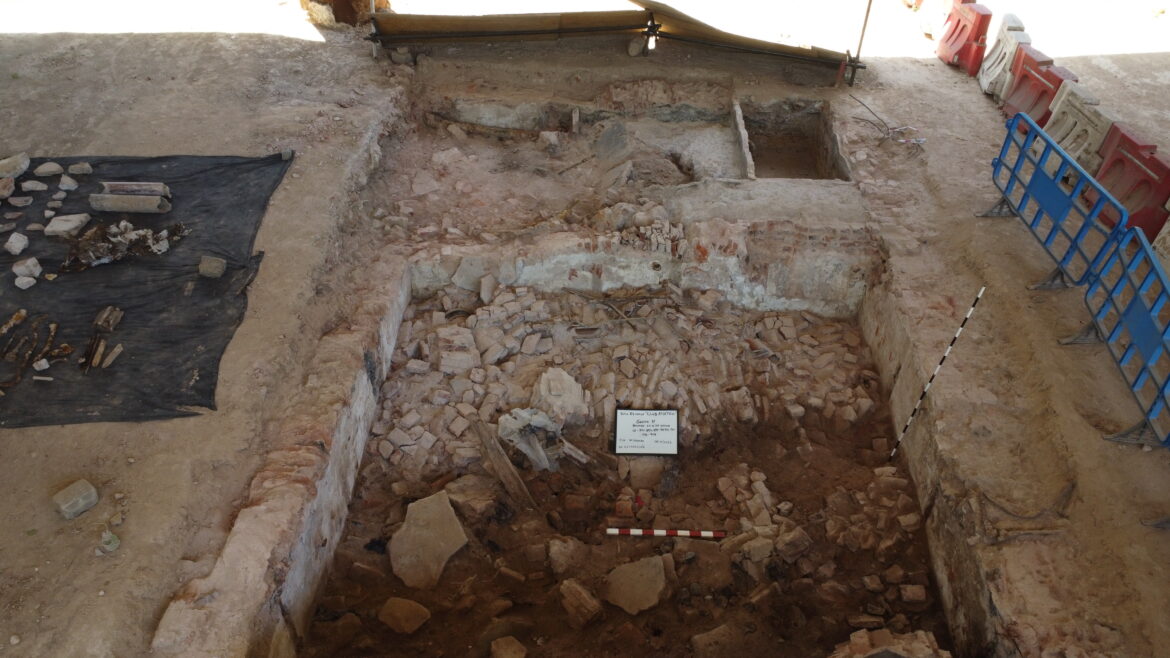
Adjacent to Avenida Paseo Colón in San Telmo, beneath the roaring 25 de Mayo highway that bifurcates downtown Buenos Aires, lies a concentration camp, or the remains of one.
For the past two decades, a dozen or so workers for the Ministry of Justice and Human Rights have toiled, often with scarce funding, to excavate a three-story police station whose basement served as one of more than 800 clandestine detention centers during Argentina’s civic-military dictatorship from 1976 to 1983.
Today, the area known as Club Atlético serves as a memorial site for the estimated 1500 victims who were held and tortured on its premises. Just over 500 of the victims have been identified, while 300 of those are believed to have been executed on the infamous “vuelos de la muerte” (“death flights”) — a system of extermination in which Argentine security forces drugged their prisoners and tossed their unconscious bodies from a plane, either into the Rio de la Plata or the Atlantic Ocean.
Since President Javier Milei issued an executive order in December terminating the contracts of workers who had been in the state’s employ for less than a year, the excavation has largely been put on pause. Now, a new round of budget cuts threatens not just the future of Club Atlético but decades of painstaking forensic work, with the open-air site exposed to the elements.

“This government despises us,” the archaeologist Laura Duguine told the Herald. “It’s evident in its level of abuse, mistreatment, and dehumanization. They didn’t even provide an explanation for their decision.”
Duguine, who specializes in modern archaeology, has led the excavation since 2009. On June 30, she and five other members of her team learned that the government would not be renewing their contracts — casualties of a “chainsaw” austerity plan that has already affected tens of thousands of state workers.
“It’s incredibly painful,” she continued. “The entire archaeological division has been dismantled. There were only a few of us at different sites across the country to begin with, so these losses are immeasurable.”
Marcos Ledesma, a spokesman for the ministry, told the Herald that the layoffs were part of a government-wide reduction in staffing and that the courts will determine their legitimacy. He also added that everything at Club Atlético “continues to work perfectly.”
Torture, rape and ping pong
According to the National Directorate of Sites and Spaces of Memory, Club Atlético’s building originally served as a depot to outfit police officers with uniforms and footwear. Little remains of the officers’ shirts and pants, but its leather shoes are largely intact, piled on a plastic tarp beneath the concrete overpass.
For much of 1977, the station also doubled as a torture center for the junta and its collaborators. There, kidnapped prisoners were blindfolded, stripped of their clothes and ushered down a staircase into an unventilated prison. Each inmate was assigned a letter and number.
The station contained 41 cells and a larger pen known as “la leonera” (“the lion’s den”), along with three “operating rooms” where inmates were tortured. All together, they could hold upwards of 200 people at a time.
In addition to several bathrooms and an infirmary, whose principal function was to keep inmates alive for further interrogation, the prison contained a rec room where the guards would play ping pong.
Club Atletico’s inmates were routinely subjected to mock executions and beatings with sticks and chains while the camp was in operation. Each month, it admitted scores of new prisoners as the inmates they replaced were either killed and disappeared or transported to other detention centers. In 1979, two years after its closure, the depot was destroyed to make way for a new highway system.
You may also be interested in: River Plate wants to build there. Dictatorship survivors say it’s a burial ground
Daniel Mercogliano was working for a perfume laboratory in April of 1977 when he was kidnapped from his parents’ home in Ramos Mejía, in Buenos Aires Province. Security forces held him for 79 days, of which he spent 36 at Club Atlético. Now 72, with a pair of white mutton chops reminiscent of the late Wilford Brimley, he can still vividly describe the abuse that he witnessed and endured at the hands of his captors.
“They did to me what they did to everybody,” Mercogliano told the Herald. “The brutality started as soon as we entered Atlético. The men suffered, but the women had it even worse. The Jewish men and women didn’t have a moment’s peace. They were constantly harassed. One of the guards would set a dog on them, and another would make them lick his boots.”
Sexual violence was pervasive at the detention center. In one uniquely harrowing episode, Mercogliano recalled how a prison guard raped one of his female prisoners. Then, when the officer running Club Atlético ordered him to stop, the guard forced the woman’s female cellmate to remove her dress and underwear and perform oral sex on her while he watched the two through a peephole.
“They saw us as less than things,” he said.
For the first six months after his release, Mercogliano wrapped his entire body in towels when he exited the shower to hide the assortment of wounds that decorated his body. He told his family what had happened and did not speak of the experience again for 38 years.
In 2014, believing that the junta’s victims had the full support of the Cristina Fernández de Kirchner administration, he finally decided to share his story, testifying before a federal criminal tribunal. That year, he joined the Comisión de Trabajo y Consenso (Work and Consensus Commission), a civic organization that aims to raise awareness about the crimes committed at Club Atlético.
“As my colleagues tell me, now I won’t shut up,” he added.
History as a puzzle on the wall
Past a wall displaying the black-and-white photographs of the disappeared, a set of metal bleachers that frame a memorial silhouette, and the inverted ziggurat of Club Atlético’s ongoing excavation stands a concrete totem with a sculpted iron facade. The piece, designed by local artists, depicts dozens of human figures scrambling over each other as they reach for the sky.
On July 7, 1996, one day after the site’s inaugural Jornada por la Memoria (Memory Day), the site’s original mural was burnt to the ground, its repressors’ names covered. A second mural was destroyed the following year, and a final structure was constructed out of sheet metal not long after.
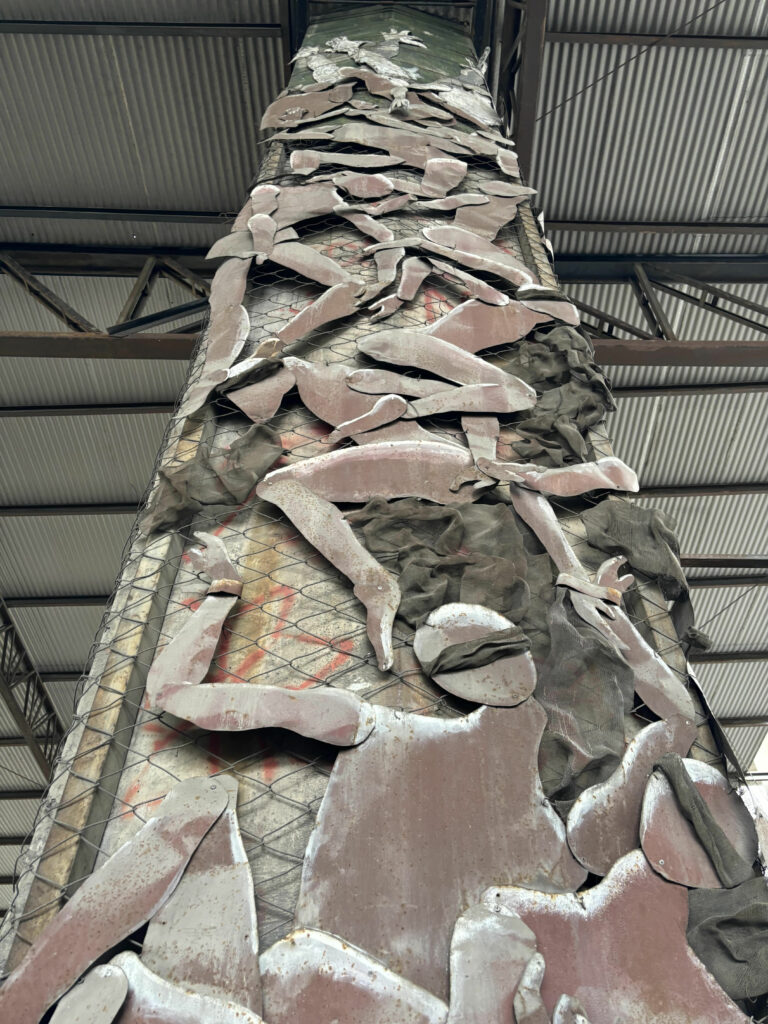
Just above the façade’s rusting limbs extends an aluminum roof that’s roughly the size of an Olympic swimming pool. Erected in advance of the first dig in 2002, the roof shields the excavation from rain and highway runoff, while a complex web of piping redirects these waters away from the site.
“It’s had some maintenance problems and a few leaks here and there, but the roof has allowed us to preserve the dig to this day,” said Valeria Contissa, one of the Club Atlético workers whose contract lapsed at the end of June. “We had a plan to repair and expand its drainage system. We just never had the budget.”
In recent months, the site has suffered a series of floods that Duguine contends would have proved devastating were there not a team in place to divert them. And because Club Atlético is situated so close to the Rio de la Plata, she believes this danger is only likely to persist.
“It wasn’t like we were swimming in resources before,” she said. “But without minimal staffing, there’s simply no way to maintain the integrity of the site. If we lose Club Atlético, we lose our very heritage. Much of history and memory are like a puzzle on the wall. We’re still unearthing pieces that allow us to identify victims and reconstruct what happened.”
These puzzle pieces come in different shapes and sizes, from police paperwork to furniture fragments and the torture rooms themselves, but each serves to corroborate witness testimony and further investigation into the junta’s crimes. Recovered objects have included a baby’s diaper, a chain segment, and a section of wall with the words “AYUDAME SEÑOR” (“HELP ME GOD”) scratched into its base.
You may also be interested in: Argentina’s largest mass grave is still revealing the dictatorship’s secrets
During one of the site’s first digs in 2002, the archaeological team uncovered a white plastic ball at the bottom of the building’s elevator shaft — a discovery that helped confirm for Mercogliano precisely where he was detained.
“I could provide a physical description, more or less, but there was only one concentration camp where victims testified to guards playing ping pong,” he said. In 2005, the city of Buenos Aires declared Club Atlético a Historical Site.
Another victim who has directly benefited from these excavations is Iñaki Eggers.
Eggers, 66, was a political exile in Venezuela in May of 1977 when he learned that his brother and sister-in-law had been kidnapped. He and his family had searched for them for decades, but it wasn’t until the Argentine Forensic Anthropology Team (EAAF, by its Spanish initials) uncovered a document indicating they’d been taken to Club Atlético that they learned where their loved ones had been held, likely before a death flight. Today, Eggers is a member of several human rights organizations including the Comisión de Trabajo y Consenso, where he works alongside Mercogliano and other Club Atlético victims.
The former student militant was saddened but unsurprised by the news of the most recent layoffs.
“We’ve been fighting for the site’s renovation for more than 20 years,” he told the Herald. “We know these jobs are very precarious, and that has always caused a great amount of stress.”
“The firings have generated a lot of frustration. The government can’t even call these people ‘ñoquis del estado’ (a derogatory term referring to state employees who collect a government paycheck without actually working). These are highly qualified professionals with families, who are carefully reconstructing what a country needs most: its memory. How else will it know where it came from and where it’s going?”
“Without workers, there is no memory”
Each Thursday at 3:30 p.m., the Mothers of Plaza de Mayo walk around the plaza’s central pyramid as they did during the dictatorship to demand the whereabouts of their missing children. On July 4, hundreds joined them in this civic ritual to protest the government’s latest round of layoffs at various memorial sites, as well as the recently-passed Ley Bases — a sweeping reform package that curtails labor rights, privatizes numerous public companies, and grants the president emergency legislative powers for a period of one year.
Several demonstrators waved laminated photographs of the human rights activist Nora Cortiñas, who had passed away five weeks earlier.
Among those in attendance was Daniel Mercogliano, who carried with him a fraying piece of paper in the breast pocket of his jacket. The document, which contained an Argentine military stamp and the signature of Colonel Reinaldo Martín Alturria, stated that Mercogliano was detained on April 20, 1977, for suspected “subversive activities” and released due to a lack of “sufficient evidence gathered against him to prolong his detention.”
“I always keep a copy on me,” he told the Herald. “No one can believe that they kidnapped me, beat me senseless, starved me, robbed me, and then gave me a certificate recognizing that I was held prisoner.”

Standing in front of the pyramid in Plaza de Mayo, Mercogliano admitted that he was “terrified” that Argentina had elected a president who has openly questioned whether the junta killed and disappeared an estimated 30,000 people, dismantled government projects designed to preserve their memory, and temporarily suspended reparations to the victims’ families. On July 11, six officials from the ruling La Libertad Avanza coalition visited a group of convicted repressors at Ezeiza federal prison as part of a “humanitarian visit” — a move that has since drawn the condemnation of local human rights organizations.
“I don’t have much to lose at my age,” he said. “But I worry that what happened to me could happen to my children. We’re seeing how easily the country’s institutions can be destroyed. There has to be a state to protect us. We can’t just defend ourselves.”
As the afternoon gave way to evening, the crowd gathered in front of a stage across the street from El Cabildo while a recording of the Argentine rock band Patricio Rey y sus Redonditos de Ricota blared from a set of concert speakers.
After a few minutes, human rights workers and opposition politicians, including Frente de Izquierda’s Myriam Bregman and Estela de Carlotto of the Grandmothers of Plaza de Mayo, issued their pleas for solidarity against a backdrop of public workers bearing oversized headscarves. Each read “Sin trabajadorxs, no hay memoria” (“Without workers, there is no memory.”)
One of the workers on stage was Laura Duguine, who previously denounced the firings before the Buenos Aires City legislature on July 1. Despite these public shows of support, however, Duguine acknowledged that the public policy surrounding sites of memory and justice remains uncertain.
“We are part of a decades-long struggle,” she said. “The Mothers and Grandmothers of Plaza de Mayo have taught us to fight with joy, to fight with love. We are demanding our reinstatement with that spirit — the spirit of democracy.”
Credit cover photo: Sitio de Memoria ex Centro Clandestino de Detención Tortura y Exterminio (CCDTyE) “Club Atlético”
