

 Buenos Aires Herald
Argentina went through a rollercoaster on Friday night after President Javier Milei made posts on social media advertising a cryptocurrency known as $Libra. The bizarre episode initially sparked amusement as it seemed his accounts on X and Instagram had been hacked, but the sentiment turned to bewilderment as the hours passed and no government official came out to explain whether Milei was indeed behind the move or not.
“Liberal Argentina continues to grow!!! The goal of this private project is to assist in the development of the Argentina economy, financing small companies and local ventures. The world wants to invest in Argentina,” read the post, which was published around 7 p.m. local time.
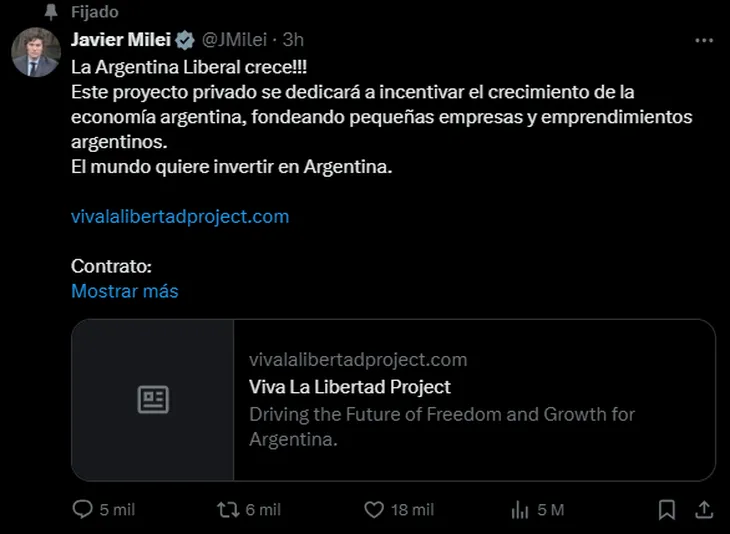
The incident was shocking not only because it is illegal for elected officials to advertise private ventures but also because the project seemed to be a fraud. Within minutes of Milei’s post, the price of a $Libra token soared to US$4,97 dollars, with market capitalization reaching US$4.5 billion a few hours later. The initial surge, however, was short-lived, as digital wallets linked to the token began to cash out, causing its value to plummet to US$0.99.
The official silence ended around 1 a.m. when the president himself took to X to reverse his position, effectively confirming that he had indeed backed the token while offering a peculiar explanation for his endorsement. He claimed that he “did not know the details” of the project he was advertising but that, once he did, he decided to withdraw his support. He went on to add that he had “no ties” to the project itself and directed his ire at the opposition.
“To all the dirty rats of the political caste who want to take advantage of this situation to hurt us, all I want to say is that it just confirms how despicable politicians are.”
Clear signs of fraud
Unlike Bitcoin or Ethereum, which operate on a decentralized network and have robust security measures, $Libra is not a traditional cryptocurrency but rather a token created on a blockchain platform called Solana, with no guarantees of real value or stability.
Experts initially believed that Solana, which was launched in 2020, could become a competitor for more established cryptos. However, the fact that there is no clear information regarding the platform’s creators or its actual purpose has raised the possibility that $Libra may simply be a scheme to manipulate cryptocurrency prices.
In a post on X, cyber security expert Pablo Sabattella said that “all indicators pointed to a scam” and listed the most telling.
“The domain is registered in a very basic registrar [meaning the company that manages the domain]. Also, the contact email is a Google account, which is linked to a phone number in the U.S.,” he wrote. He added that it could be legitimate, but that it all looked “very clumsy.”
Sources from cryptocurrency platforms contacted by Herald sister publication Ámbito, who wished to remain anonymous, also said that the project seemed fraudulent. In addition to the email and phone setup, they pointed to the concentration of tokens as a clear factor that raises suspicion.
“Three digital wallets have 80% of the tokens, which means they go up and down very quickly. It has all the signs of what is called a rug pull. In other words, a scam,” the source explained.
A rug pull is a cryptocurrency investment scam in which developers create a project with very attractive returns that attracts investors quickly. They all of a sudden abandon the venture, taking the funds with them and leaving users with tokens that have no value.
The political opposition took aim at the president and vowed to bring forth charges against him. Socialist deputy Esteban Paulón announced that he will ask that Chief of Staff Guillermo Francos appear before the Lower House and explain the president’s actions. He later added that on Monday he will file a petition requesting that impeachment proceedings be launched.
Buenos Aires City Senator Martín Lousteau posted a reminder that this is the second time since becoming an elected official that Milei has advertised a cryptocurrency that “ends up being a scam.”
“Would he receive the penalty for recidivism that Patricia Bullrich proposes in her bill that has now been sent to the Senate?” he wrote in a post on X. He went on to say that he will request an audit in order to find out who “made a profit at the expense of all Argentines who believed in the president’s post.”
With information from Ámbito
