
 Buenos Aires Herald
The Argentine government will conduct a “structural” reform of its healthcare system, including changes in the controls for approving vaccines and revising the use of fast-track authorizations for medicine. The decision comes on the heels of the country’s move to withdraw from the World Health Organization (WHO), which was announced in February.
The statement was published on Monday evening after a meeting held between Argentine health officials and U.S. Health Secretary Robert F. Kennedy Jr., who is on a two-day visit to Buenos Aires.
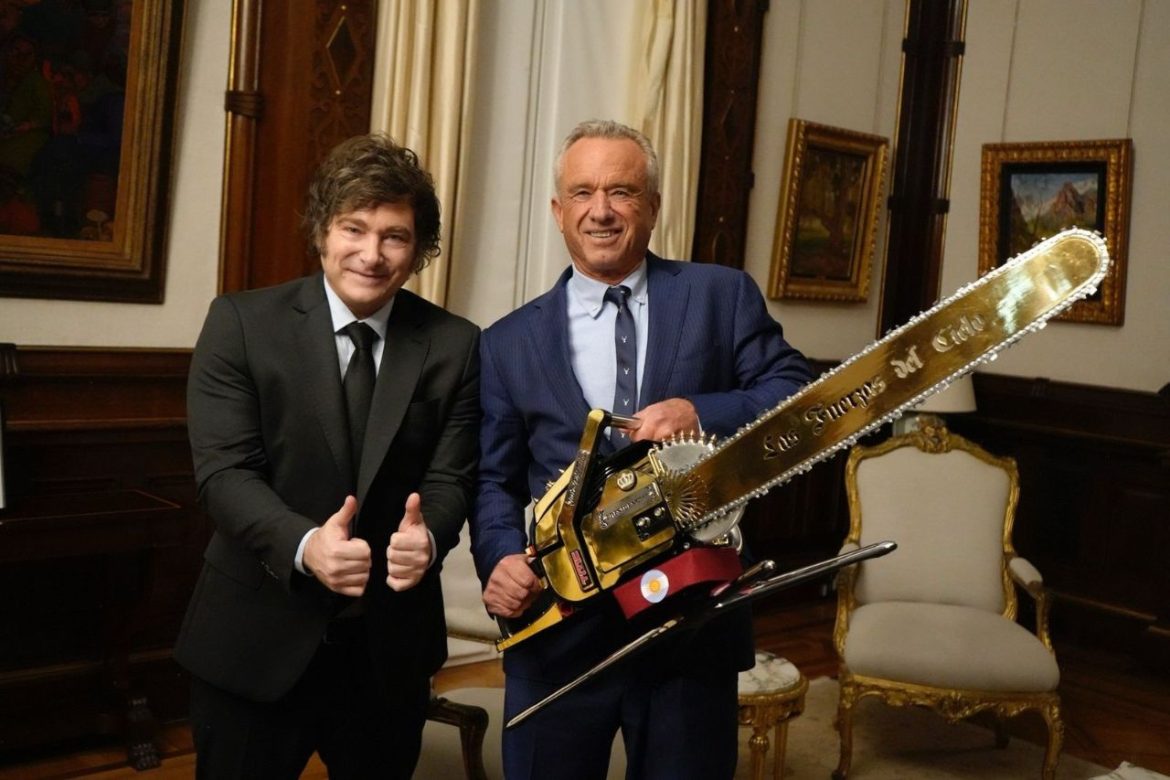
Kennedy also met President Javier Milei on Tuesday, along with U.S. chargé d’affaires in Argentina Abigail Dressel, Kennedy’s main advisor Stefanie Nicole Spear, and Health Minister Mario Lugones. Milei and Kennedy later took pictures together, posing with the custom chainsaw Milei keeps in his office and a “Don’t tread on me” cap.
The government is yet to release details about the contents of the meeting.
The health ministry released a statement on Monday saying that “evidence indicated that the WHO’s recipes do not work, because they are not based on science but rather on political interests and bureaucratic structures that refrain from reviewing their own mistakes.”
The Argentine government said that international organizations that are “financed by everyone” should “be held accountable” and “not turn into platforms of political imposition above the member states.”
Health reform
According to the health ministry’s statement, Argentina has decided to “move from a sanitary model centered on curing disease to one focused on healthcare based on scientific evidence.”
Processes regarding the manufacture, approval, and supervision of vaccines will be under the ministry’s revision, “with the goal of guaranteeing that sanitary decisions are based on evidence that is public, verifiable, and with effective controls.”
The government will “promote” that vaccines be “subjected to clinical studies with a placebo group as a basic standard, just like other medical products.” They added that the COVID-19 vaccine “was applied with no control group and under exceptional approval conditions.”
“Revising is not denying: it is demanding more evidence, not less.”
Science journalist Nora Bär questioned the ministry’s stance. “Ethical rules demand that when there is an effective treatment or vaccine against a disease, new [treatments or vaccines] are not compared against a placebo but rather with the best existing treatment in order not to put the patient at risk.”
Kennedy, an anti-vaccine activist, says there is a causal link between vaccines and autism, attention deficit hyperactivity disorder (ADHD), food allergies, cancer, and autoimmune diseases. During the COVID-19 pandemic, Milei also voiced his distrust of science and spread vaccine misinformation.
The government will carry out a “structural revision” of the entities that make up the healthcare system. The goal is to eliminate “overlaps, obsolete norms, and lack of supervision” in state structure and “simplify what became bureaucratic.”
Revisions and restrictions will also be applied to “synthetic additives that are potentially risky in some food products,” with the goal of “protecting the population’s health and reducing everyday exposure,” especially in children. However, it didn’t clarify which additives they are referring to or what their effects are.
The ministry questioned the use of certain ingredients used in the food industry and their “potential link to the rise of chronic diseases.” They added that Argentina is “moving forward to a safer diet and a more free citizenry.”
Argentina will revise the use of “fast-track” authorizations for high-cost medicine, “especially those destined for children and rare diseases.” The justification is that “innovation cannot justify rushed decisions without solid evidence.” The ministry said they will also discuss approval criteria prioritizing the patient’s safety “so that new treatments are not transformed into authorized improvisation.”
