

 Martina Jaureguy
 Chile is holding elections on November 16 to vote for President Gabriel Boric’s successor.
It stands to be a watershed political moment. The leftist former student leader came from behind to beat the far-right José Antonio Kast in the 2021 runoff. At 35, he was Chile’s youngest president ever. He took office with grand promises to rewrite the constitution after a 2019-2020 social uprising against inequality claimed 36 lives.
But his flagship constitutional overhaul fell through when Chileans rejected it by referendum. His approval rating has tanked to around 21% in recent polls. Kast is once again in the running, and with fears over organized crime and insecurity growing, is polling slightly ahead of Boric’s party successor, Jeannette Jara.
The president himself is out of the race due to Chile’s electoral law.
Kast and Jara are the favorites, but eight candidates are in the running. If none secures an absolute majority, the top two will go to a runoff on December 14.
The context
Compared to its neighbors, Chile has a strong economy and stable political system, but in recent years it has suffered turmoil that has shaken those foundations. Massive protests, a rising murder rate, surging organized crime and economic stagnation are issues the next president will have to face, according to Alberto Mayol, a political analyst and sociologist at the University of Santiago.
“Chile is a country that is used to institutional stability, which is currently at a critical point,” Mayol said.
The 2011 and 2019 mass protests were “like a heart attack and a stroke” for Chile’s institutional stability, he said. The two most recent plebiscites to change the Pinochet-era national constitution failed to solve the underlying issues. Meanwhile, rising interest rates and inflation only add to these issues.
The candidates
Jeannette Jara is the presidential candidate representing Unidad por Chile (Unity for Chile), the government-backed center-left coalition. A long-time member of the Communist Party, Jara served as Boric’s labor minister until April.

Jara has promised to hike the minimum wage, boost employment and adopt a more progressive tax system. However, she has moderated her discourse throughout the campaign, seemingly seeking to appeal to more conservative sectors. She has backtracked on proposals such as the nationalization of copper and lithium and the legalization of abortion. Instead, she has promised to prioritize the public sector.
Far-right José Antonio Kast will run for president a third time. While he had more radical conservative proposals, such as an absolute abortion ban, when he ran against Boric, he also seems to have slightly moderated his discourse.
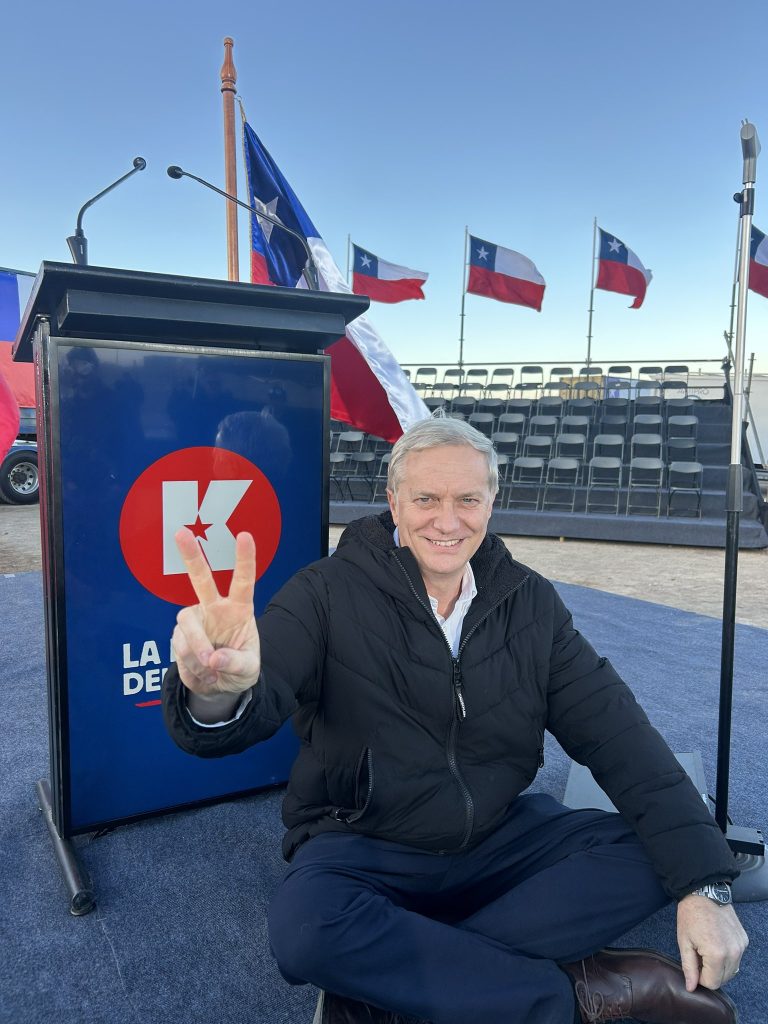
Kast’s campaign promises include implementing his “Border Shield Plan” to combat organized crime and illegal immigration, especially along its northern border with Bolivia. This includes Trump-like measures such as setting up five-meter-high walls and fences, and three-meter deep ditches, as well as deploying the armed forces. “Those who enter illegally have to leave,” he has said. He also aims to lower taxes for large and medium companies, carry out a pension reform and cut down on public expenditure.
Evelyn Matthei currently looks set to come in third. She represents the more traditional Chilean right. Matthei attempted to negotiate a coalition with Kast and far-right candidate Johannes Kaiser, leader of the local Libertarian party, but both refused.
The polls
Most polls currently put Kast marginally above Jara. A recent survey by CADEM consultancy shows a virtual tie between Kast (27%) and Jara (26%), followed by Matthei (14%). Another by Criteria shows similar results, with 28% for Kast, 27% for Jara and 15% for Matthei. A survey by agency Black & White, however, positioned Jara as the winner with 32%, leaving Kast second with 30%.
“The destiny of this election lies to the right,” Mayol said. He expects Jara to get the most votes in the first round because she’s the only leftist candidate, while the right is fragmented into “three strong candidates” whom he expects to get the second, third and fourth place.
However, the right-wing candidates between them appear to commandeer between 53% and 57% of the vote, he said. “This practically grants a win of the right in the runoff… This is a highly polarized and radicalized scenario, which tends to happen during institutional crises.”
Chile will also renew 155 deputies, while some regions will vote to renew a total of 23 senate seats. Candidates for each political front were decided in the primaries on June 29 and registered with the electoral authorities on August 18.
Boric’s farewell
President Boric cannot run for reelection this time around. In 2022, the Chilean Constitutional Convention passed a bill allowing presidents to serve up to two consecutive terms — but that provision enters into force after Boric’s term. He could run for a second, non-consecutive term in future.
This means Chile’s next president will be the first leader allowed to run for reelection since 1925, when consecutive re-election was banned. Since the return of democracy in 1990 after the Augusto Pinochet dictatorship, Chile has maintained four-year presidential terms without reelections.
According to a recent poll by the Center of Public Studies, 66% of Chileans disapprove of how Boric is running his government.
“The government destroyed their historic advantage,” Mayol said. “They had a highly convenient cultural and political ecosystem, which was very unusual. The constitutional assembly was in their favor. They could write the constitution of the future. They had overwhelming majorities. All of that was gone in exactly 10 months.”
This, according to Mayol, also ended “a 10-year cycle of left-wing values” in the social sphere that was replaced “by very rigid right-wing values.” The speed at which those changes happened, he added, is related to the political crisis Chile is undergoing. “One space was emptied, and another was filled,” he said.
“It is very shocking.”
