
 Ariel Basile
 The Supreme Court’s ruling upholding Cristina Fernández de Kirchner’s six-year prison sentence and a lifelong ban from public office shook Peronism. The opposition, who had been struggling to find a coherent response to the challenges posed by Javier Milei’s government, mobilized around a cause that had left internal issues on hold and returned a discourse — perhaps an epic one — aimed at generating the necessary conditions for political action.
Will Cristina’s imprisonment be an incentive to invent the “new songs” that a sector of Peronism is demanding? Or will it serve to recreate, through analogies that hark back to Juan Perón — the party’s old mystique — which seemed dormant?
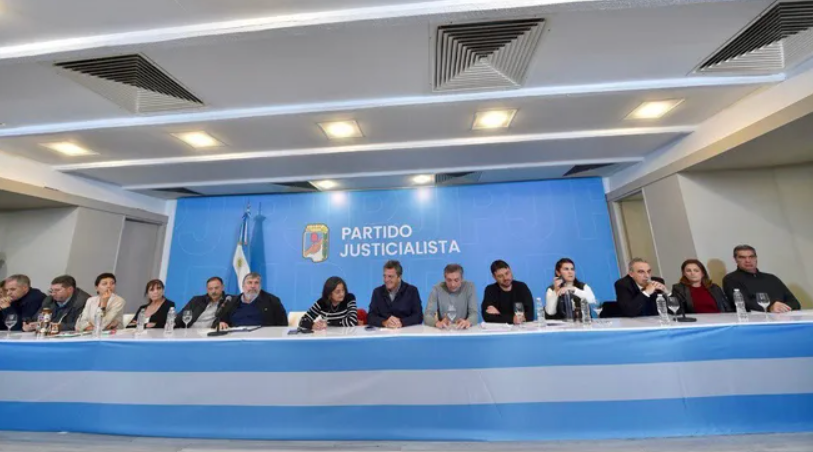
The first reaction was as expected: the party closed ranks behind Cristina. Leaders who had viewed each other with suspicion, unions, mayors, governors, allied parties, and even those who questioned Kirchnerism or who had built bridges with La Libertad Avanza, lined up. Gestures of unthinkable unity just a couple of weeks ago.
Permanent summits have a very short-term goal, like the mega-mobilization being prepared for Wednesday in Comodoro Py, and a short-term one, like the Buenos Aires elections in September and, then, the national mid-term elections in October.
“If the unions mobilize what they’re saying, it will be historic,” Peronists enthuse. Not only will the city and suburban activists arrive at the federal courts, but regional representatives from across the country have been urged to come to the fire. Therefore, rumors began to circulate that the courts would heed the request of the former president’s lawyers and that she would be granted house arrest without having to go to Retiro Park. The march will still take place; the organization will be a show of strength, with wide-angle shots from drones that will go down in history.
So far, everyone agrees.
Polarization, fantasy and reality
Even the government found a way out. Silence on the Court’s ruling, fueled also by Javier Milei’s European and Middle Eastern tour. These are two messages, one explicit and one implicit. The explicit one: LLA does not interfere in justice. The implicit one: in that case, look to Mauricio Macri.
“They know we have nothing to do with it, that this network answers to Mauricio,” people say in the increasingly less-traveled hallways of the Casa Rosada. And while one sector of the ruling party is enthusiastic about flaunting the anti-Peronist demand to see Cristina imprisoned, another is concerned about the reorganization of Peronism and the increasing difficulties in polarization — a campaign strategy that best suits the libertarians.
In this context, there are already voices recalibrating: the idea of ”Kirchnerism or freedom” that brought success to LLA in Buenos Aires city will be maintained under the idea that “Kirchnerism” does not necessarily mean Cristina Kirchner. Rather, that label will be attached to any leader who opposes Milei, including radicals.
Unions will also play a key role, especially regarding Wednesday’s mobilization. Argentina’s main workers union, the CGT, maintained a zigzagging stance toward Kirchnerism, but will contribute everything necessary to broaden the march. However, on Tuesday, after the ruling, they did not cause any commotion in the streets. “It’s not something to stand up and get arrested. Kirchnerism has never treated prisoners well,” reasoned one union leader, referring to the muted reaction to the Court’s ruling.
Unity and opposition
The realignment of the political map cannot be anticipated. The events are premature, and the consequences are uncertain. There are immediate guidelines, such as the search for a broad front against Milei, a position championed by Peronism’s 2023 presidential candidate Sergio Massa, a possible candidate in the province of Buenos Aires.
The other axis is to emphasize the opposition’s profile in Congress. Peronism’s bloc will attempt to advance projects and initiatives that bother the libertarians. This will not happen alone, but with a diverse majority, including dissident radicals, Lilitos, and leaders of the federal blocs. Concentrating this support is a central task to be able to translate the majority of seats into parliamentary victories.
Cristina’s mandate to the senators, on the same Tuesday as the sentencing, was to rebuild the ties of representation with society For Peronism, this weakness explains the rise of Milei, the anti-caste outsider who capitalized on the feeling of disdain for politics. And, likewise, the experience of the split calendar in the provinces shows that discontent with the President (who remains the most highly rated politician, according to the latest Management & Fit survey) does not translate votes to Peronism, but rather expresses itself in the form of electoral absenteeism. Reseeding this field with patience, is another unavoidable task for the opposition.
Last Wednesday, the Peronism senators welcomed the doctors from Garrahan, in a spirit of listening that will be extended to every sector affected by the chainsaw. The Senate will seek to unblock bills that have been partially approved, such as laws to increase salaries for retirees, reinstate the pension moratorium, and establish a disability emergency.
In the immediate future, Comodoro Py will be the “Normandy of Peronism.” But once the landing is over, the unknowns will re-emerge.
Orginally published in Spanish on Ámbito
