
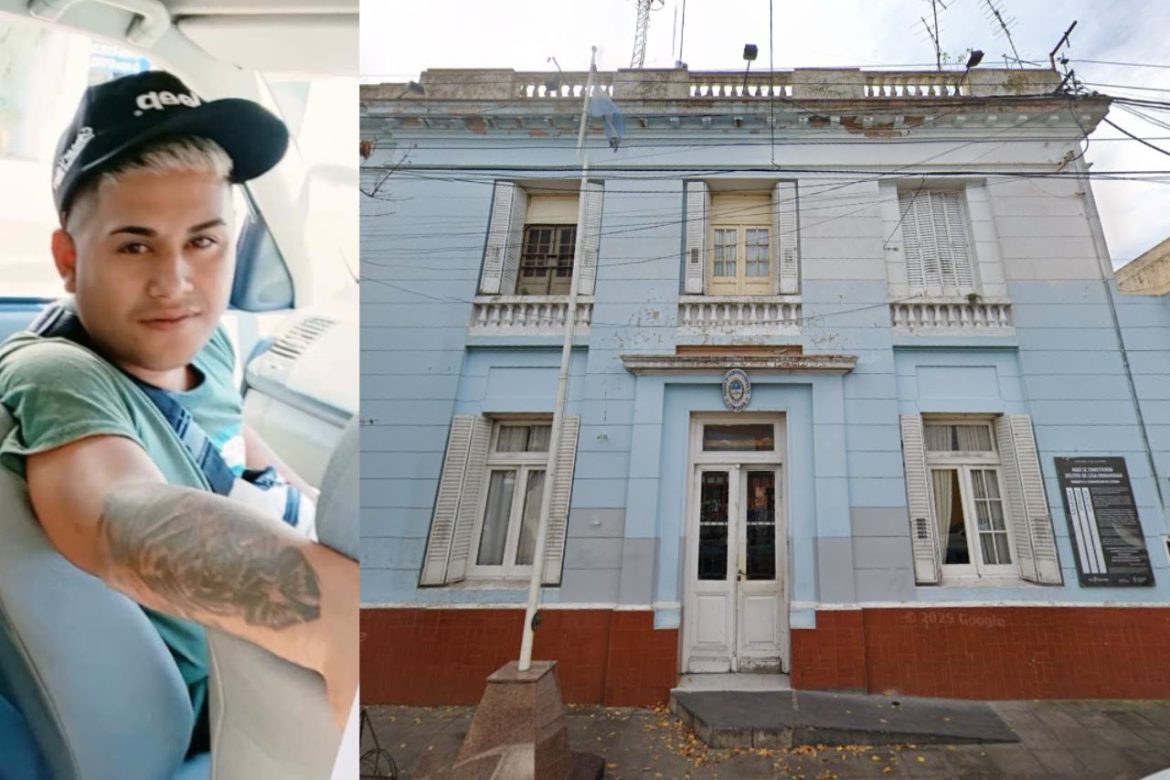
 Martina Jaureguy
 A 29-year-old man died in police custody on Wednesday morning just hours after officers were seen beating him on the streets. The authorities have launched an investigation into his death, while human rights organizations have disputed official claims that he died by suicide and called for the probe to be swift and objective.
Gonzalo Tamame was arrested in the early hours of Wednesday in the Buenos Aires province city of Olavarría, 350 kilometers from the Argentine capital.
Olavarría’s number 4 Specialized Prosecutors Investigations Office is leading an investigation to establish the cause of Tamame’s death, as well as deciding whether the authorities committed crimes such as breach of duty, abuse of authority, and illegal harassment in their treatment of Tamame.
The Comisión Provincial por la Memoria (CPM) human rights entity is a plaintiff in the investigation because it acts as the province’s local torture prevention organization. It demanded an “objective investigation that moves the police forces out of the process,” as well as focusing on “investigating events that could constitute serious violations of human rights.”
According to a source from the CPM, Tamame was arguing with his partner on the street when a neighbor called the police, and he was arrested. In a statement, the CPM said that Tamame was beaten at the moment of his arrest, before being taken to an Olavarría police station, where the beatings continued. “Hours later, Gozalo was found dead in the police station,” the organization said.
The CPM said that the police say Tamame died by hanging himself with a sweatshirt.
A video shared online and in local media shows Tamame’s arrest. A group of police officers hold him down while hitting and insulting him. An unidentified woman’s voice can be heard saying “stop recording.” In another video taken outside the police station, a man that appears to be Tamame can be heard howling and saying “I can’t breathe” and “they’re choking me.”
“These pieces of evidence cast doubt on the police claim of a suicide, which is often used to guarantee impunity, and reflect the need for an in-depth investigation that clarifies what happened,” the CPM wrote.
When Tamame’s family held a protest on a central Olavarría shopping street on Thursday, the police cracked down with rubber bullets. Three people were arrested and two injured, according to the CPM.
“The people of Olavarría have the right to demand clarity over Gonzalo’s death,” CELS wrote in an X post accompanied by a video showing police with riot shields shooting rubber bullets.
Suicide in police stations
It is not uncommon for Argentina’s police to say that individuals who die in custody have died by suicide. Families and human rights organizations say such deaths are reported as suicides to cover up police violence, including torture and murder.
Suicide was the most reported common cause of death in Buenos Aires province police stations between 2012 and 2023, according to annual reports by the CPM. In that period, the entity registered 89 cases of suicide by hanging. “Unknown causes” is second, followed by health issues, fires, and homicide.
“All of these deaths happened under state custody and care, and there is no doubt that they are the responsibility of public officers for either causing them, failing to stop them, or failing to fulfill their duty of care,” the CPM said about the suicides. The CELS said that, even if Tamame died by suicide, the police had a duty to prevent it.
There have been several such high-profile cases in recent years. They include trans women Daiana Abregú (2022) and Sofía Fernández (2023), whose families say they were murdered because of their gender; Mauricio Castillo (2023) and Marcos Portela (2024), among others. In some cases, their bodies showed signs of torture.
Notorious police murders include those of Walter Bulacio (1991), Miguel Bru (1993) and Luciano Arruga (2009). Bulacio and Arruga were 17 and 16 respectively when they were arbitrarily arrested and tortured by officers in police stations, which led to their deaths. Arruga’s remains were found five years later, buried as a John Doe in Chacarita cemetery in Buenos Aires.
Bru was not arrested but rather kidnapped by police. Witnesses testified to seeing him being tortured in a police station in La Plata. Two officers were convicted to life imprisonment for his kidnapping, torture, and death. His body has never been found. Bru is considered to be the first Argentine desaparecido since the return of democracy in 1983.
