
 Buenos Aires Herald
Argentine rancher Ricardo La Regina has been found guilty of aggravated environmental harm and animal cruelty for killing hundreds of penguins in a historic trial for natural rights in the country. Regina stood accused of slaughtering the penguins in Punta Tombo, in the Patagonian province of Chubut, in 2021.
Carlos Richieri, Eve Ponce and Laura Martini, a trio of Chubut judges, announced their verdict on Thursday. They must now announce La Regina’s sentence.
The trial against La Regina started on October 28. The plaintiffs in the case were Greenpeace Argentina, the Natural Patagonia Foundation, and the Argentine Association of Environmental Lawyers.
The rancher was accused of the crimes of aggravated harm and animal cruelty for causing “the apparent death of several penguins in the Punta Clara farm, located to the north of the Punta Tombo reserve, in the period between August and 2021.”
Investigators found that the cattle farmer had used a digger to build a parallel route to the sea shore without due authorization, causing what they described as “a negative impact on penguins’ nests in the middle of their breeding season.” He is also accused of installing an electric fence without permission, damaging the penguins’ environments.
The plaintiffs argued that the slaughter was without precedent. “The heavy machinery driving over the colony left around 100 penguins, eggs and chicks dead and 175 nests destroyed, as well as destroying native vegetation,” they stated.
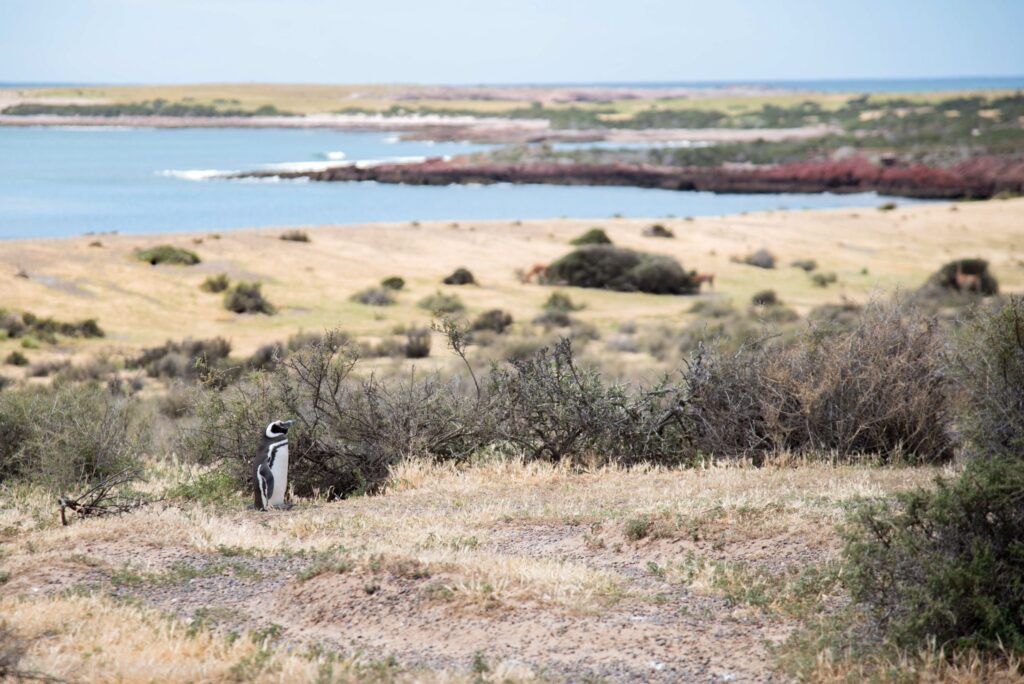
Punta Tombo is a reserve of over 210 hectares in the Patagonian steppe along Chubut’s coast. It is around 110 kilometers from the provincial capital of Rawson.
Magellanic penguins are considered to be among the species of the least concern according to the International Union for Conservation of Nature’s red list of threatened species. However, they have suffered not only from human activity on land, but also from activities at sea, such as oil drilling, intensive fishing, and the effects of climate change on the oceans.
On the first day of the trial, La Regina offered to donate 500 hectares of land to the state by way of reparation. However, prosecutor Florencia Gómez and the two plaintiffs rejected the proposal. “The crimes committed are proven, with the testimony of professionals and specialists who have expressed their opinions on the damage caused,” Gómez said.
“The action carried out with a digger caused the destruction of 2,049 square meters of flora and fauna, vegetation that was not the property of the accused but of the state, harming it irrecoverably in some places, in addition to nests, eggs and penguin chicks during breeding season,” Gómez continued.
A milestone for environmental justice
She concluded that there had been a “complete contempt for the place’s biodiversity, since the accused was conscious of the harm he was causing in pursuit of his economic objective, which he put above the serious environmental [harm] he was causing.”
The case is a milestone for environmental justice, according to Matías Arrigazzi, a biologist and campaigner for Greenpeace Andino.
“This massacre of over 100 penguins, which sparked outrage among the population, is seeing justice done today,” he said. “This constitutes a historic precedent that we hope will establish the basis for implementing stricter policies and actions to avoid future attacks on animals and the environment.”
Lucas Micheloud, an environmental lawyer and the co-director of the Argentine Association of Environmental Lawyers, said: “This is a historic conviction and a decisive inflection point in the struggle against environmental impunity in Argentina. It is a powerful precedent that confronts ecological crime. Today, the judiciary has sent a very clear message to society: destroying nature and abusing non-human animals has criminal consequences.”
The question looking forward is how this will affect similar cases in future, according to José María Musmeci, president of the Natural Patagonia Foundation. “Now, the expectations are looking ahead, above all with regard to the tools we will have at our disposal in the justice system to defend biodiversity, ecosystems, and protected areas,” he said.
