
 Juan Marcos Pollio
 The utility-rate adjustment carried out by Javier Milei’s government has sharply cut the purchasing power of lower-income households, holding back the recovery in domestic consumption — and, with it, in economic activity.
Utilities are a category that has risen well above average inflation since Milei took office.
The Interdisciplinary Institute of Political Economy (IIEP) estimated that between December 2023 — the month Milei took office — and June 2026, water rates rose 555%, electricity 494%, transport 1,354% and natural gas 2,073%.
By comparison, the Consumer Price Index (CPI) over the same period was 312.7%.
That above-inflation increase has held up over the past year.
The think tank Fundación Capital noted that while the CPI rose 33% over the past 12 months, in the Buenos Aires metropolitan area (AMBA), electricity and gas rates climbed an average of 55% year-on-year, and public transport 49%.
The report concluded that the average spending on utilities in June represented 10.8% of the average income of registered wage earners in the AMBA — up from 9.1% in June of last year — a figure close to the IIEP’s own estimate, which put it at 15%.
“It’s worth noting that, at the start of the current administration, the ratio was 4.3% of income,” the Fundación Capital report recalled.
For the Institute of Thought and Public Policy (IPyPP), the situation translates into “severe pressure on real incomes compared with historical levels, structurally altering the pattern of consumption of goods and services.”
It added that “the average for registered wages tends to hide uneven realities,” since the pressure on lower-income families with informal jobs “is as much as double that of the formal sector.”
Fundación Capital agreed with the diagnosis and calculated that for a family earning the equivalent of two minimum wages — 735,600 pesos in June (around US$ 500 at the official exchange rate)— utility payments would have reached 22% of household income.
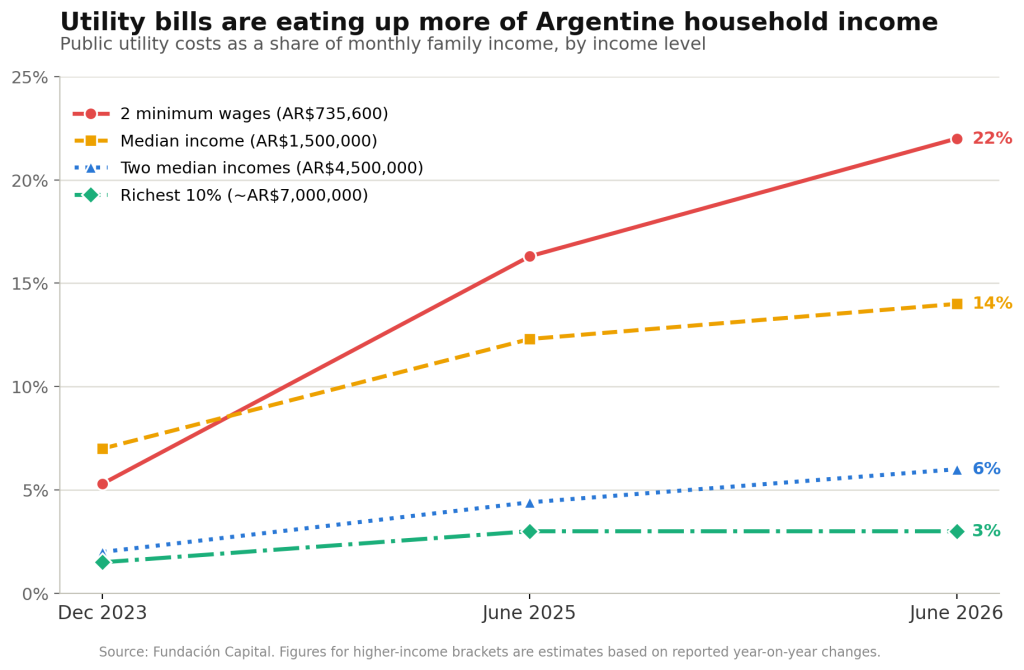
That’s an increase of 5.7 points from a year earlier, and four times the 5.3% recorded in December 2023.
For middle-income households, the blow is smaller. A family with an income of 1.5 million pesos (aprox. US$ 1020) spent close to 14% of its earnings on utilities.
That level is 1.7 points higher than a year earlier and more than double the December 2023 figure, when it stood at 7%.
For a household with two middle-range formal-sector incomes — the equivalent of 4.5 million pesos (around US$ 3080 at the official exchange rate) — utilities account for just 6%: a year-on-year increase of 1.6 points, and well above the 2% of December 2023.
Finally, for a household earning the average income of Argentina’s richest 10% — nearly 7 million pesos (aprox. US$4800)— utilities would account for 3% of income, the same as in 2024 and 2025, double the level of late 2023.
Wage trends and economic activity
The registered private-sector wage index rose 4% month-on-month in April, amounting to a real gain of 1.4% helped by slowing inflation, though it remained 2.3% below the same month last year.
Looking to the second half of the year, Fundación Capital said the “most likely scenario” combines “a moderate real recovery in wages, but with disposable income still constrained by the path of utility rates.”
Local demand for mass-consumption goods “could show a bit more momentum, though still in a limited way.”
It added: “We see the real recovery in wages, then, more as ‘no longer losing ground’ than as a genuine driver of activity.”
The research firm ACM projected a gradual recovery in real wages of around 0.5% for 2026. It warned, however, of two challenges ahead.
The first is that “the recovery in activity doesn’t take hold and sectoral unevenness persists, especially among the more labor-intensive industries, which would limit the room for wage recovery in the formal segment.”
Second, it noted that “slower disinflation or episodes of greater exchange-rate tension could speed up the pass-through to prices and erode nominal increases, even within the band scheme.”
