
 Facundo Iglesia
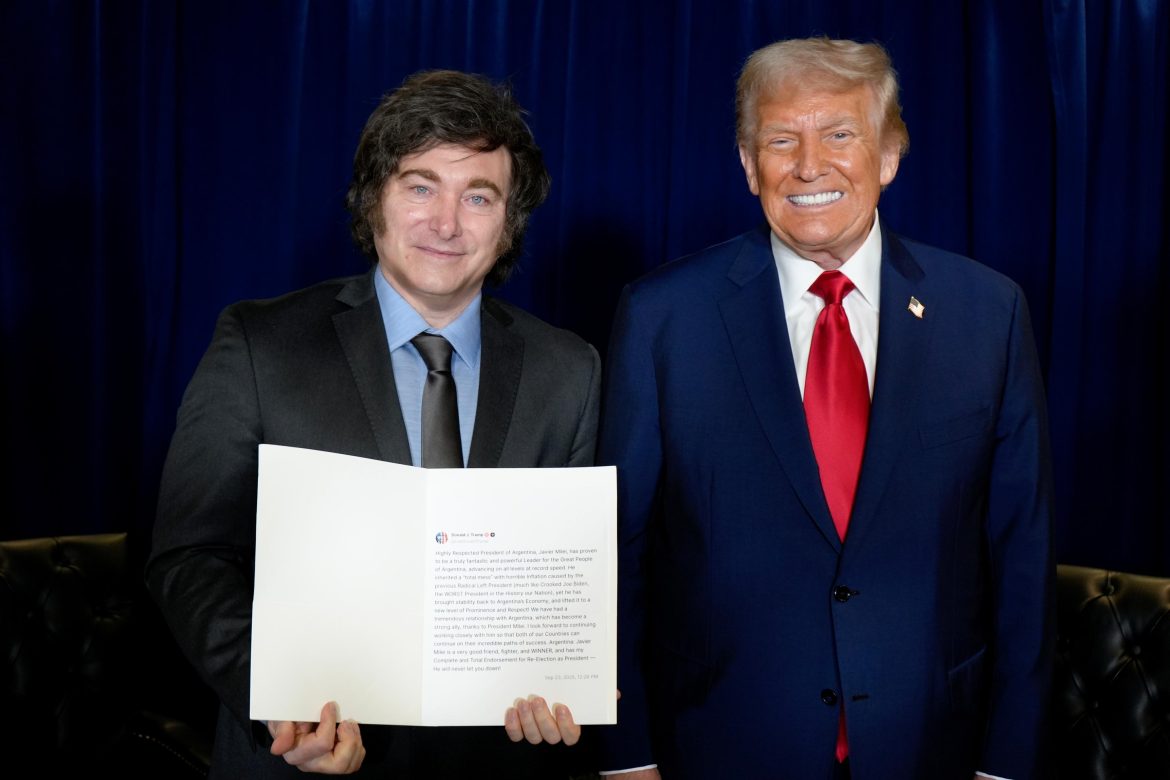
The Argentine peso strengthened on the eve of President Javier Milei’s meeting with his U.S. counterpart, Donald Trump. The White House is expected to share details of its recently-announced bailout of Argentina after the meeting.
On Monday, the official exchange rate fell 5.5% from AR$1,459 to AR$1,379, while the MEP rate traded at AR$1,410 after a 2.1% decline. The blue-chip swap rate (CCL) trading flat at AR$1,440 (up by just 0.1%).
Dollar bonds rebounded by up to 4% in the local market, while country risk remains below 1,000 points. The U.S. bond market was closed due to the Columbus Day national holiday.
Argentine stocks also rose. The top market index, S&P Merval, was up 1.7% and Argentine stocks traded on Wall Street through American Depositary Receipts (ADRs) increased by up to 17.2%.
Last month, the U.S. Treasury announced a full-on bailout for Argentina, including the purchase of the country’s USD bonds, a stand-by credit line, and a US$20 billion swap with the Central Bank. Last Thursday, the U.S. government bought pesos in the Argentine foreign exchange market as part of the bailout negotiations under way in Washington.
Argentina’s exchange rate had been volatile amid pre-electoral uncertainty and increased sales of international reserves by the Central Bank and Treasury.
Economist María Belén San Martino, of Balanz brokerage, said that “the initial expectation was that the announcement of support from the U.S. Treasury would be enough to stabilize the exchange rate within the [currency] band, but recent dynamics showed that the market needed a stronger signal.”
San Martino added that the “direct intervention by the US Treasury last week helped anchor expectations, and assets are reacting today to the liquidity support and the reaffirmation that the support program to be announced will be significant.”
However, she said that there is still “uncertainty” about the bailout composition — whether, in addition to the US$20 billion swap, it would include “a credit line, bond purchases, or a combination of instruments.”
“The market’s focus is on the meeting between Trump and Milei, where definitions on the scope of the package are expected,” San Martino said.
If the Argentine and U.S. governments agree that the peso should remain strong, it could create hurdles for the country’s economic activity further down the line, according to Pablo Repetto, head of research at broker Aurum Valores. “The prices of our imports would go down and it would stimulate the demand for dollars, whether for tourism or hoarding,” he told the Herald.
Conversely, a strong peso could favor the U.S. by forcing Argentina into tighter competition with the U.S. in selling goods they both produce, such as soybeans, he continued. “The truth is that they are competitive economies, not complementary.”
Economist and professor Juan Manuel Telechea said that, even though the bailout announced by the US is unprecedented, “we have to wait a little longer to find out the fine print of how they are going to implement it because, 10 days ago when they announced it, it helped stabilize the market, but a few days later, [US dollar] demand reappeared.”
He said that the announcement will have to be clear on the measures they will take to increase reserves and the demands the U.S. government could impose on Argentina regarding its current currency swap with China.
“If the U.S. government asks to pay for [the China swap], it’s practically an exchange between yen and US dollars, because the swap with China is about $19 billion,” he said — almost the same amount as the potential swap with the US.
