
 Facundo Iglesia
An International Monetary Fund (IMF) technical mission has landed in Buenos Aires amid ongoing negotiations between the government and the lender, who have confirmed that a new agreement is in the works. On Wednesday, Economy Minister Luis Caputo announced he was skipping the World Economic Forum in Davos so he could meet with IMF representatives.
“Already in Buenos Aires. Excellent trip to Washington,” Caputo posted on X. “I could not accompany the President to Davos because it will be three days of hard work between the Fund mission, the bond bidding announced yesterday, and Trade Secretariat’s measures whose design we are finalizing.”
A visit by IMF technical staff to a country in collaboration with local government officials can mark the Fund’s interest in further negotiating a possible new deal, although the Economy Ministry did not respond to the Herald’s request for comment.
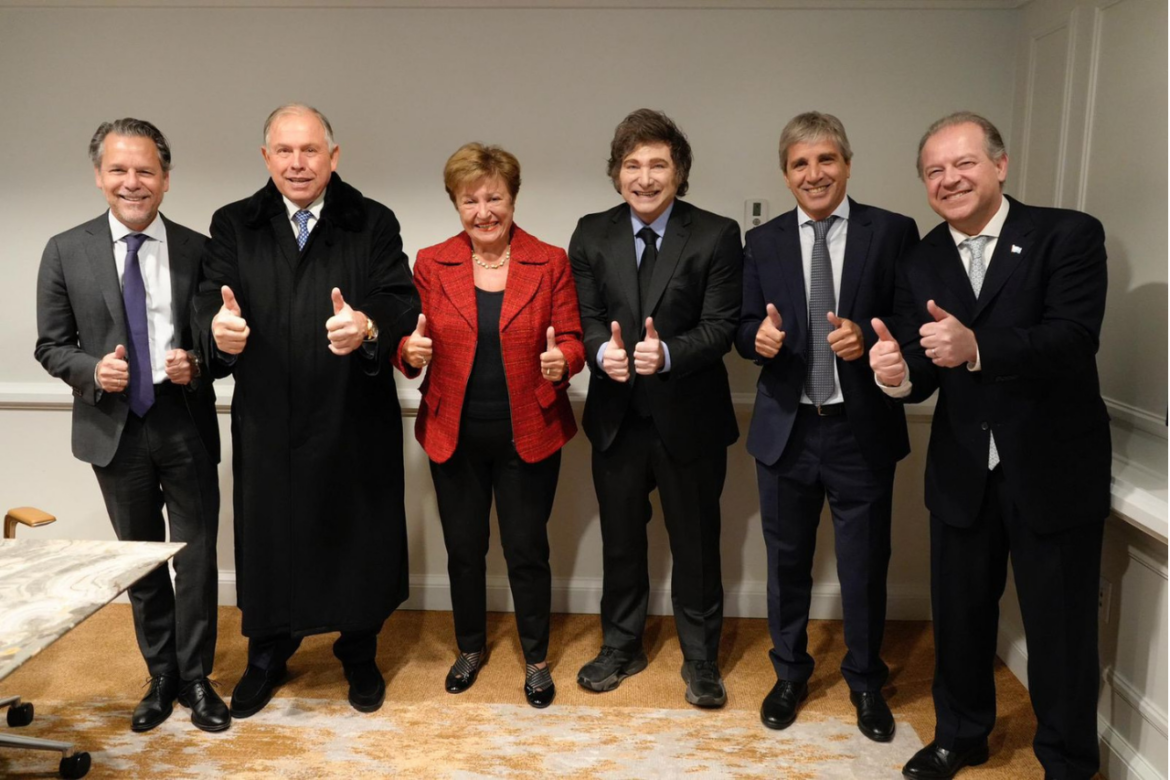
Caputo met with IMF Director Kristalina Georgieva on Sunday alongside President Javier Milei, after which she said the fund wanted to “work expeditiously on a new program.”
“We are working toward a new program to support a vibrant economy for the prosperity of the Argentine people,” Georgieva said in a post on X.
However, in a report published last week, the Fund highlighted Argentina’s need to remove exchange controls, increase exchange rate flexibility, maintain positive interest rates, and introduce automatic tariff adjustments.
In an interview in Davos on Wednesday, Milei said his administration would accelerate the elimination of the country’s extensive currency controls, collectively known as the cepo, if the lender provided extra funds.
“We are committed to eliminating capital controls. We are still going to get out of the cepo anyway, the issue is the speed. Obviously, the more financing we get, the faster we are going to get out,” Milei told Bloomberg.
Two weeks ago, Milei said in an interview with El Observador that his administration would need US$11 billion to lift the controls.
The country signed an Extended Fund Facility agreement with the IMF in 2022 when Alberto Fernández’s administration renegotiated the US$44-billion debt former President Mauricio Macri acquired in 2018.
The 2022 Extended Fund Facility was designed to aid Argentina in meeting its payments. It comes with an economic program the country must comply with to get disbursements from the Fund every three months. Those disbursements were then used to pay Argentina’s previous debt with the IMF.
Jaime Reusche, vice president and lead analyst of Moody’s Ratings, said that new funds could help Argentina in a context “of very tight external finances.”
“This year, for example, [Argentina] is only paying interests to the Fund for approximately US$3.5 billion,” Reusche told the Herald. “In future years, that interest rate is going to stay more or less at that level, but starting in 2026, you already start repaying some of the principal to the Monetary Fund — one billion, then US$4 billion and US$6 billion in 2028. So that new loan helps because it gives you air and helps you a little bit to carousel the debt,” he added.
“It gives you a little more room to see how you handle the opening of the capital account and the elimination of the cepo and that you don’t have too much repayment pressure,” he said. Assessing the relationship between the current administration and the IMF, Reusche told the Herald he did not believe the Fund is playing the role of a guarantor that demands austerity measures, as it did under the arrangement reached in 2022.
“Here, the adjustments are clearly coming before having a program with the Fund,” he added.
