
 Facundo Iglesia
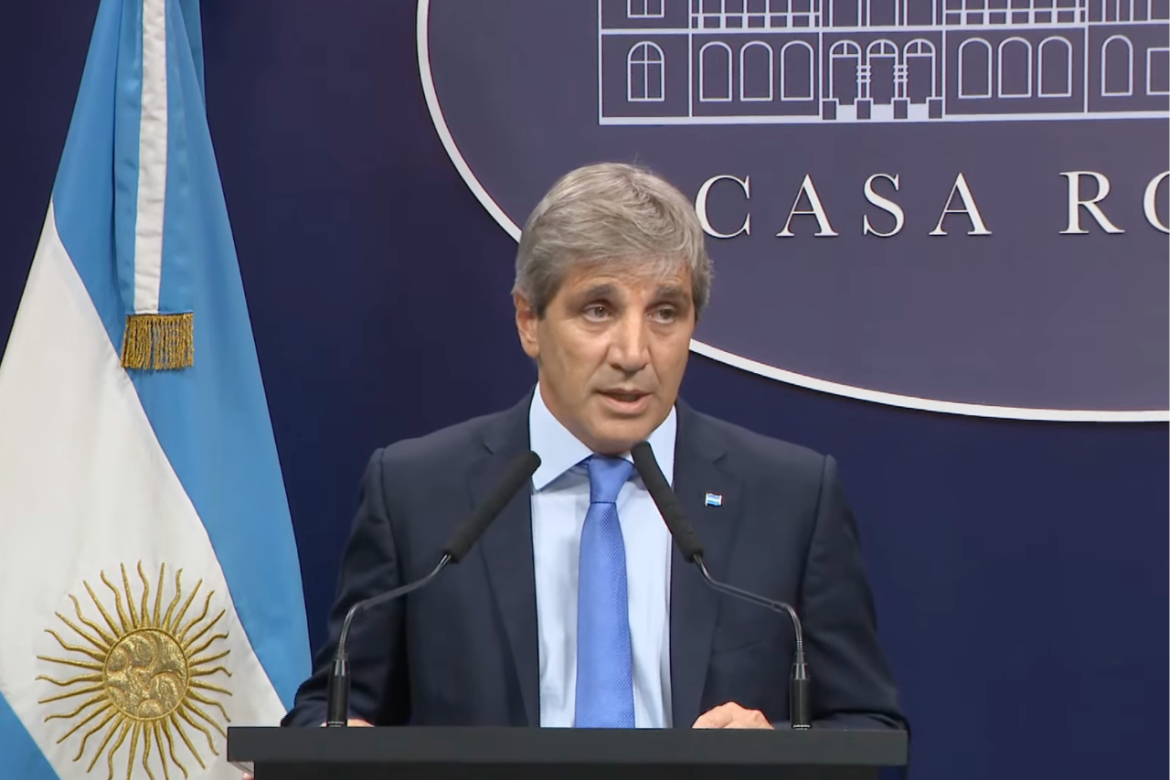
Economy Minister Luis Caputo said the government is moving forward with measures to incentivize Argentines to spend the dollar bills they hide “under the mattress” without explaining their origins. The announcement, of which details have yet to be fully disclosed, has its fair share of critics.
“We want people to be able to use their dollars without being afraid of being persecuted,” Caputo said on Monday, adding that he aims to create “more jobs and have better salaries.” However, experts pointed out to the Herald that allowing people to use undeclared dollar bills could incentivize money laundering and tax evasion, as well as damage the country’s ability to have its own monetary policy.
Used to combat sudden and steep devaluations of the peso, Argentines have historically saved in U.S. dollar bills. At a larger scale, big companies have been accused of resorting to capital flight.
President Javier Milei also entered the debate, saying that his administration does not consider those who took their dollars out of the formal system to be criminals. In an interview with the Neura streaming channel, the president said that people only did that to “protect themselves from thieving politicians that were killing them with inflation.” He calculated that between US$200 billion to US$400 billion were “stored under Argentines’ mattresses” and that Caputo’s proposal aims for that amount to go back into the formal system.
The president was elected on a platform that included dollarization — that is, abolishing Argentina’s Central Bank, eliminating the Peso, and adopting the US dollar as the country’s legal tender. However, despite some modifications, this has yet to come to fruition. Caputo introduced the measure as a way of “endogenous dollarization.”
Martín Kalos, an economist and director of the Epyca consulting firm, said that the government is “playing with fire” with its new measures. “No developed country has two currencies. The ‘dual currency’ economy is the symptom of a problem of macroeconomic disorder,” Kalos added.
The economist told the Herald that the government is aiming for dollars to circulate and put a stop to small-scale demand for dollars from the Central Bank. “Beyond the very short-term goal of trying to solve these months’ exchange rate problem, [the government] presents it as an endogenous dollarization,” he said. “And it is, because anything that increases, even gradually, the use of dollars in our economy, is a form of dollarization.”
For Gustavo Quintana, an analyst and broker for PR Corredores de Cambio, the measure aims to stimulate consumption. “It is a resource that I believe intends to use dollars that, for now, are stored and without a concrete application,” said Quintana. “Many people cannot justify their origin, and this would free them from that.”
Argentines currently use dollars as a means of saving and only large transactions are made with the greenback — namely, real estate, vehicles, and construction. “The government is aiming for the dollar to become more popular as a means of payment for the most common, everyday transactions,” Kalos said, adding that by doing so, the administration will “lose control over part of its economy.”
Money laundering and tax evasion
María Eugenia Marano, a lawyer focusing on economic crimes, called the move “dangerous and alarming.” She told the Herald that the decision “encourages evasion, non-declaration, and the circulation of illicit financial flows.” The lawyer, who is part of the Futuros Mejores think tanks also added: “They are legitimizing the last stage of money laundering, which is the reinsertion of funds in the formal system.”
Argentines usually buy the greenback in informal exchange houses, known as ‘cuevas,’ when governments impose currency controls (commonly referred to as ‘cepo,’ Spanish for clamp). According to Marano, since they are not audited, some cuevas handle funds arriving from illegal activities, such as drug dealing or human trafficking. She added that human trafficking rings had been dismantled after authorities detected irregular transactions made with large amounts of dollar bills. “That’s why authorities ask people to declare their funds’ origin — it’s not to bother people,” said the lawyer.
Adrián Falco, a member of the Global Alliance for Tax Justice NGO, said that the move gives an “absolutely negative” message for taxpayers. “The message is that in Argentina, if you evade, if you incur capital flight, if you hide information from the tax authorities, nothing happens,” he said. “Because at some point they will open an amnesty and you will pay much less than what you should have paid if the tax authorities had discovered you,” he added.
All but two presidential administrations since the recovery of democracy in 1983 have carried out tax amnesties to recover U.S. dollars leaving the country’s formal financial system.
Kalos pointed out that, if the country passes such a regulation, it would “fail to comply” with international obligations to prevent and combat money laundering, drug trafficking and terrorism. “Argentina runs the risk, with a measure such as the one announced, of re-entering a Financial Action Task Force (FATF) gray list or black list of countries that promote money laundering.”
Last March, Alberto Mendoza, head of the government’s Financial Information Unit (UIF), quoted a study by the International Monetary Fund saying that countries that are placed on FAFT’s grey or black lists show a decrease of 5 to 7% of their gross domestic products.
In his Wednesday press conference, presidential spokesman Manuel Adorni attempted to spin Caputo’s statements, calling them “superficial”.
“No measure that would imply being included in any gray list, be it FATF or any other,” he said, answering a question from a journalist. “What [Caputo] said was superficial, in terms of what is going to happen […] we are going to know it when the modifications are effectively finished, not before. Do not speculate,” Adorni added.
