
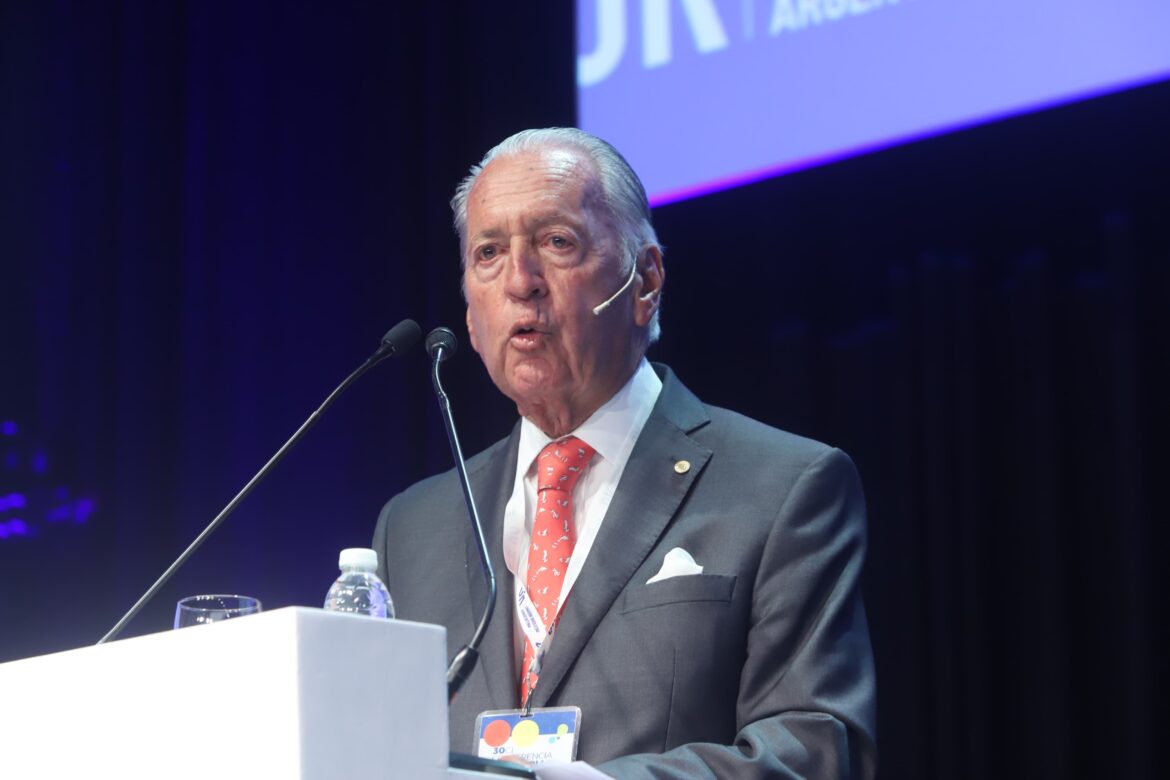
 Facundo Iglesia
Argentina’s industrialists demanded government policies during the sector’s most important conference, which President Javier Milei snubbed after months of lambasting the country’s manufacturing companies.
“Sometimes we hear many unfair attacks on national companies,” the head of this year’s Argentine Industrial Union (UIA) conference, Martín Rappalini, said in his opening speech. “We want respect, as [the industry] is respected in all countries where our fundamental role in society is understood.” Rappallini was referring to Milei and his allies’ remarks against industry protection policies carried out by previous administrations.
“We contribute 30% of the tax collection, and the sector is an engine of growth,” said Rappallini.
In September, Milei said that protectionism “harmed all Argentines because they forced us to pay more for lower quality products.” On the day of the conference, LLA deputy José Luis Espert said industrialists who asked for tax reduction should “go screw themselves,” adding that they “sell us expensive and poor quality stuff for decades and decades of dreadful misery.”
One of the key points of disagreement between the government and industrial companies is import liberalization. “We are not against the opening of imports — the issue is that Argentina did not make [Milei’s promised] reforms to lower the so-called ‘Argentine cost,’ the tax burden on added value or labor,” said Jorge Sorabilla, member of UIA’s Executive Committee and secretary of Pro Tejer, a foundation that groups textile companies. Sorabilla told the Herald that the government is encouraging imports from “countries that subsidize their production and compete unfairly with Argentine costs.”
He added that since Milei took office, he has overappreciated the national currency, the peso, creating an “exchange rate lag” to fight inflation. However, Sorabilla said this policy has made Argentine industrial products more expensive and reduced export competitiveness even further.
Daniel Funes de Rioja, president of the UIA, said that other countries are protecting their manufacturing industries. He said that U.S. President elect Donald Trump vowed to increase tariffs for imported products once he takes office. “We have to coordinate so as not to leave anyone behind, especially many labor-intensive sectors, which are sometimes the most affected at this time,” he asked.
The sole official from the Milei administration who attended the conference, Secretary of Production Coordination Juan Pazos, pushed back against that idea. “The best industrial policy is to have a balanced monetary and fiscal policy,” he said, echoing Milei’s September claims against protectionism.
“There is a huge level of anxiety for a government that stepped into an economic disaster,” Pazos added, saying that Milei took office only 10 months ago. “We can’t take responsibility for 70 years of economic failure,” he added.
Pazos defended Milei’s “open economy” policies, saying that “more than 80% of imports are inputs and capital goods” and that “only 11% of what enters Argentina is a final good.”
He also promised the government would send a bill similar to Milei’s Large Investment Incentive Regime (RIGI, by its Spanish initials), which offers major investors a flurry of tax breaks, currency exchange perks, and other sweeteners. The new bill would be destined toward national industrial investments.
“We have to learn to compete,” he said.
Meanwhile, according to a report published last week by INDEC, the government’s statistics institute, economic activity fell 3.3% year-on-year in September 2024 and 0.3% when compared to August. The manufacturing sector’s activity dropped by 6.2%.
