
 Buenos Aires Herald
Determining prices and building transport infrastructure to move gas from Vaca Muerta are two of the most important challenges Brazil and Argentina face in order for their energy integration to be successful, said Marcello Gomes Weydt, director of the Natural Gas Department at Brazil’s Energy and Mines Ministry.
Gomes Weydt made these remarks in the initial segment of a discussion panel called “Argentina-Brazil: The challenge of regional energy integration.” Fluxus Oil Gas & Energy CEO Ricaro Savini and Buenos Aires Herald Editor-in-Chief Estefanía Pozzo joined him on stage at the debate held on Wednesday in San Carlos de Bariloche.
The panel was part of the 2025 Energy and Production Meeting, an event organized by Herald sister publication Ámbito, Polp-P, and Energy Report, which gathered business leaders, government officials, and energy experts from the two countries.
Gomes Weydt also said that the Brazilian Development Bank (BNDES, for its Portuguese initials) could finance the extension of the Mato Grosso do Sul pipeline within Brazil, from Uruguaiana to Porto Alegre. This investment is estimated to be US$1 billion (between RS$6 and 7 billion). The remaining tranche that still has to be built in Argentina, however, must find a source of financing of its own.
The challenges of prices and infrastructure
Gomes Weydt spoke about the natural gas reform Brazil is undertaking and the importance of the relationship with Argentina. “We are working on reforming the natural gas market in order to detach it from price volatility. This is linked to in-country production and regional integration,” he explained.
He added that a joint group in Argentina and Brazil is already working on the key issues related to integration, construction, and infrastructure to develop the market. “The big challenge, however, is how do we define prices for long-term contracts.”
Gomes Weydt went on to say that it is “important to create integral wealth in South America.” “Brazil has an energy matrix that is already very clean, but gas will assist in decarbonization as it is a stable energy source,” he said.
Ricardo Savini, from Fluxus Oil Gas & Energy, commented that his company is “very active” in Brazil and Bolivia. They are part of J&F Investimentos SA, a private holding company with diversified investments that include mining and banking, among other sectors.
“We own a gas company called Enegas, one of the first that tried exporting gas from Argentina to Brazil; we were pioneers,” Savini explained.
“Brazil has a very large industrial matrix. Our economic group is a proxy for energy integration because we not only produce and sell gas in Brazil: J&F is also a large consumer of gas, which is why we are interested in having a presence where production is happening.”
Savini explained that the holding is working in the Campo Centenario field, located in the capital of Neuquén province. “It’s a gas field we are going to run tests on to see if it has Vaca Muerta’s potential,” he said.
“For Brazilian companies, the prospect of using natural gas as an energy source is like the story of a dog chasing its tail. Industries will only change their engines to work with natural gas if they are certain they will always have enough cheap gas in order to be competitive. That’s where Vaca Muerta can make a difference,” he continued.
Gomes Weydt estimated that a competitive price for the Brazilian industry is around 7 to US$10 per million BTU.
Savini also mentioned that a large quantity of gas from Vaca Muerta will make its way to Brazil through three possible routes. “One of them is internal; the other possibility is using the pipelines already in existence, like the one that goes through Bolivia or Uruguaiana; and then there’s [liquefied natural gas]. This is a good solution for the global market, and Brazil is part of that market.”
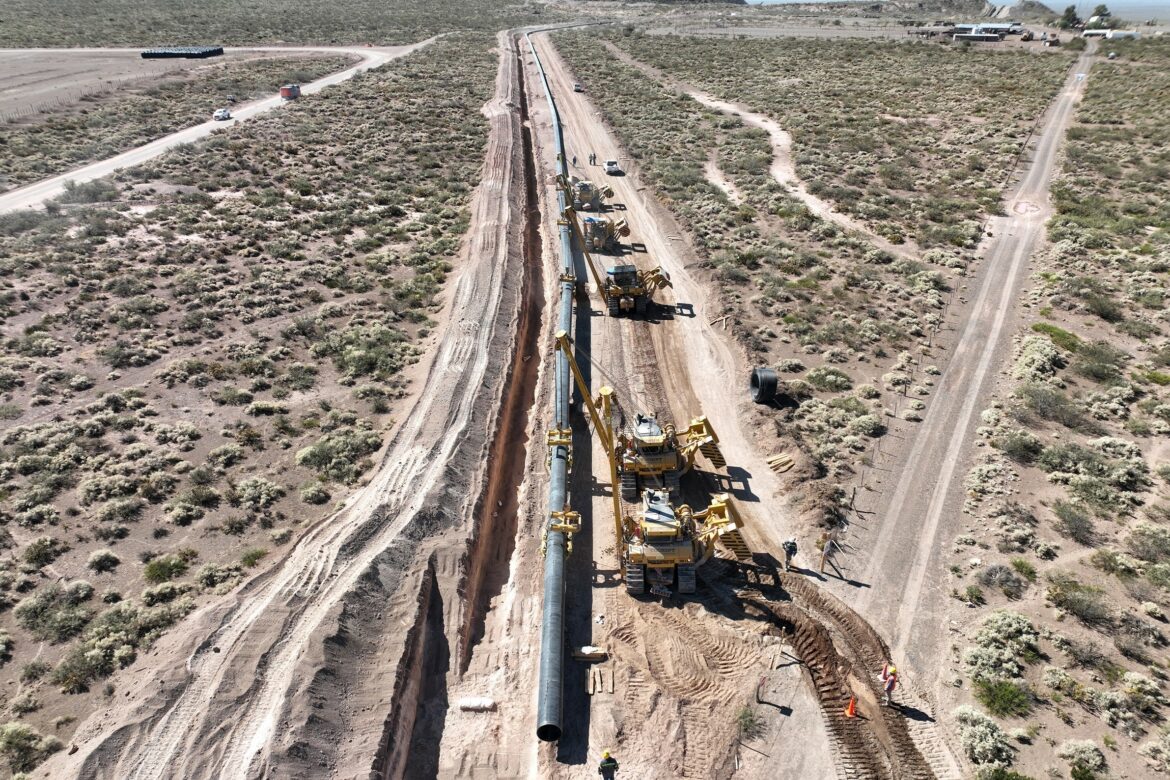
Regarding the required infrastructure, Argentina could export gas using the Bolivian pipelines. This infrastructure initially carried gas from Bolivia to Argentina, but a series of works were done to reverse the flow and can now be used in the opposite sense. Furthermore, Bolivia is only using 40% of its installed capacity, so this would mean working with infrastructure that is already operational.
Other possible pipelines are Uruguaiana — which would have to be extended to Porto Alegre, a work Gomes Weydt mentioned the BNDES could finance on the Brazilian side — and Cruz del Sur, which goes from Ensenada, Buenos Aires province, to Montevideo, Uruguay. Another alternative would be to build a new pipeline through Paraguay, an option Paraguayan President Santiago Peña has floated.
Bolivia v. Argentina
Savini pointed out that Bolivia is a country with geography that’s very favorable to gas production. In 2006, however, the country made a regulatory change that made it very difficult to conduct a primary investment.
“Bolvia depends on [state-owned oil company] YPFB for investments; I highly respect the company, but they don’t have the financial resources to do large investments,” he said. He added that Bolivia would be a “tough competitor” for Vaca Muerta, but that the country’s wells are deeper, which means higher costs and risks.
“The only thing going on in Bolivia right now are small investments aimed at recovering production from mature wells.”
The Fluxus Oil Gas & Energy CEO added that Argentina is “much more favorable to private investment,” although he admitted they encounter regulatory roadblocks in their day-to-day operations. He mentioned that an operational transference with oil company Pluspetrol is still not complete after 18 months.
“It’s a very long time. We still don’t have the Neuquén Energy Secretariat’s approval, but things are beginning to move now.”
Marcello Gomes Weydt, director of the Natural Gas Department at Brazil’s Energy and Mines Ministry, closed the initial segment echoing Savini’s remarks, saying that transport infrastructure is suffering the same problems. He added that the difficulties in obtaining financing aren’t so much related to access to capital but to regulations that need to be changed in order to facilitate the process.
The possibility of BNDES financing
In the second segment of the panel discussion, economist Marcelo Miterhof, from the BNDES Infrastructure, Energy Transition, and Climate Change Division, offered details regarding the possibility of financing the pipelines.
“BNDES President Luis Mercadante said in an event in Argentina that there was interest. However, it’s not possible at the moment. We have restrictions because we have to finance things made in Brazil. When we had strong construction companies that were capable of competing for work outside the country, we could finance the exportation of engineering services. Unfortunately, Brazil doesn’t have companies that could do that right now,” he explained.
Miterhof said that financing the Argentine tranche would require looking elsewhere but acknowledged that it is “possible” because Brazil is importing a lot of liquefied natural gas (LNG), which is very expensive. He added that the Uruguaina-Porto Alegre tranche in Brazil is easier to do because it’s only a matter of offering a credit line.
Miterhof acknowledged that the reason it would be simple to secure funding for these works is because Brazil needs a “steady and cheap supply of natural gas.”
