
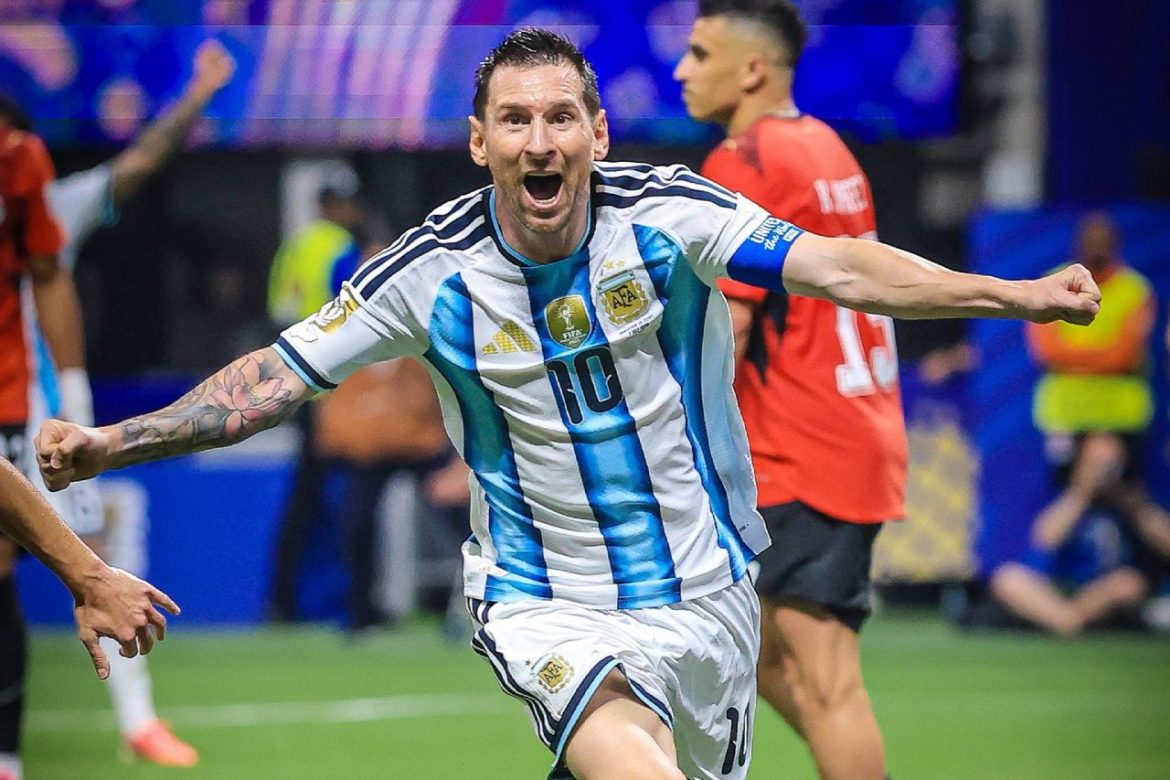
 Fernando Romero Nuñez
 July 19, 2026, could forever become a special date in football history. Every World Cup final is an historic occasion, but when the final kick of the ball is taken on Sunday, one has to wonder if that won’t be Lionel Messi’s last dance at a World Cup.
Messi has demonstrated incredible passion for playing football — not just being in the game, but being on the pitch, with the ball. At 39, he remains one of the best players in the world.
He’s largely disregarded the option of becoming a coach, so it’s likely that extending his playing career remains his only way to keep doing what he loves.
Yet, the signs of a potential farewell have been there for a long time.
The 2030 World Cup, hosted by Morocco, Portugal, and Spain, is set to have at least one game hosted in Buenos Aires, as part of FIFA’s decision to honor the inaugural 1930 World Cup with three games in Uruguay — where the 1930 tournament was held — Argentina and Paraguay.
The prospect of playing a World Cup game in his home country is perhaps the one thing that could entice Messi to stick around, but the question of whether he wants or even can is an entirely different one.
The Rosario-born star will be nearing 43 years old by the time the ball rolls for the first time in 2030.
While Messi has shown his game style doesn’t need the blistering pace he had in his 20s, the question of whether he’ll be able to stay fit for long enough periods of time has already proven a challenge for 2025.
After Argentina took on Venezuela in September 2025 in its second-to-last game in the World Cup qualifiers, Messi was adamant that he’d only stick around for as long as playing was fun for him.
“I’m honest with myself, when I’m feeling alright I enjoy it, but when I’m not I suffer a lot so I’d rather not play like that,” he said.
He had already been brought to tears by fans who began pouring into the stadium hours in advance, displaying giant flags, tattoos, and other homages for him
“A lot of things went through my head [when I entered the pitch],” said Messi, who stepped onto the grass with sons Thiago, Mateo and Ciro.
“I knew it was going to be the last official game here. I’ve been many things on this pitch, some good, some not so good, but it’s always a joy to play in Argentina, in front of our fans,” he added.
Hints and clues
It’s not the first time Messi has circled the issue. In the build-up to Qatar 2022, the Rosario player hinted at an international retirement
“This is probably my last World Cup,” said Messi at the time.
At 35, he was arguably the best player in the world and was leading the charge for a top European club like Paris Saint-Germain. Yet, it looked like, with Argentina going on to win it all at Lusail Stadium, the last thirst for glory had finally been quenched.
Messi himself more or less confirmed it in a January 2023 interview.
“What I desired the most finally has come, nearly at the end of my career,” he said. “It was like closing a circle. We won the Copa América and the World Cup, that’s it, there’s nothing left.”
Many hypothesized that his move to Inter Miami was aimed at a more relaxed lifestyle, a less demanding league and a place away from the spotlight of the European elite leagues. Therefore, retirement was surely around the corner.
And yet, Messi kept going. Success at Inter Miami didn’t take long to arrive, and after that came the 2024 Copa America title.
He had a quieter, less dominant performance than in Qatar, famously tearing up after an injury took him out of the final game against Colombia, but proved ever crucial in motivating his teammates to victory.
Despite insisting after that game against Venezuela that he wasn’t sure if he’d be at the 2026 World Cup, Messi went on to have one of his best tournaments ever, breaking the record for most goals in the competition’s history and leading Argentina to a second consecutive final.
One of the World Cup’s best
Regardless of his decision for the future or what happens on Sunday, Messi will retire as one of the World Cup’s most laureled players.
When he steps onto the pitch against Spain, he’ll become one of only two players to feature in three World Cup finals, alongside Brazil’s Cafú. He’ll become the only one to have started in three deciding games, with the Brazilian having started from the bench in 1994.
It all started in 2006, when Messi was part of then-Argentina coach José Pekerman’s squad aged just 18. The Argentine player was one of the breakout stars of the tournament, becoming Argentina’s youngest scorer in tournament history at age 18 as well as providing one assist in three appearances. However, he was unable to help Argentina avoid a quarterfinal exit to host Germany on penalties.
Four years later, in 2010, he donned the number 10 jersey for the first time at a World Cup under head coach Diego Maradona. Already the best player in the world by then, Messi drove the Argentine attack, creating dozens of chances but failing to score a single goal and was once again ousted by Germany, this time in a 4-0 thrashing.
Vindication almost came in Brazil 2014. Still at the peak of his powers, Messi was the undoubted star of the tournament, as he scored four crucial goals on his way to winning the Golden Ball and carrying Argentina to the final, where the Albiceleste once again lost narrowly to Germany.
Messi left the national team on June 26, 2016, after losing the Copa América Centenario final to Chile. Amid the frustration, he announced his retirement from the team, but returned just 66 days later, spurred on by the fans’ support, to play against Uruguay in the World Cup qualifiers.
An Argentina team filled with infighting and completely incohesive on the pitch seemed to waste Messi’s last chance at World Cup glory at Russia 2018. Messi became the first player to score in his teens, twenties, and thirties at the World Cup with a brilliant strike against Nigeria that helped secure a Round of 16 spot, but France in the Round of 16 was too much.
Yet from ruin was born hope, as the disastrous Jorge Sampaoli tenure left with nobody else to take the helm but Lionel Scaloni. The head coach, who had never before held a first-team coaching job, rebuilt the squad, brought in new players, and gave Messi the confidence to soar at the 2021 Copa America and the 2022 World Cup.
Four years later, Messi is once again at the top of the world, so we better enjoy it while it lasts.
