
 Martina Jaureguy
 The United Nations’ Special Committee on Decolonization issued a new call urging Argentina and the United Kingdom to resume negotiations over the Malvinas Islands sovereignty dispute and arrive at a peaceful resolution.
The UN committee adopted the resolution on Thursday with unanimous support from all the countries that participate in it.
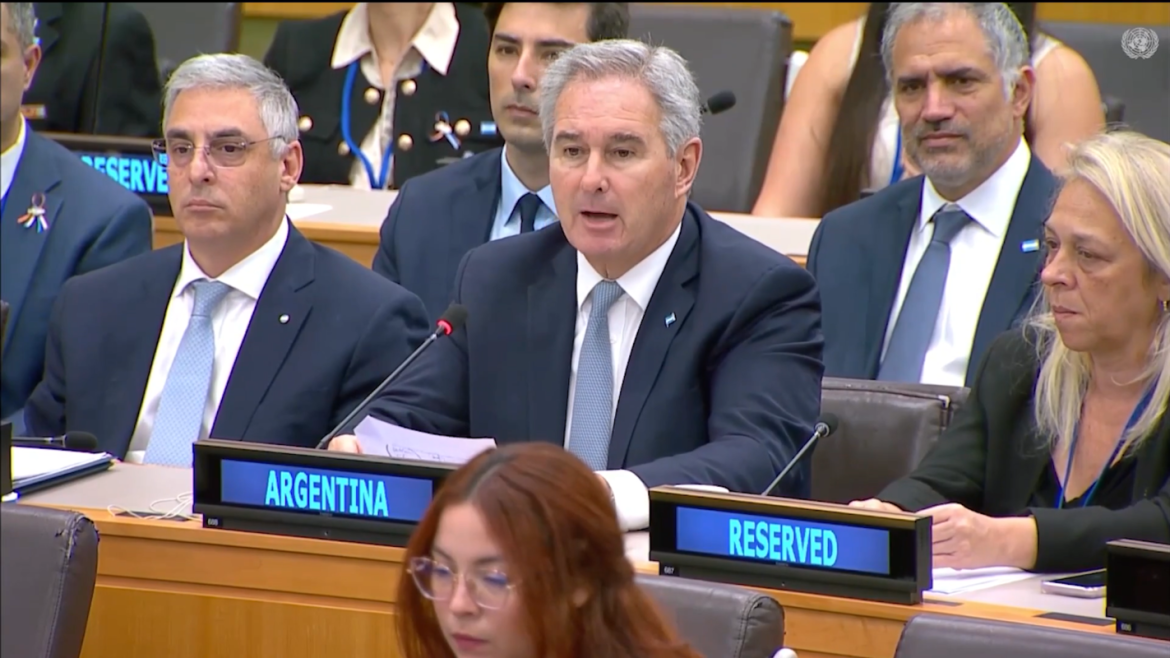
“The decision we have just adopted renews a call that the international community has consistently maintained for decades,” Argentine Foreign Minister Pablo Quirno said during the committee’s meeting.
“A call to dialogue, negotiation, and the search for a peaceful and definitive resolution to the sovereignty dispute between the Argentine Republic and the United Kingdom, in line with the UN’s resolutions,” he added.
Quirno celebrated the decision in an X post saying that the call “reflects, once more, the firm support of the international community to the Argentine position.”
“The Malvinas issue is a state policy, a national cause, and a commitment that unites all generations of Argentines,” he said. “By history, by law, and by conviction: the Malvinas belong to Argentina.”
Quirno also expressed a strong rejection of the hydrocarbon exploitation activities that have been carried out unilaterally in the areas surrounding the islands.
The Malvinas sovereignty dispute
Since 1965, Argentina has maintained a formal sovereignty claim before the UN over the Malvinas, South Georgias and South Sandwich Islands and their surrounding maritime areas.
That year, the international organization acknowledged the dispute and qualified it as a colonization issue. Since then, the UN has consistently urged the two countries to arrive at a peaceful solution, with little developments.
The dispute began in 1833 after the U.K. occupied the islands — which are located on the Argentine continental platform — and ousted its inhabitants. After that, British settlers arrived at the islands to populate it, starting a community that lives there to this day.
In 1982, the two countries went to war, with the British armed forces vastly outweighing the Argentine soldiers.
Contrasting positions
During the Special Committee on Decolonization meeting, two members of the Falkland Islands Legislative Assembly defended the islanders’ right to self-determination, citing a 2013 referendum in which virtually all inhabitants voted to remain an overseas British territory.
However, the UN established in 1965 that the right to self-determination is not applicable because the population arrived after the territory was colonized and is therefore a “special and particular” case of colonization.
Islander lawmaker Michael Goss asked the UN to send a visiting mission. “Come and see for yourselves. The resolution before this committee uses the word ‘interests.’ We are asking you to recognize our wishes. Those are not the same word.”
In recent years, President Milei has vowed to “recover” Argentina’s sovereignty over the Malvinas Islands, and even argued that his economic policies would help the deed.
“We want to turn Argentina into such a power that [islanders] choose to be Argentine, without any further arguments or convincing required,” Milei said, in a statement that seemed to imply that the islanders are entitled to self-determination.
Argentina’s historic position, which has been upheld by the United Nations, is that the Malvinas were colonized by the British, and therefore the right of self-determination afforded to native populations is not applicable.
Editorial disclaimer: Although the UK refers to the territory as the “Falkland Islands”, Argentina strongly contests this name. The Buenos Aires Herald uses “Malvinas” to refer to the islands.
