
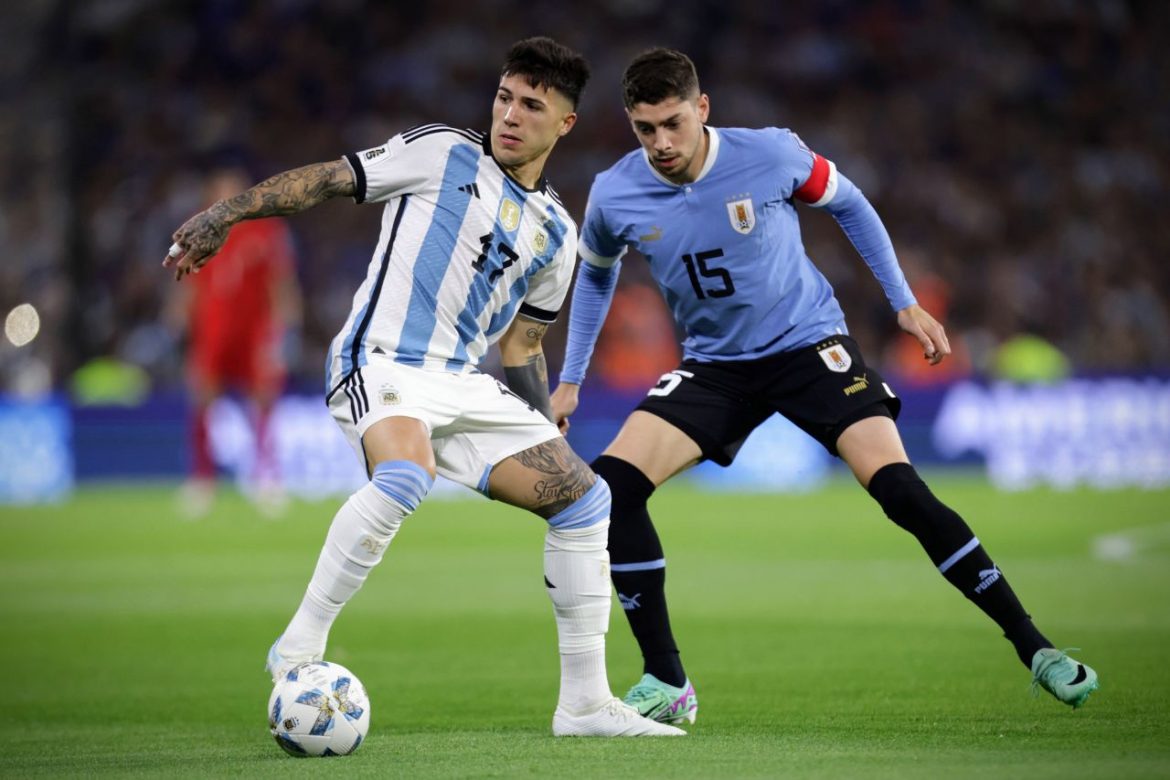
 Fernando Romero Nuñez
 Argentina and Uruguay are, in many ways, a pair of bickering siblings. From the birthplace of tango legend Carlos Gardel to the origins of dulce de leche, few cultural debates stay settled for long on either side of the Río de la Plata.
So it is hardly surprising that football’s most enduring regional argument concerns something much bigger: who has won more World Cups.
At first glance, the question seems simple enough. Look up the list of champions, count the trophies and compare totals. But, as is often the case with Argentina and Uruguay, things are more complicated than they appear.
The Uruguayan case
The dispute begins with Uruguay’s trophy count, which, depending on whom you ask, stands at two, four or even five titles.
The traditional Uruguayan position is that the Celeste won four world championships: in 1924, 1928, 1930 and 1950. The apparent problem is obvious: the International Federation of Association Football (FIFA) World Cup did not begin until 1930. How, then, could Uruguay have won two before the tournament even existed?
The answer lies in the Olympic football tournaments of 1924 in Paris and 1928 in Amsterdam. While football had featured at previous Olympic Games, these were the first editions organized by FIFA and contested by full senior national teams.
Unlike the modern Olympic tournament, participation was not restricted to under-23 players.
At the time, the tournaments were widely regarded as the highest level of international football competition. Newspapers in Europe and elsewhere described Uruguay as “world champions” after both victories, and FIFA later acknowledged their significance by allowing Uruguay’s national team to wear four stars above its crest.
For many Uruguayans, the matter is straightforward: the 1924 and 1928 triumphs were world titles won under FIFA’s authority and therefore deserve equal standing alongside the World Cups of 1930 and 1950.
The Argentine case
Argentina’s argument is less about titles than terminology.
Few in Argentina dispute that Uruguay’s Olympic victories were world championships of their era. The disagreement centers on whether they should be counted as World Cups.
From this perspective, the distinction is clear. The FIFA World Cup was created as a separate competition in 1930, independent of the Olympic framework. Even the official poster for the inaugural tournament — ironically, held in Montevideo as a recognition of the two Olympic gold medals — described it as the first World Cup.
Under that definition, Argentina has won three World Cups — in 1978, 1986 and 2022 — while Uruguay has won two.
This interpretation has increasingly aligned with FIFA’s own presentation of football history.
Although Uruguay continues to wear four stars, FIFA’s museum and many of its official graphics distinguish between Olympic world championships and World Cup titles, often listing Uruguay as a two-time World Cup winner.
In other words, the disagreement is not over whether Uruguay were world champions in 1924 and 1928. It is over whether those championships belong in the same category as the tournament that began in 1930.
Uruguay’s fifth world title?
The debate becomes even more complicated when some Uruguayans argue the country’s tally should be five rather than four.
Ahead of the 2026 World Cup, former Uruguay captain Diego Lugano suggested the real discussion was not whether Uruguay had won two or four titles, but “whether it’s four or five.”
The fifth title in question is the 1980-81 World Champions’ Gold Cup, better known as the Mundialito.
Organized by the Uruguayan Football Association with FIFA’s backing, the tournament was staged to mark the 50th anniversary of the first World Cup.
It brought together every World Cup winner up to that point — Uruguay, Italy, West Germany, Brazil and Argentina — with the Netherlands replacing England after the latter declined the invitation.
Uruguay defeated Brazil 2-1 in the final and proclaimed itself “Champion of Champions.”
For Lugano and some supporters, the tournament’s FIFA recognition and elite field give it a status comparable to a world title. Outside Uruguay, however, the argument has gained little traction, and FIFA has never treated the Mundialito as an equivalent to a World Cup or world championship.
Which leaves the Río de la Plata exactly where it likes to be: with one more argument unlikely to be settled anytime soon.
Cover image: Selección Argentina Twitter
