

 Christopher Martin
 An underwater robot situated on the deep sea floor of the South Atlantic near the city of Mar del Plata has captured the attention of hundreds of thousands of Argentines after new specimens have been found, some of whom resembling characters from SpongeBob SquarePants.
The National Scientific and Technical Research Council (Conicet) launched the ‘Underwater Oases of Mar del Plata Canyon’ expedition of the depths of Mar del Plata in collaboration with the Schmidt Ocean Institute. The objective of the dive is to explore the underwater region of high biodiversity, where little knowledge exists up until now.
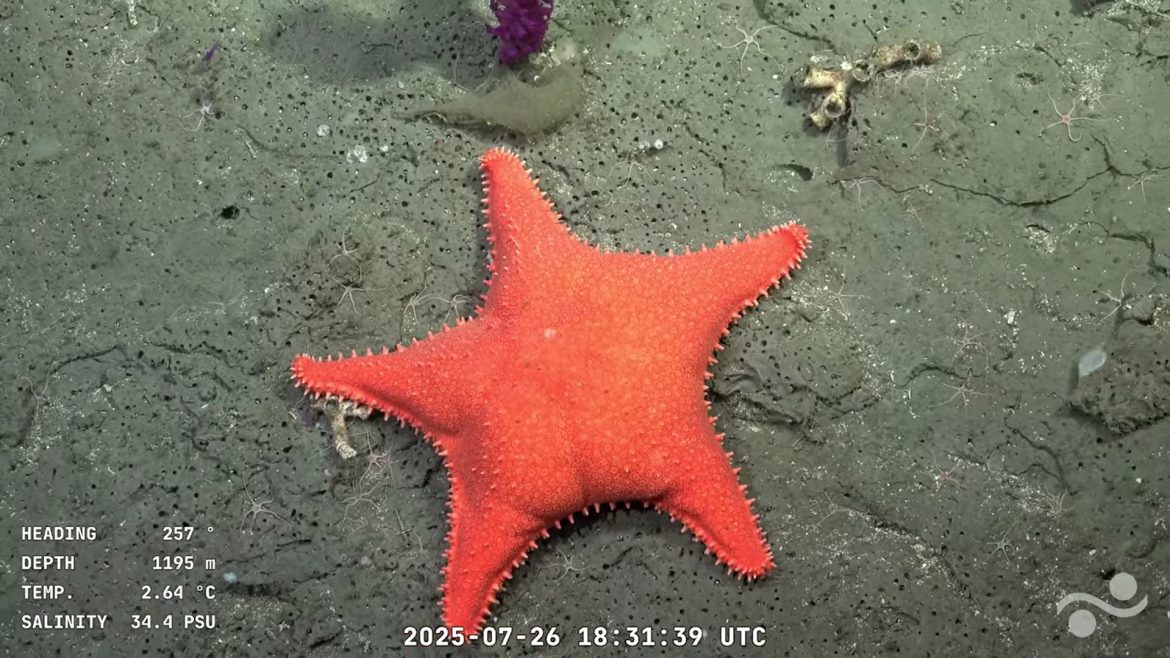
The live streams have quickly captured the attention of millions across Argentina due to the large number of unknown marine animals that appeared. Many onlookers highlighted a creature they dubbed an orange “estrella culona” (fat-bottomed starfish, by its Spanish translation) because the folds between its arms resembled a buttocks. Its body position struck a cartoonish resemblance to Patrick Star of SpongeBob SquarePants fame.
On the latest stream on Tuesday, the Nickelodeon cartoon’s comparisons continued. A small gastropod mollusk was nicknamed ‘Gary’ by online commenters, due to its similarities with SpongeBob’s pet snail.
Other viewers also took a shine to a deep sea crab that looked like a hairy spider and a sea cucumber who was nicknamed ‘sweet potato’.
The streams have dominated television news coverage and online viewers across Argentina and, unexpectedly, become another catalyst for a broader national conversation over the future of scientific research and its public funding.
The surge in interest comes at a time when libertarian President Javier Milei pushes through continuing sweeping austerity measures. His aggressive economic decisions have seen deep cuts to science budgets, prompting alarm and criticism from researchers, academics and institutions concerned about the long-term impact on Argentina’s scientific and technological capacity.
Earlier in May, thousands of scientists protested the cuts in Buenos Aires, many wearing gas masks in tribute to the hit Netflix show ‘The Eternaut’.
Against that backdrop, this specific project remains a first for the region. It represents an unprecedented technological and scientific leap for global underwater exploration, with much still to be learnt and discovered about the globe’s ocean depths.
It is the first time that the remotely operated vehicle (ROV) named ‘SuBastian’ has been used in Argentine waters. Conicet says it is capable of capturing ultra-high-definition underwater images and collecting samples “without disturbing the environment.”
More than 30 researchers from the government agency are participating in the expedition, where depths of over 3,000 metres are being explored for samples and high-quality imaging of the area. The robotic vehicle can reach depths of up to 4,500 metres, according to Conicet, but in this expedition, they are expecting to reach 4,000 metres.
“It’s a unique opportunity because this region is completely unknown to humanity and society,” researcher Emiliano Ocampo told the Herald’s sister publication C5N. “It’s a device with hands and suction cups, necessary elements to collect both images and physical and chemical parameters of the water, as well as to take some biological samples.”
The area of focus is the north wall of the Mar del Plata deep-sea canyon in Buenos Aires province. Fish and invertebrates are being collected for study, while other specimens plucked by the robot will include biological samples, water, sediment, and environmental DNA.
The stream began on July 23 and can be viewed live on the Schmidt Ocean Institute’s YouTube channel. Real-time images will be available until August 10.