
 Martina Jaureguy
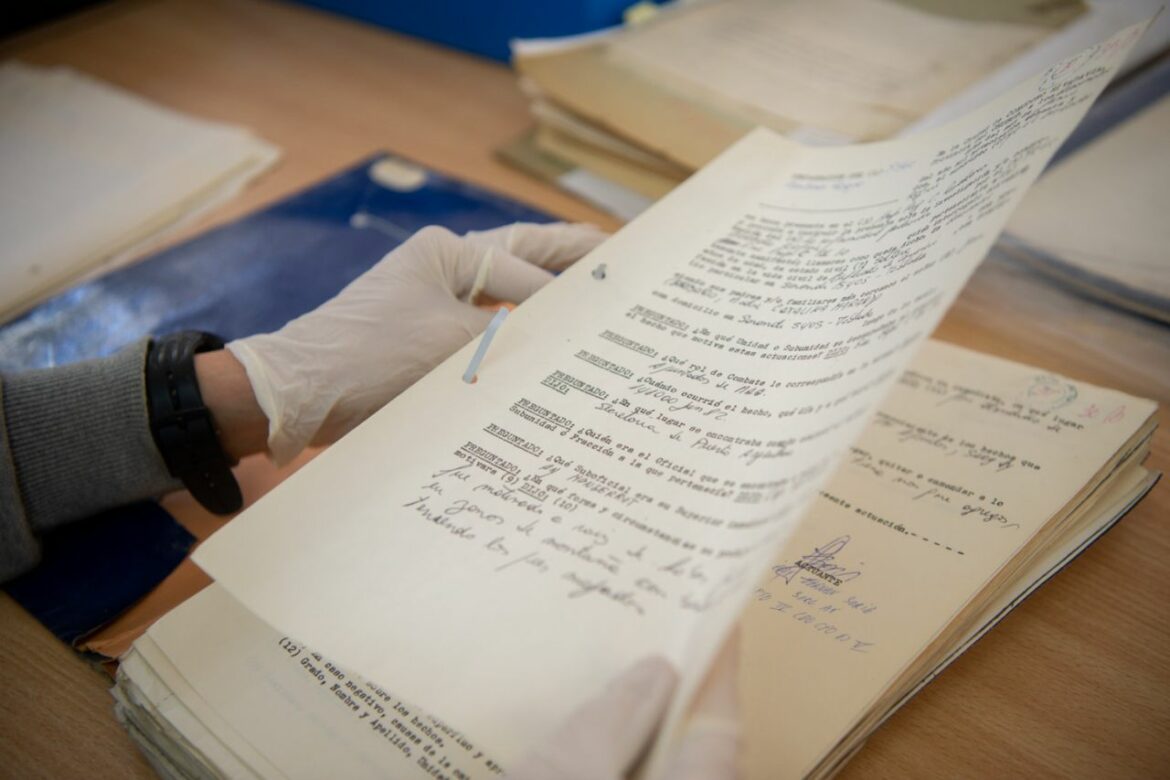
 The Argentine judiciary ordered the Navy to preserve documents that could serve as evidence of dictatorship crimes, halting an internal command issued by the force to transfer documents from their archive and destroy some of them at their discretion.
In a ruling issued on Friday, Judge Alicia Vence accepted stays made by human rights attorney Pablo Llonto and Federal Prosecutor Miguel Ángel Blanco García Ordás demanding a reversal of the Navy’s decision.
“Our goal is to preserve documents being used as evidence in crimes against humanity trials,” Llonto told the Herald. “To do that, we need to know which documents they want to transfer and which would be shredded according to the navy’s criteria.”
Judge Vence said in her ruling that the documents “have an immeasurable historical value for our country” and for investigations “that have the goal to find the truth about crimes committed during state terrorism,” not only in her Buenos Aires district of San Martín but further afield in Mar del Plata or Bahía Blanca, where the navy operated clandestine torture centers.
The judge said that “any modification or alteration” of the archive can affect the result of eventual criminal sentences and ordered the Navy to refrain from moving them or destroying them to prioritize their preservation.
On Tuesday, the Argentine Public Sector Archivists Association was the first to alert the public in an Instagram post about a Navy memo ordering the destruction and transfer of documents from the Navy’s General Archive. The archivists said that, if put in a line, the documents stored there would measure over “eight lineal kilometers.”
“It’s urgent and necessary to guarantee that the documents with permanent value be preserved, whether because they contain unique information about history or institutional memory, or because they are linked to serious human rights violations,” the archivists said in their post. They also called on the Navy to comply with international and national guidelines for documental preservation.
The memo, issued on January 9, informed about a “purge/selection” of the archive’s documents that would be starting that day. Documents currently in use would be transferred on February 10 to a storage unit, while the remaining ones “will stay in their current location to be shredded and, if necessary, digitalized for historical reasons,” the memo said.
It’s not clear whether any documents have already been destroyed or not.
Lawyers and organizations issued several stays in the following days, including two from Llonto in San Martín and the Buenos Aires City federal court known as Comodoro Py, where the Navy School of Mechanics (ESMA) case is being investigated. The Center for Legal and Social Studies (CELS) also issued a stay in Comodoro Py as one of the ESMA case plaintiffs.
There are currently no civilian archivists working at the Navy archive. In 2024, the Defense Ministry dismantled the Compiling and Analysis Team, a group of experts from different fields who worked on Armed Forces archives. The team used to respond to judicial requests for crimes against humanity trials and unearthed significant information in documents that helped solve several dictatorship-era crimes.
In their presentation, CELS mentioned that the team’s analysis of navy aviation documents “served as a base for accusing the pilots that participated in death flights,” among other cases.
The Armed Forces have since handled requests for documentation that used to be addressed by the archives team. However, they are not performing the same analysis work. “They are not trained to do that and could potentially have a political bias that favors the genocidal criminals,” Llonto said.
The Navy was one of the forces with the most repressive power during the dictatorship. Several clandestine torture centers fell under its purview, including the largest and one of the deadliest, the former Navy Mechanics School (ESMA). Trials investigating crimes committed in those centers are still ongoing.
Llonto also requested that Defense Minister Luis Petri and Navy head Carlos María Allievi be called to give explanations on the decision, but Judge Vence declined.
You may also be interested in: This archive team brought dozens of dictatorship criminals to trial. Now it’s gone
