
 Buenos Aires Herald
Argentina’s Federal Cassation Chamber has upheld the fraud conviction against former two-term president and vice president Cristina Fernández de Kirchner in the case known as “Vialidad.”
Kirchner was first convicted in December 2022 and sentenced to six years in prison and a lifelong ban on holding public office. The court found that she had arranged for 51 public works contracts in Santa Cruz province to go to a company belonging to her friend Lázaro Báez.
Judge Gustavo Hornos announced that he and his peers Mariano Borinsky and Diego Barroetaveña had reached a unanimous verdict in a hearing at 11 a.m. on Wednesday. Kirchner was not present, instead attending a women’s event in Moreno, on the outskirts of Buenos Aires.
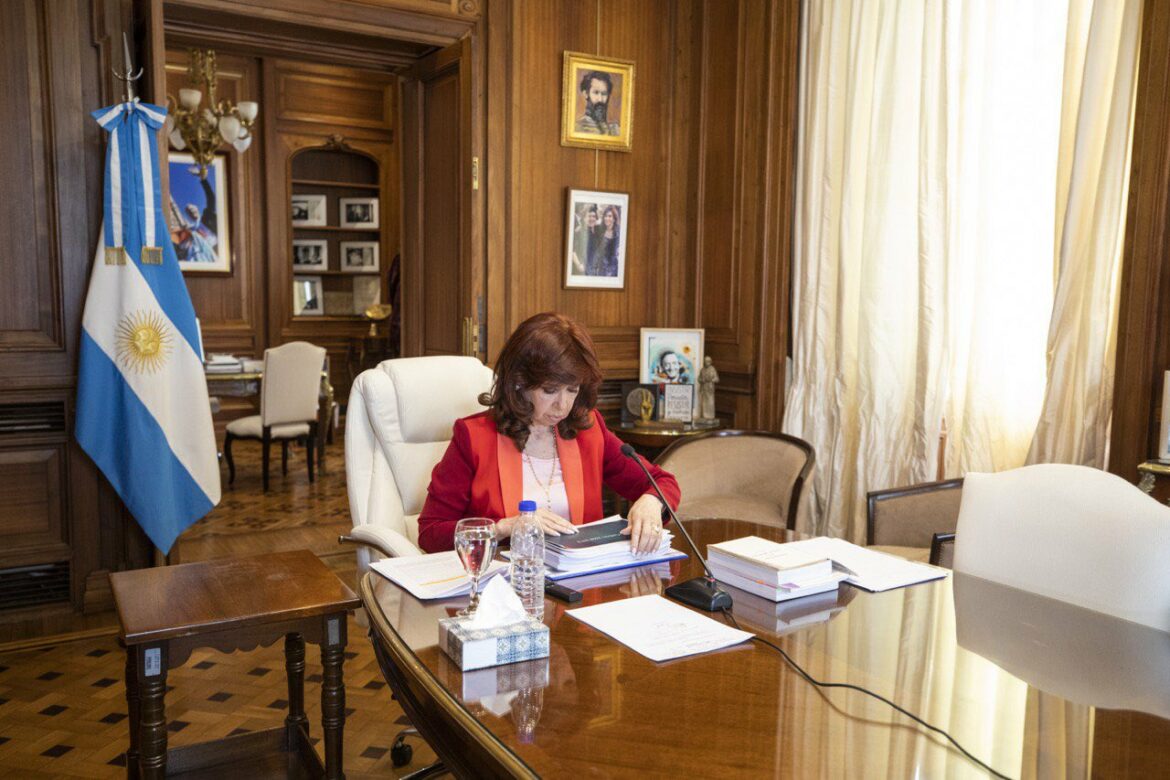
The former president has always maintained her innocence and claimed that the charges against her are politically motivated. The night before the Cassation Chamber’s verdict, she posted a statement online accusing the judges of conflicts of interest and alignment with her political opponents.
In the five-page text, Kirchner also laid out the case for her innocence defense. Her main point of contention is that, as president, she was unable to carry out the fraudulent handling of road work contracts for which she was convicted and sentenced.
“The funding for these works was included in provincial budgets and approved by Parliament. They were later bid on, executed, and paid for by the Santa Cruz province government,” reads her statement. Kirchner goes on to say that all expenses were approved by the General State Auditor and Congress and that no Chief of Staff, the person “constitutionally in charge of executing the budget,” has ever been accused of this crime.
“There is no redemption from ridicule,” she added.
Kirchner also accused judges and prosecutors of seeking to exclude her from electoral politics by imposing the lifelong ban on holding public office. She cited the case of a security secretary and a Federal Police Chief convicted for the police crackdown around Plaza de Mayo during the incidents of December, 2001, which left dozens dead amid the country’s worst crisis in decades.
“[The minister] received a 9-and-a-half-year ban, while the [police chief] got an 8-year ban […] In short, those responsible for the deaths of 31 people got a much less strict ban than I,” she wrote, adding that casting her aside from politics is the “true goal” of the judiciary.
Kirchner is not expected to spend time in prison because the sentences do not take effect until she has exhausted her appeals. In Argentina, people with prison sentences are typically eligible for house arrest after they turn 70. Kirchner is 71.
