

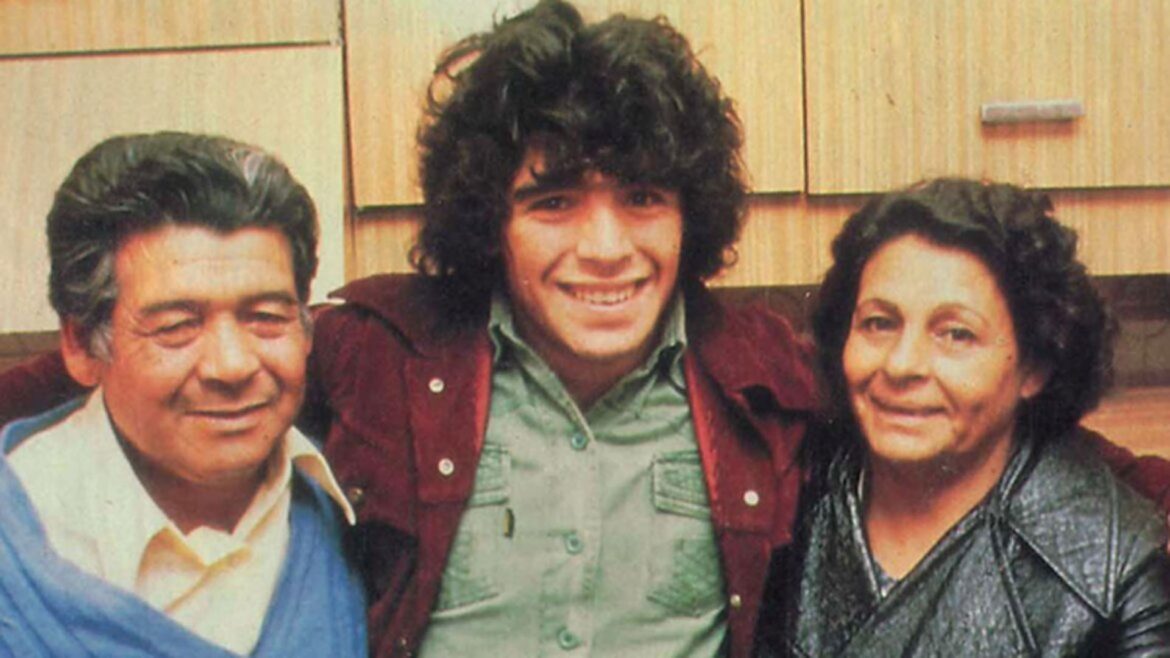
 Fernando Romero Nuñez
 Before Lionel Messi or Pope Francis, football legend Diego Maradona was hands-down the most famous Argentine person in the world.
Throughout the decades, his ubiquitous persona had an immeasurable influence on the lives of several generations of Argentines. From those who got to see and rave about him dominating the 1986 World Cup to younger generations of fans who have only known El Diez through anecdotes of their relatives or his former teammates, everyone — fans and haters alike — has witnessed his mythical status.
After his passing in 2020, over a million people showed up to pay their respects at his public funeral in Buenos Aires, and the country as a whole mourned a man who had long transcended his role as a gifted footballer. But aside from the massive, global fame of Maradona, the sports hero, there are countless stories of Maradona as a person floating around, and many who shared even a minute of their lives with him are eager to tell their story.
Proyecto Pelusa, a gargantuan project created by long-time friends Damián Cukierkorn and Sebastián Schor, is a collection of those everyday, common stories.
“The goal was to depict something that happened with Diego — and only happened with a few people — which is that you can almost recreate every day of his life through the photos he took with the people he came across,” Schor told the Herald.
“It’s like a biography, only through the eyes of the fans. Our goal is to showcase that.”
The project was born from Cukierkorn’s mind, who started working on it in 2010, but technological limitations made it hard for him to gather enough photos. Ten years later, during the COVID-19 lockdown, he shared the idea with Schor, and the two decided to tackle it together.
They opened an Instagram account to share the images they had, understanding that it was the best way to reach out to fans and encourage them to send their photos and stories. The project quickly snowballed, and they now have over 7,000 photos of Diego.
“We have no requirements,” said Schor. “If you have a photo with Maradona you wish to share, we want it.”
Every day, at 10:10 a.m. Argentina time, the Instagram account posts a picture and the story behind that particular photo, which can range from a few sentences to several paragraphs.
Photos come in all sizes and styles. Given Maradona’s quick rise to fame — he first debuted with Argentinos Juniors in 1976 at the age of 15 — and his everlasting impact on Argentine culture, the project’s archive ranges from worn-out, black-and-white pictures to last-gen smartphone photos.
No amount is too many for Proyecto Pelusa, although Schor admits there’s a golden number: 16,107. That’s the total number of days between Maradona’s official debut in Argentina’s first division and his passing.
“We believe there must be at least one photo of him for every single one of those days,” he said.
There’s only one picture they refused to publish: the one a funeral home employee took of himself next to Maradona’s dead body, right before the funeral. Schor believes it has no place in a tribute to his life, but at the same time understands why that photo exists: “Why would someone take such a picture? Well, because it was Diego, and that dimension of him is present even in that sort of moral foul play of taking a selfie next to a dead person’s body.”
However, Schor insists, even the photos of Diego that were taken in a less-than-ideal situation are shared with loving words and treasured memories. That includes one taken of Schor with Maradona when working as a TV ad producer: he was heavily reprimanded by the football legend on the shoot.
“There is no photo that doesn’t have the symbolic and biographical value we need,” he said.
‘He was comfortable being with anyone, anywhere’
Ever since Maradona’s passing in November 2020, every project that used his image has constantly been marred by the turmoil of legal disputes over the use of his brand. However, Cukierkorn and Schor maintained that they have always had a very good, if limited, relationship with El Diez’s family and friends who manage Maradona’s state.
“When we post something, we never comment on it,” he said. “Diego was extraordinarily loved but also very polarizing, but the project doesn’t pass judgment on any of that.”
Schor recalls how one night, after the project got its initial head of steam, he started receiving screenshots from Cukierkorn that showed one of Maradona’s daughters, Giannina, liking and commenting on several Instagram posts.
“We had some contact, via Instagram, and she was always very thankful and appreciative,” he said, adding that, while the Maradona family has an open invitation to join or even share some of the pictures of their own, communication with them has never gone past a few friendly conversations.
“We’ve never tried to make any profit from this. I think the family understood that, and that’s why they liked our project,” he said.
In August 2021, Schor and Cukierkorn decided to turn Proyecto Pelusa into a book, which they published four months later, and the second edition is now in the works. Funded out of their own pocket, the book features a selection of some of the best pictures and stories they’ve received through the years — some of them quite incredible.
One of the 10 chapters, called Pelusa, gathers the first photos taken of young Maradona when his career took off. It features what Schor believes to be the first picture someone ever took of Maradona because he was Maradona.
It was taken in 1973 by the father of one of Maradona’s teammates at the youth team “Cebollitas.” The man used to carry a camera around everywhere — rather rare in 1970s Argentina — and told his son to “pose next to that kid, because he’s out of this world.” This was three years before Maradona played his first-ever match in the first division.
The chapter Mi casa es tu casa (“My home is your home”), which gathers photos taken by regular people who invited El Diez to their home, includes a story Schor admits left a mark on him.
During a 1995 trip to Mendoza, when Maradona was coaching Argentine football team Racing Club, a person close to El Diez told him that a family who lived nearby were huge fans, and wanted to invite him to eat roast goat. “They were working-class people, they weren’t famous and didn’t have any influential friends,” said Schor.
One of the sons of the family — who sent the pictures to Proyecto Pelusa — recalls Maradona having to leave the hotel where the team was staying inside the trunk of a car, to avoid the press on his way to meet them. During the visit, El Diez jokingly threw himself onto the son’s bed and accidentally broke it. For as long as he lived there, the kid refused to have it fixed.
“As he was leaving, the mother told him, ‘Diego, we want to thank you so much for this, we are very humble people.’ He replied, ‘That’s why I came,” Schor recalls.
“He was the most famous person in the world, but he was comfortable being with anyone, anywhere.”
After the book, the next step for Schor and Cukierkorn is to keep expanding Proyecto Pelusa. Their current dreams are producing a documentary and hopefully putting together a live show about it.
“We want to keep developing it,” said Schor. “Some goals are closer than others, but that’s the direction we want to head in.”