

 Buenos Aires Herald
In 2024, President Javier Milei’s first year in power, Argentina’s inflation was 117.8% — 93.6 points less than in 2023, when prices rose by a record 211.4%. The figure, published Tuesday by the government’s INDEC statistics institute, is a win for Milei, who promised to “exterminate the cancer of inflation” on the campaign trail amid the country’s record-high price hikes.
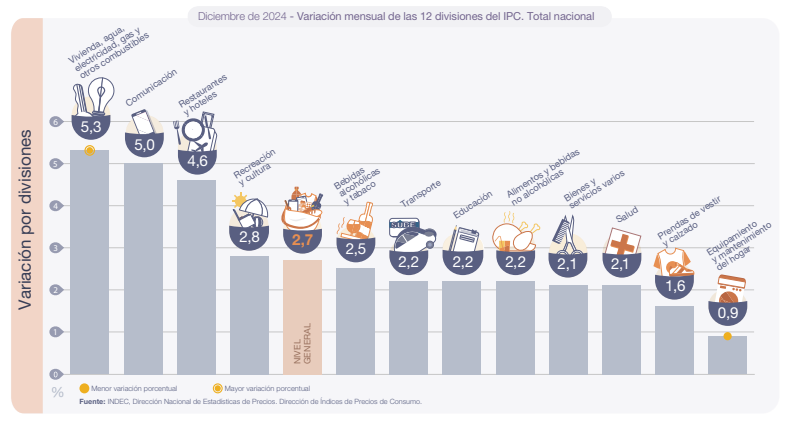
Prices rose 2.7% in December 2024, with the lowest monthly inflation rate of the year being 2.4% in November.
Economy Minister Luis Caputo said that, despite the slight increase, the figure confirms “the continuity of the disinflation process.” In a post on X, he explained that December usually has higher inflation rates due to the “holidays and the beginning of the summer vacation period, and in a context where both the economic activity and the real income of the population present a strong recovery.”
However, the leading monthly increases weren’t seasonal, the highest being housing and utilities (5.3%) due to rent, gas, and electricity prices. That was followed by 5% in the communications category, which includes telephone and internet fees, and 4.6% in restaurants and hotels.
Monthly inflation has consistently decreased since December 2023, when prices increased by 25.5% after Milei devalued the Argentine peso by more than 50%.
You may also be interested in: Inflation, dollar, consumption: here’s what Argentina’s consultancies expect in 2025
However, some analysts doubt the consistency of Milei’s anti-inflation plan. For example, the latest INDEC salary report, published in October, revealed that wages had not kept up with inflation: salaries had risen by 172.1% inter-annually, and inflation was up 193% in the same period. Meanwhile, poverty rose by 11 points in the first half of 2024, with 52.9% of Argentines being poor. However, private reports published in the following months claimed it began decreasing after that.
Florencia Florentin, chief economist at Epyca consultancy, told the Herald that the government’s main tactics for controlling inflation were austerity measures and the consequent drop in monetary issuance, an exchange rate policy based on a 2% monthly devaluation, and intervention in the financial U.S. dollar markets.
“In order to be sustainable, among other things, there must be dollars,” Florentin said. She added that net international reserves remain negative despite the inflow of foreign currency last year due to the trade surplus and the tax amnesty launched by the government in July — two factors, she said, that will not be repeated in 2025.
“If the level of activity improves and if the exchange rate continues to appreciate, there will be less inflow from exports and more outflow from imports,” she said, adding that the government should change its plan for it to be sustainable.
Last week, in an interview with journalist Luis Majul, Milei said that if December’s inflation rate were 2.5%, the administration would cut the crawling peg — the controlled devaluation of the Argentine peso — in half. Roughly one hour after the INDEC’s much-awaited report, the Central Bank announced it would slow the crawling peg to 1% despite the 2.7% figure.
You may also be interested in: Is Argentina headed to dollarization? Two developments point in that direction
