
 Buenos Aires Herald
By Despeñaderos Mayor Carolina Basualdo and former Vancouver Mayor and Special Envoy for Cities in CHAMP, GCoM Global Ambassador Gregor Robertson
As the mayor of Despeñaderos (Córdoba, Argentina) and former mayor of Vancouver (British Columbia, Canada), we recognize that communities on opposite sides of the equator face unique environmental challenges.
However, despite our cities’ vastly different summers and winters, both share a common struggle: finding ways to reduce the devastating impacts of the climate crisis on our residents. Recent record-breaking wildfires in both Canada and Argentina led to mass evacuations, air pollution hazards, and widespread damage across our countries and cities — impacting people’s health and livelihoods.
In spite of this, many cities are showing how communities, both big and small, are leading the way in developing and implementing innovative, scalable climate solutions. For example, Despeñaderos is transforming challenges into opportunities by empowering women with jobs that support financial independence and combat climate change. In Vancouver, renewable energy neighborhoods are using low-carbon energy technologies to provide hot water and heating, strengthening energy security while fostering climate and economic resilience.
With the UNEP’s latest Emissions Gap report revealing that the world is off track to meet the goals of the Paris Agreement, the leadership of mayors has never been more important for advancing global climate progress and implementing solutions at a hyper-local level. Mayors are essential not only for leading the sustainable development of their own cities and towns but also for sharing effective solutions that can support national efforts to reduce pollution and build a sustainable, inclusive, and climate-resilient future.
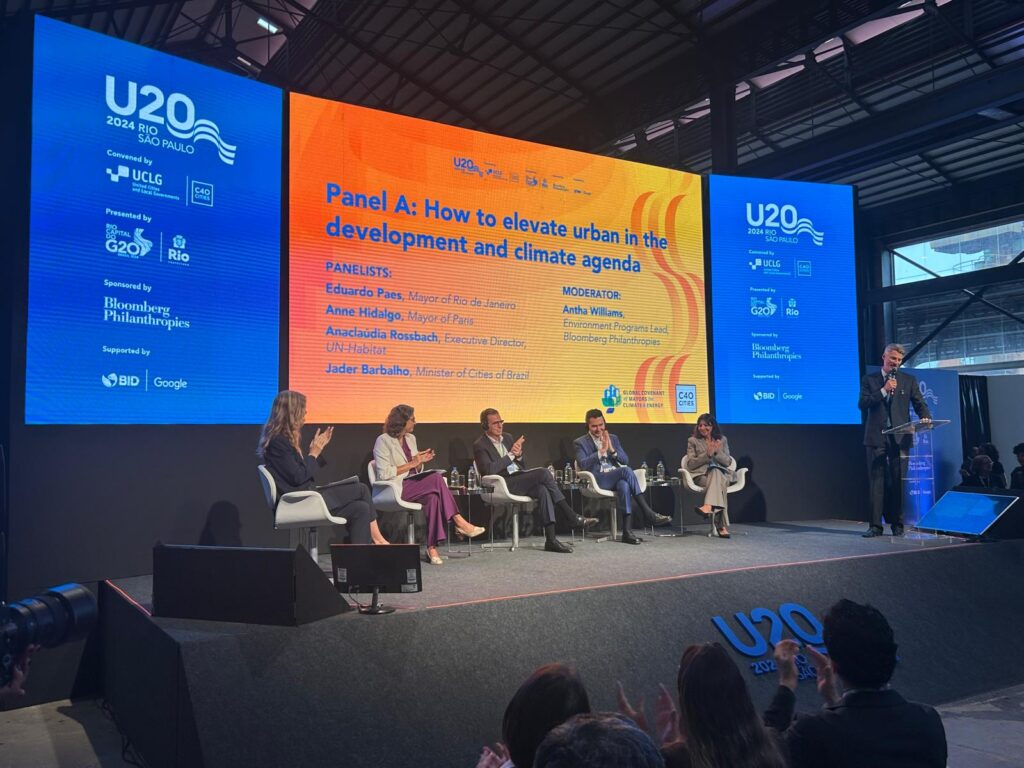
One thing is clear: cities cannot tackle the climate crisis alone. As the impacts of climate change become more extreme, joining forces with national governments is the only way to drive bold and impactful climate action forward. With the U20 Summit in Rio de Janeiro currently underway ahead of this year’s G20, national governments have a key opportunity to address shared vulnerabilities and collaborate with local leaders to strengthen climate action. Local leaders, in turn, are uniting to elevate tried-and-tested local solutions to help accelerate global climate action.
Supported by Bloomberg Philanthropies, mayors from around the world are gathering at the U20 to create an urban agenda and communiqué for the G20, detailing city and local government priorities. The priorities are clear: to build resilient and empowered communities while staying on track to meet the Paris Agreement’s global climate targets, G20 nations must prioritize the U20 communiqué. This focus is especially critical as we approach COP30 and countries work to finalize their 2025 national climate action plans (NDCs).
The primary challenge for cities and nations alike is the lack of funding to support climate action, diminishing their capacity to make meaningful progress towards their climate goals or NDC targets. It is critical that national governments and multilateral development banks, such as the World Bank, recognize the work cities are doing and provide the financial backing necessary to accelerate projects that help fight climate breakdown.
Innovative local solutions are key to thwarting the existential challenge presented by an increasingly hostile climate, and require strategic funding and collaboration between cities and national governments to ensure that resources are properly deployed. Cities must be adequately equipped in order to handle the devastating climate disasters, while in turn helping to accelerate global efforts. This is not a feat they can achieve on their own.
Last year at COP28, mayors gathered on the international stage for the Local Climate Action Summit (LCAS) to launch the Coalition for High Ambition Multilevel Partnerships (CHAMP). Seventy four nations have already pledged their commitment to engage local governments in their climate planning, financing, and implementation.
Now, at U20, alongside nearly 60 mayors and local leaders, including the Global Covenant of Mayors and C40, we are calling for at least US$800 billion in annual public investment from national governments and multilateral development banks by 2030. This investment is crucial to scaling up city-level climate projects and building pathways for healthier, more sustainable, and economically vibrant communities.
This funding is critical to bridging the massive gap in financing for city climate solutions. Currently, cities receive only a fraction of the US$4.5 trillion needed by 2030, despite the fact that investing in cities could supercharge climate action,allowing countries to nearly double their climate ambitions by incorporating city climate plans into national strategies.
The future of both people and the planet depends on the progress we make at U20. As a convening force that elevates the role of cities as global leaders, the U20 Summit will help shape outcomes for COP29 and COP30, setting the stage for world leaders to take stock and push forward on Paris Agreement targets.
The citizens of Despeñaderos, Vancouver, and other cities worldwide know all too well that the time for action is now. The U20 Summit represents a pivotal moment in the global climate conversation, showcasing the power of local action to drive global change. But one critical question remains: will national governments and development banks step up, collaborate, and invest in the future of our cities? Time is running out and so many lives are at stake.
The world is watching. Let’s act with the urgency that the climate crisis demands and fund the solutions that cities are ready to lead.
